How to Choose the Right Wheel and Tire Combo for Your Jeep JK
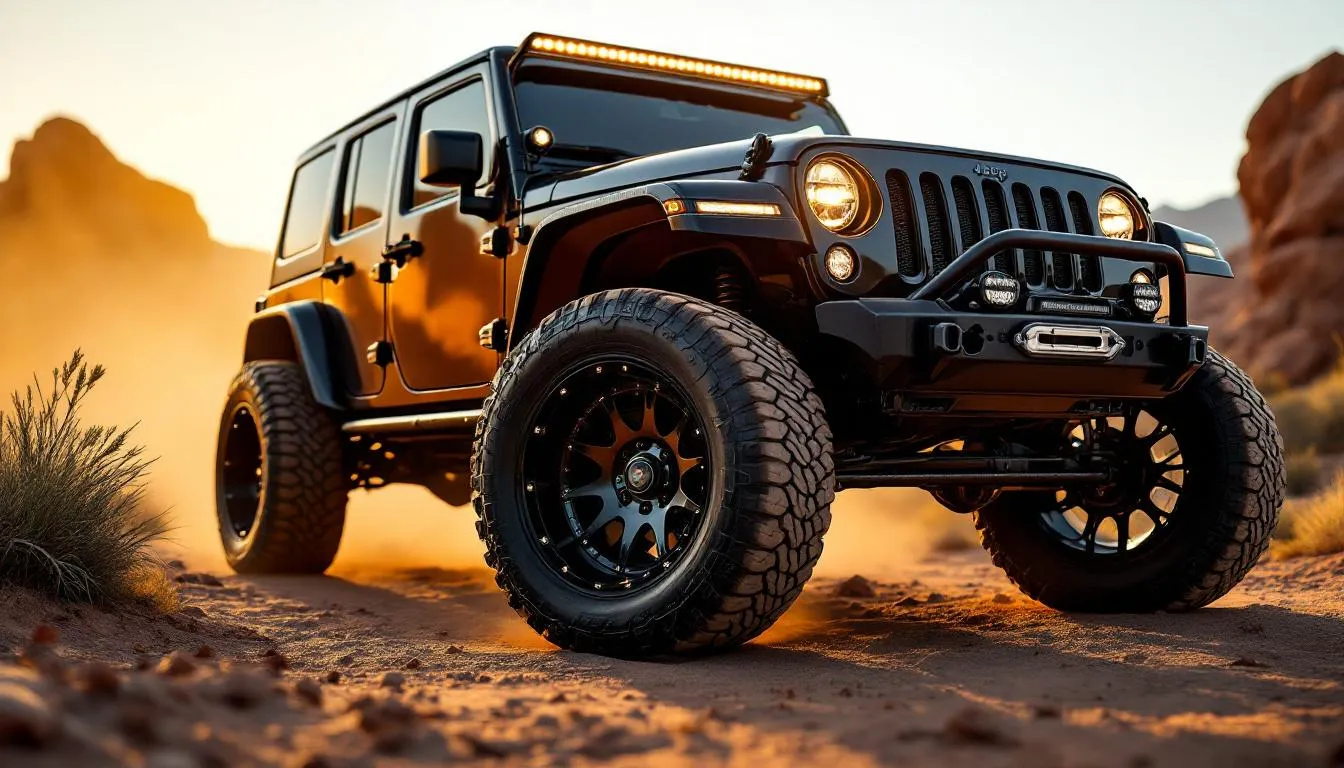
Choosing a wheel and tire combo for your Jeep JK requires matching five critical specifications to avoid rubbing, mechanical interference, or handling problems. You’ll need to verify bolt pattern (5x5 for all JKs), select appropriate wheel offset and backspacing for your lift height, ensure tire diameter fits your suspension setup without rubbing at full articulation, and verify load rating meets or exceeds factory specs. Get any one of these wrong and you’re looking at either constant fender contact, premature wheel bearing failure, or a setup that handles like a shopping cart.
This guide walks through each specification in decision-making order — from non-negotiable compatibility requirements like bolt pattern to preference-based choices like wheel width and tire tread pattern. Proper selection depends on your lift height, intended use (daily driver versus trail rig), and whether you’re willing to modify fenders or invest in regearing.
Before I started building my JK into anything capable, I had to fix what was broken. The radiator was shot — swapped it clean. Then the AC failed on a drive up to the Cederberg in 112°F heat with our two-month-old in the back seat. Not fun. Got that sorted immediately. Then came the cylinder heads — the 3.6L Pentastar’s heads were warped, a known issue on this generation. Rather than skim them again, we sourced brand new replacement heads and did it right.
None of that was glamorous. But it taught me something: mechanical integrity before cosmetic ambition. You can’t bolt 35-inch mud tires onto a Jeep with questionable foundations and expect anything but problems. Every recommendation here follows that same philosophy — function first, appearance second.
Understanding JK Bolt Pattern: The Non-Negotiable Starting Point
All 2007-2018 JK Wranglers use a 5x5 bolt pattern — that’s five lug holes spaced on a 5-inch diameter circle (or 5x127mm in metric). This is a hard compatibility requirement. Wheels must match this pattern exactly or they physically won’t mount to your hubs.
The 5x5 pattern is shared with JL Wranglers (2018+) and several Grand Cherokee models, which means JK owners have access to a massive aftermarket wheel selection. Quadratec’s wheel catalog includes hundreds of 5x5 options ranging from budget steel wheels to billet aluminum designs.
Here’s the catch: older TJ Wranglers (1997-2006) use a 5x4.5 bolt pattern. If you’re shopping used wheels or browsing listings that just say “Jeep Wrangler,” verify the generation. TJ wheels won’t fit your JK without adapters — and adapters introduce problems with hub-centric fitment and bearing stress.
{{PRODUCT_CARD:B08DCBHH12}}
Once bolt pattern is confirmed, the real decisions begin. Offset and backspacing determine how far your wheels sit from the hub, and unlike bolt pattern, these specs offer flexibility — though not without consequences.
Choosing Wheel Offset and Backspacing for Your Lift Height
Offset measures the distance from a wheel’s centerline to its mounting surface. Positive offset means the mounting surface sits toward the outside of the wheel (tucking it inward). Negative offset pushes the mounting surface toward the inside, shoving the wheel outward from the hub. Backspacing measures the distance from the mounting surface to the inner wheel edge — it’s the complementary measurement that tells you how much clearance you have between the wheel and suspension components.
Here’s where lift height becomes critical. Stock JK suspension typically uses +40 to +50mm offset wheels. That keeps everything tucked under the fenders with zero rubbing at full lock or compression. Stack a 2.5-3 inch lift under there and suddenly you can run -12 to +25mm offset without major rubbing issues. Go bigger — 3.5+ inch lifts — and you can accommodate -25 to +12mm offset, though you’ll likely need fender trimming with aggressive setups.
More negative offset pushes wheels outward, which gives you a wider stance and better stability on off-camber trails. It also improves brake clearance if you’re running big brake kits. But there’s a mechanical cost: increased scrub radius puts more stress on wheel bearings and steering components. You’ll feel it in heavier steering at low speeds and accelerated bearing wear over time.
{{PRODUCT_CARD:B08DCBHH12}}
The Rough Country 17x9 Black Steel wheel runs -12mm offset with 4.5-inch backspacing, and the RockTrix RT110 17x9 matches those specs exactly. Both are aggressive enough to clear most aftermarket brake setups but conservative enough that a 2.5-inch lift handles them without constant fender contact. That’s the sweet spot for most modified JKs.
Conservative offsets (+25mm and higher) reduce mechanical wear but can cause clearance headaches with larger brake calipers or control arm setups. If you’re staying close to stock suspension geometry, stick with moderate offset. If you’ve got 3+ inches of lift and you’re willing to trim fenders, go negative and enjoy the stance.
For a 9-inch wide wheel, 4.0-4.5 inch backspacing translates to roughly 0mm offset. Many JK owners prefer this range because it balances outward appearance with mechanical practicality. Just remember: the more you push wheels outward, the more you’ll feel it in steering effort and bearing longevity.
Proper wheel offset selection affects more than appearance — it directly impacts suspension geometry and component longevity.
How Wheel Width Affects Tire Fitment and Protection
Wheel width — measured bead seat to bead seat — determines how wide a tire you can mount and how the tire’s sidewall sits relative to the wheel lip. This matters more than most people realize because it directly affects both sidewall protection and handling characteristics.
Common JK widths: 8-inch wheels are conservative and keep tires tucked, which works well for daily drivers running 33x10.50 tires. Nine-inch wheels are the sweet spot for 33-35 inch tires, especially in 12.50 widths. Ten-inch and wider wheels are for extreme tire stretching or competition setups where you’re deliberately flattening the sidewall profile.
{{PRODUCT_CARD:B08HLSTY9P}}
Here’s the protection tradeoff. Narrower wheels (8 inches) with wide tires (12.50 width) create bulging sidewalls that extend past the wheel lip. When you slam a rock, the tire sidewall absorbs the impact and protects the wheel from damage. Wider wheels (9+ inches) with the same tire flatten the profile — the tire sits closer to flush with the wheel lip. That improves handling response because there’s less sidewall flex, but it exposes your wheels to rock strikes that would otherwise hit rubber.
The Rough Country 15x8 Black Steel wheel and the Rough Country 85 Series 15x8 both run 8-inch widths with 19mm offset. They’re built for 33-inch tires in 10.50 or narrower widths — ideal for JKs on 2.5-inch lifts running daily driver setups. If you’re planning to air down regularly and you want maximum sidewall cushion on the trail, 8-inch wheels are your friend.
Wheel width also affects your effective offset. A 9-inch wheel at -12mm offset sits much farther outboard than an 8-inch wheel at the same offset because the extra inch of width pushes the outer bead seat farther from the hub. If you’re calculating fitment, don’t just look at offset — factor in width or you’ll end up with wheels sticking out farther than you expected.
Match wheel width to tire width for best results: 33x10.50 tires work well on 8-inch wheels, 35x12.50 tires are ideal on 9-inch wheels. Stretch a 10.50 tire onto a 10-inch wheel and you’ll get a flat, stretched profile that looks good in photos but handles poorly on uneven terrain because there’s no sidewall flex to absorb impacts.
| Wheel Width | Recommended Tire Width | Use Case |
|---|---|---|
| 8 inches | 10.50-11.50 | Daily drivers, mild trails |
| 9 inches | 12.50-13.50 | Weekend wheelers, 35” tires |
| 10+ inches | 12.50+ | Competition, extreme setups |
Matching Tire Diameter to Your JK’s Lift and Clearance
{{PRODUCT_CARD:B0FR4H3XVQ}}
Tire diameter is where most fitment disasters happen. You can nail bolt pattern, offset, and backspacing perfectly, but if your tire diameter exceeds what your suspension and fenders can clear, you’ll hear it every time you turn the wheel or hit a bump.
Here’s the lift-to-tire compatibility breakdown:
- Stock suspension: 31-32 inches max, zero rubbing at full lock or compression
- 2.5-inch lift: 33-35 inches with minimal fender liner trimming
- 3.5+ inch lift: 35-37 inches, expect fender trimming on aggressive offsets
- 4+ inch lift: 37 inches and larger, requires suspension geometry correction and significant body modification
Every inch of tire diameter you add drops your effective gear ratio by roughly 10%. Move from 32-inch stockers to 35-inch tires and your Jeep will feel noticeably slower off the line. Highway cruising at 70 mph will push RPM uncomfortably low unless you regear to 4.88 or 5.13 ratios. This isn’t optional for drivability — it’s the difference between a Jeep that accelerates confidently and one that feels gutless merging onto highways.
The first real test for my 35” mud terrains was a weekend in the Cederberg — about three hours north of Cape Town. The difference from stock was immediate. Lines that would have scraped the factory bumper opened up. I could pick my way through rock gardens without that sickening crunch of skid plate on granite. But the education came fast. Aired down to 18 PSI on the gravel road in, and by the time we hit the rocky sections near Sneeuberg Pass, I was wishing I’d gone lower. Sidewall flex at 15 PSI gave the grip I needed. Big tires only work if you actually let them work. I keep a tire deflator and a portable compressor in the Jeep now — non-negotiable.
Clearance checks are non-negotiable before you commit to a tire size. Here’s the process:
- Full steering lock test: Turn the wheel all the way left, then all the way right. Have someone look for contact at upper control arms, fenders, or sway bar links
- Full compression test: Push down hard on each corner of the Jeep, bouncing the suspension to full compression. Listen for rubbing
- Articulation test: Drive one front wheel onto a ramp while the opposite rear wheel sits in a dip. This simulates extreme flex and reveals rubbing that normal driving won’t show
Tire width affects clearance as much as diameter. A 35x12.50 tire is more likely to rub than a 35x10.50, especially at full steering lock where the wider tire sweeps a larger arc through the fender well. If you’re borderline on fitment, drop tire width before you drop diameter — a 35x10.50 might clear where a 35x12.50 rubs constantly.
Larger tires also stress your spare tire carrier. Factory JK carriers start failing around 35-37 inch tires — the tailgate hinges weren’t designed for that much weight hanging off the back. You’ll hear squeaking, see stress cracks in the tailgate mount, or eventually watch the whole thing sag. The Rough Country Spare Tire Carrier Spacer is a cheap first fix that relocates weight slightly outward, but if you’re running true 37s, upgrade to the Rough Country Hinged HD Tire Carrier or the Heavy Duty Spare Tire Carrier rated for up to 40 inches. These bolt directly to the body tub and bypass the tailgate entirely.
Skip the carrier upgrade and you’re looking at expensive body repairs when the factory mount tears through the sheetmetal.
Verifying Load Rating for Safe Weight Capacity
Load rating is the spec most people ignore until something fails. It’s indicated by a letter code on the tire sidewall — Load Range C, D, E — and it specifies the maximum weight each tire can safely carry at a given inflation pressure.
JK Wranglers typically require Load Range C (6-ply construction) as minimum for stock setups. That’s fine if you’re running factory weight with minimal armor and no rooftop tent. Add a steel bumper, winch, skid plates, and roof rack, and you need Load Range D (8-ply). Go full expedition rig with front and rear bumpers, sliders, a full-size spare, and camping gear on top, and Load Range E (10-ply) becomes necessary.
{{PRODUCT_CARD:B0DN3N65G3}}
Here’s the math: divide your JK’s GVWR (Gross Vehicle Weight Rating, typically 5200-5400 lbs for 2-door models, 5400-6000 lbs for 4-door Unlimited) by four tires, then add a 20% safety margin. Each tire should support at least 1400-1600 lbs. Load Range C tires typically max out around 1750 lbs at 35 psi; Load Range E can handle 2200+ lbs at 50 psi.
Undersized load ratings lead to sidewall flex, overheating, and blowouts under sustained highway speeds or heavy loads. Tire manufacturers like BFGoodrich publish load capacity charts showing exact weight limits for each load range at various inflation pressures.
Higher load ratings also increase sidewall stiffness, which improves puncture resistance on rocky trails but makes ride quality harsher on pavement. Load Range E tires feel noticeably stiffer than Load Range C — you’ll feel every expansion joint and road imperfection. It’s a tradeoff: comfort versus durability.
If you’re building a weekend trail rig that sees mostly pavement, Load Range C or D will serve you fine. If you’re building an overland rig that carries serious weight or you regularly air down for technical terrain, Load Range E is the minimum.
| Load Range | Ply Rating | Max PSI | Typical Weight/Tire | Best For |
|---|---|---|---|---|
| C | 6 | 35-50 | 1750 lbs | Stock-weight JKs |
| D | 8 | 50-65 | 2000 lbs | Light armor, basic mods |
| E | 10 | 65-80 | 2200+ lbs | Full armor, overlanding |
Beadlock Wheels: When You Need Them (and When You Don’t)
Beadlock wheels mechanically clamp the tire bead to the wheel rim using an outer ring and bolts. The clamp prevents the tire from separating from the wheel at low air pressures — typically below 10 psi — which is where serious rock crawling happens.
Here’s the use case: if you regularly air down to 5-8 psi for maximum traction on ledges or loose rock, beadlocks are essential. At those pressures, a standard wheel can’t maintain bead seal through aggressive articulation or side impacts. The tire rolls off the bead, you lose air instantly, and you’re stuck with a flat in the middle of a trail.
{{PRODUCT_CARD:B0DVKN49FY}}
But if you’re running 15+ psi for mild trails or you never leave pavement, beadlocks are overkill. They’re expensive ($300-500 per wheel for true beadlocks versus $150-250 for standard wheels), they require maintenance, and they’re technically not DOT-approved for street use — though enforcement is rare and most JK owners run them daily without issues. Manufacturers like Walker Evans engineer beadlocks specifically for low-pressure off-road use.
Maintenance is non-optional. Beadlock ring bolts must be torqued to spec (typically 10-15 ft-lbs depending on manufacturer) and re-torqued after the first 100 miles as the assembly settles. Then you check torque every 500-1000 miles. Skip this and bolts loosen, the clamp loses pressure, and the tire can still separate from the wheel — which defeats the entire purpose.
Simulated beadlocks offer the aesthetic without the functionality or maintenance burden. They look like beadlocks with a decorative outer ring, but that ring doesn’t clamp the bead. The Rough Country 17x9 Simulated Beadlock, Rough Country 15x8 Simulated Beadlock, and Rough Country 16x8 Simulated Beadlock all fall into this category. They’re substantially cheaper than true beadlocks, DOT-approved, and maintenance-free. If you like the look but you’re not crawling at single-digit PSI, simulated beadlocks are the practical choice.
True beadlocks make sense for dedicated trail rigs that see technical terrain regularly. For daily-driven JKs with occasional weekend trips, the maintenance and cost outweigh the benefits.
Using Wheel Spacers to Adjust Fitment and Stance
{{PRODUCT_CARD:B07XKR8L8K}}
Wheel spacers are bolt-on plates that push wheels outward from the hub, effectively changing offset without buying new wheels. A 1.5-inch spacer on a +40mm wheel creates roughly +2mm effective offset — you’re moving the wheel farther from the hub and closer to where a negative offset wheel would sit.
Common JK spacer thicknesses range from 1.25 to 1.5 inches (30-38mm) for achieving aggressive stance or clearing aftermarket brake kits. Two-inch spacers exist but they’re considered extreme and they significantly increase stress on wheel bearings and steering components. The farther you push wheels outward, the more leverage you create on bearing surfaces — which accelerates wear and can introduce steering shimmy or vibration.
Hub-centric versus lug-centric design matters critically here. Hub-centric spacers mate to the JK’s 71.5mm hub bore and center the wheel properly before lug nuts tighten down. This is mandatory for vibration-free performance. Lug-centric spacers rely only on lug nuts for centering, which almost always causes wheel wobble at highway speeds because lug holes have clearance — they’re not precision-fit surfaces.
The KSP 5x5 Wheel Spacers (2 inch), dynofit 5x5 Wheel Spacers (2 inch), and Customadeonly Forged Adapters (1 inch) are all hub-centric designs CNC-machined from billet aluminum. These are safe when properly installed and maintained. Cheap cast spacers from unknown brands are a safety risk — they crack under load and can cause catastrophic wheel separation.
Spacer also increase scrub radius and change steering geometry. You’ll notice heavier steering at parking lot speeds and potentially more feedback through the wheel on rough roads. Wider spacers amplify this effect. If you’re running 2-inch spacers, expect noticeably different steering feel compared to stock.
Quality spacers are a legitimate solution for fine-tuning fitment without the expense of new wheels. Just understand the mechanical tradeoffs and buy from reputable manufacturers who machine spacers from billet rather than casting them. And never exceed 2 inches of total spacer thickness unless you’re prepared to replace wheel bearings more frequently.
Choosing Tire Tread Pattern for Your Primary Use Case
Tire tread pattern determines how your Jeep behaves on pavement versus dirt, how much noise you tolerate on highway drives, and how long the tires last before you’re shopping for replacements.
{{PRODUCT_CARD:B07YL24F64}}
All-terrain tires (A/T) balance on-road comfort with light trail capability. They’re suited for 70/30 street/dirt driving — daily commutes, highway trips, fire roads, and mild trails. Tread blocks are moderately aggressive with siping for wet traction and voids for self-cleaning. Expect 50,000-60,000 miles of treadlife and relatively quiet highway manners. A/T tires are the default choice for JKs that see mostly pavement with weekend adventure use.
Mud-terrain tires (M/T) prioritize off-road traction with large, widely-spaced tread blocks and minimal siping. They’re suited for 40/60 or 30/70 street/trail splits — rigs that regularly tackle mud, rocks, or technical terrain where traction is critical. M/T tires self-clean mud and rocks more effectively than A/Ts because the large voids eject debris as the tire rotates. But they’re louder on highways (think constant hum at 60+ mph), they wear faster (30,000-40,000 miles), and they can make steering feel heavier at low speeds due to stiffer sidewalls.
All-season tires are for pure street use and not recommended for modified JKs. They lack the sidewall strength to handle off-road impacts and the tread depth for loose terrain. Skip these unless you’ve bought a JK solely for pavement driving — which would be missing the point entirely.
Here’s the handling tradeoff: M/T tires have stiffer sidewalls and heavier construction, which can make steering feel less responsive at highway speeds compared to A/T tires. You’ll also notice more road noise and potentially harsher ride quality over expansion joints and rough pavement. A/T tires are more compliant, quieter, and better suited to daily driving comfort. Tire Rack’s testing data shows A/T tires typically deliver 3-5 dB lower cabin noise at 65 mph compared to equivalent M/T models.
Most JK owners land on 33-35 inch A/T tires as the best all-around compromise. You get capable off-road performance for weekend trails, decent treadlife for the cost, and highway manners that won’t drive you insane on your daily commute. M/T tires make sense when you’re wheeling hard every weekend and you’re willing to sacrifice comfort for traction.
| Tread Type | Street/Dirt Split | Noise Level | Treadlife | Best For |
|---|---|---|---|---|
| All-Terrain | 70/30 | Moderate | 50-60K mi | Daily drivers |
| Mud-Terrain | 30/70 | High | 30-40K mi | Dedicated wheelers |
| All-Season | 100/0 | Low | 60-70K mi | Pavement only |
Alignment and Installation: Getting Your Setup Dialed In
{{PRODUCT_CARD:B0FJ19Y9CH}}
Any wheel and tire change requires a professional alignment check, especially after installing a lift. Camber, caster, and toe all shift when you alter suspension geometry, and improper alignment chews through tires faster than aggressive off-roading.
JK suspension geometry changes with lift height. Two-and-a-half inch and taller lifts often benefit from adjustable control arms to correct caster angle and prevent steering wander. Stock control arms are fixed-length — they can’t compensate for the geometry changes that come with lifting. You’ll notice vague steering at highway speeds, the Jeep tracking slightly left or right without input, or uneven tire wear across the tread.
Lug nut torque is non-negotiable. JK lug nuts must be torqued to 95-130 ft-lbs (check your specific year’s owner’s manual for exact spec) in a star pattern. Over-torquing can warp brake rotors by unevenly loading the rotor face. Under-torquing allows lug nuts to loosen over time, which can lead to wheel wobble or even complete wheel separation if ignored long enough.
New wheels and tires should be re-torqued after the first 50-100 miles as everything settles into place. Then check torque at every tire rotation — typically every 5,000 miles. This isn’t paranoia; it’s basic mechanical maintenance that prevents expensive problems.
If you wheel hard, keep a portable alignment tool in your toolkit for trail adjustments. The Sixzoo Wheel Alignment Tool is a magnetic camber gauge that lets you verify alignment settings after a trail day where you’ve been flexing suspension to the limit. It won’t replace a professional alignment rack, but it’ll tell you if something’s bent or significantly out of spec before you drive home on the highway.
Professional alignment costs $80-150 depending on location. It’s cheap insurance against premature tire wear that could cost you $800+ in replacements within 10,000 miles.
What I Wish I Knew Before Choosing My Setup
Most JK owners underestimate how much tire diameter affects daily drivability. You see 35s or 37s on Instagram builds and think that’s the move. Then you install them, hit the highway, and realize your Jeep’s struggling to maintain 70 mph without screaming at 3500 RPM. Regearing to 4.88 or 5.13 ratios costs $1500-2500 depending on whether you’re regearing front and rear or just rear — and that’s on top of the wheel and tire expense.
{{PRODUCT_CARD:B0D1SH3199}}
Size up conservatively. A 33-inch tire on a 2.5-inch lift gives you 95% of the capability with zero drivability penalty if you’re running stock 3.73 gears. You’ll still clear trails, you’ll still look good, and you won’t spend weekends researching gear ratios and shop labor rates.
The second mistake is ignoring spare tire weight. Factory JK carriers start failing around 35-37 inch tires — the tailgate hinges weren’t designed for that much weight hanging off the back. You’ll hear squeaking, see stress cracks in the tailgate mount, or eventually watch the whole thing sag. Upgrading the carrier isn’t optional — it’s mandatory for anything over 33 inches. Budget $200-400 for a quality aftermarket carrier or plan on expensive bodywork when the factory mount tears through the sheetmetal.
Third: test-fit everything before cutting fenders or trimming anything permanent. JK owners on forums regularly report hacking fender liners based on advice for a specific tire size, only to discover their particular combination of offset, backspacing, and lift height didn’t rub at all. You can’t un-cut metal. Do full articulation tests, full lock tests, and compression tests before you reach for tools.
Finally, don’t cheap out on wheel spacers or load ratings. A $40 set of cast spacers might look identical to $200 billet spacers, but they’re not engineered the same. Cast spacers crack. Billet spacers don’t. And undersized load ratings cause blowouts. Pay for proper specs the first time or pay exponentially more when something fails at highway speed.
How do wheel spacers affect bearing wear?
Every inch of spacer outboard increases the moment arm on wheel bearings by approximately 15-20%. Two-inch spacers can reduce bearing life by 30-40% under heavy loads or aggressive driving. Hub-centric spacers distribute load more evenly than lug-centric designs, but any spacer adds stress to the bearing assembly.
Common Questions About JK Wheel and Tire Combos
{{PRODUCT_CARD:B00C0XB7XY}}
What’s the largest tire I can fit on a stock JK?
Thirty-one to 32 inches is the absolute max with no rubbing at full lock or compression. Some owners squeeze 33s onto stock suspension with minor fender liner trimming, but you’ll still get rubbing at full articulation or during aggressive turning. If you’re planning to stay stock height, stick with 31s — anything larger requires at least a 2.5-inch lift for daily drivability without constant fender contact.
Do I need to regear if I go to 35-inch tires?
Not required, but highly recommended for anything beyond occasional trail use. Factory 3.21 or 3.73 gears will feel sluggish with 35s — you’ll notice slower acceleration, reduced passing power, and uncomfortably low RPM at highway speeds. Regearing to 4.88 or 5.13 ratios restores factory-like drivability and prevents transmission hunting between gears on hills. Budget $1500-2500 for front and rear regearing including installation.
Can I mix wheel offsets or tire sizes?
Never mix tire sizes front versus rear — it damages the transfer case by forcing the front and rear axles to rotate at different speeds, which the transfer case tries to compensate for constantly. Mixing wheel offsets side-to-side is technically possible but creates uneven track width and handling imbalance. Your Jeep will pull slightly to one side under braking and behave unpredictably in crosswinds. Match all four corners for predictable, safe handling.
How much do I need to trim my fenders for 35s?
With a 2.5-3 inch lift, minor fender liner trimming is usually enough — cutting the plastic inner liner at the front and rear of each wheel well typically clears 35s with moderate offset. Flat fenders or cutting the pinch seam becomes necessary with very aggressive negative offset (beyond -20mm) or wider tires (12.50+). Some JKs clear 35s with zero trimming if offset is conservative and lift is 3+ inches — test-fit before you cut.
Are steel wheels or aluminum wheels better for off-roading?
Steel wheels are cheaper ($100-150 per wheel versus $200-400 for aluminum), more durable against rock strikes (they bend rather than crack), and easier to repair on the trail with a hammer. Aluminum wheels are lighter (improving fuel economy and reducing unsprung weight for better handling), resist corrosion better in salt or coastal environments, and offer far more design options. For hardcore wheeling, steel wins on repairability. For daily driving with occasional trails, aluminum wins on performance and aesthetics.
Building Your JK Wheel and Tire Setup
Start with bolt pattern — 5x5 for all JKs, non-negotiable. Match offset and backspacing to your lift height: stock suspension needs conservative offsets (+40 to +50mm), while 2.5+ inch lifts can accommodate aggressive negative offsets (-12 to +25mm) without constant rubbing. Choose tire diameter that fits your suspension — 31-32 inches stock, 33-35 inches on 2.5-inch lifts, 35-37 inches on 3.5+ inch lifts. Verify load rating meets or exceeds your GVWR divided by four tires, and select tread pattern based on your street/dirt usage split.
{{PRODUCT_CARD:B06XKW9Y53}}
Test-fitting is critical. Full steering lock, full compression, and articulation checks prevent expensive mistakes. Don’t assume forum fitment charts apply to your exact combination of offset, backspacing, lift brand, and tire width — every setup is slightly different.
The “perfect” setup is subjective. A daily-driven JK prioritizes comfort, fuel economy, and highway manners. A trail rig prioritizes clearance, traction, and durability. Most owners land somewhere in between — capable enough for weekend trails, comfortable enough for Monday commutes.
Consult JK forums or local 4x4 shops for real-world fitment photos before committing to a setup. Seeing your exact wheel, tire, and lift combination on someone else’s Jeep eliminates 90% of the guesswork. And if you’re borderline on fitment, err conservative — you can always go more aggressive on your next set. You can’t un-install tires that rub constantly.
Selecting the right wheel tire combo Jeep JK requires balancing five specifications: bolt pattern compatibility, offset matched to lift height, tire diameter within suspension clearance limits, load rating for your vehicle weight, and tread pattern for your driving conditions. Get these specs right and you’ll have a setup that performs reliably on road and trail without constant mechanical problems.
Get the Free JK Build Planner
Complete PDF with mod checklists, gear ratios, tire sizing charts, and budget worksheets. Everything you need to plan your JK build.
No spam. Unsubscribe anytime. By subscribing, you agree to our Privacy Policy.
Allan
I'm Allan. I bought a 2014 Jeep Wrangler JKU and I research the hell out of every mod before I touch it. Everything here is tested or deeply researched on my own rig - no sponsored fluff, just honest findings.
Learn more about me →Get the JK Build Planner
Free PDF with complete build checklists, gear ratios, and tire fitment guides.
By subscribing, you agree to our Privacy Policy.
Related Articles
Best Wheels for Jeep Wrangler JK: Top 8 Picks for 2026
Find the best wheels for Jeep JK with expert picks for beadlocks, daily drivers, and budget builds. 4.5-inch backspacing, 1,500+ lb load ratings, verified fitment.
Best All-Terrain Tires for Jeep Wrangler JK: 2026 Top Picks
Find the best all-terrain tires for your Jeep Wrangler JK with our expert guide. Real-world testing, honest reviews, and size recommendations for stock to 35-inch builds.
Best 35 Inch Tires for Jeep Wrangler JK: Top 8 Picks for 2026
Discover the best 35 inch tires for Jeep JK with our expert comparison of 8 top options. Complete fitment guide, real-world reviews, and installation requirements.