Best Control Arms for Jeep JK: Adjustable Upgrade Guide

Best Control Arms for Jeep JK: Adjustable Upgrade Guide
When you lift your JK, the factory control arms operate at increasingly incorrect angles. This causes driveline vibrations, premature bushing wear, and compromised suspension geometry. Adjustable control arms let you correct these issues, restoring proper caster, pinion angle, and overall handling.
This guide covers when control arms need upgrading and which options perform best for different lift heights.
Why Control Arms Matter After Lifting
Geometry Changes with Lift
Factory control arms are designed for stock height. As you lift, several things change:
Caster angle decreases: The steering axis tilts backward less, causing wandering steering and reduced returnability.
Pinion angle increases: The driveshaft runs at steeper angles, causing vibration and u-joint stress.
Wheelbase shortens slightly: Upper arms push the axle forward at increased height.
When Upgrades Become Necessary
2.5” lift or less: Adjustable lower control arms often sufficient 3-4” lift: Front adjustable uppers and lowers recommended 4”+ lift: Full set of adjustable arms front and rear typically required
JK Control Arm Types
Lower Control Arms
The primary suspension locators. Factory lowers are approximately 20” long. Adjustable lowers allow wheelbase and pinion angle corrections.
Upper Control Arms
Shorter arms that primarily control caster angle. Adjustable uppers let you dial in proper caster for highway stability.
Front vs Rear
Front arms affect steering geometry and driveline angles most directly. Rear arms matter for pinion angle and overall suspension balance.
Best Control Arms for Jeep JK
1. Synergy Manufacturing Adjustable Control Arms - Best Overall

Synergy’s control arms use premium DOM steel tubing with dual-durometer bushings that balance street comfort with off-road durability. The adjustment mechanism is robust yet easy to use, and the quality construction handles serious abuse.
Why it’s our top pick:
- Premium construction throughout
- Easy, secure adjustment mechanism
- Excellent bushing design
- Strong track record in JK community
Best for: Serious builds where quality matters.
2. Teraflex FlexArm - Best Heavy Duty
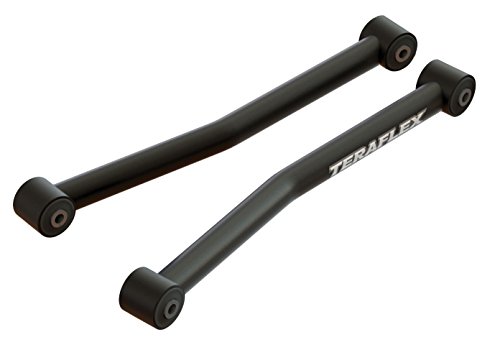
Teraflex FlexArms use forged flex joints instead of traditional bushings. These joints provide more articulation range and eliminate bind during extreme suspension travel. Built for serious off-road duty.
Heavy-duty advantages:
- Forged flex joints for maximum travel
- No bushing bind at extremes
- Built for hard use
- Excellent support network
Best for: Rock crawlers and extreme suspension travel builds.
3. Rough Country X-Flex - Best Value

Rough Country delivers functional adjustability at budget pricing. The X-Flex design provides necessary geometry correction without premium cost. Build quality is adequate for moderate use.
Budget benefits:
- Significant cost savings
- Functional adjustability
- Includes all hardware
- Good for moderate builds
Best for: Budget builds or those testing lift heights before premium investment.
4. JKS Manufacturing Adjustable Arms - Best Mid-Range
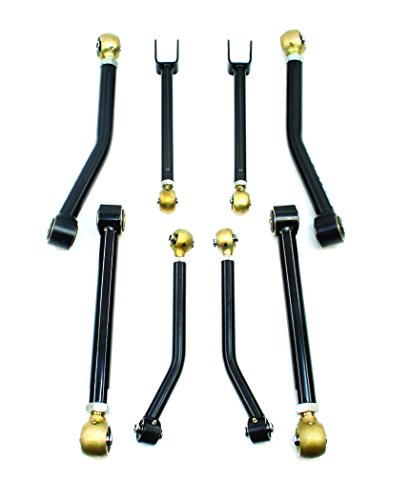
JKS balances quality and cost effectively. OE-style bushings maintain street manners while DOM construction ensures durability. A solid middle-ground option.
Mid-range advantages:
- Quality construction at fair price
- Comfortable street manners
- Reliable adjustment mechanism
- Good all-around choice
Best for: Daily drivers wanting quality without premium pricing.
What to Adjust and Why
Front Lower Control Arms
What they correct: Wheelbase and front pinion angle
The front lowers have the most impact on driveline angle. Lengthening them pushes the axle forward, correcting the wheelbase shortening that lifting causes.
Front Upper Control Arms
What they correct: Caster angle
Adjustable front uppers let you restore positive caster—the backward tilt of the steering axis that provides steering stability. Low caster causes wandering and poor steering return.
Target caster: 4-6 degrees positive (varies by lift height)
Rear Control Arms
What they correct: Rear pinion angle and square alignment
Rear adjustables primarily address pinion angle. The rear driveshaft angle should approximately mirror the front—both pointing slightly downward toward the center of the vehicle.
Proper Geometry Setup
Pinion Angle Guidelines
Goal: Both axle pinion angles should be 1-2 degrees down (toward ground at front of pinion)
Problem signs: Vibration at highway speeds, especially under acceleration
Caster Angle Guidelines
Goal: 4-6 degrees positive caster
Problem signs: Wandering steering, poor self-centering, heavy steering feel
Professional Alignment Recommended
After installing adjustable arms and making initial corrections, a professional alignment shop can verify and fine-tune your geometry. Many shops with off-road experience can measure and adjust caster and pinion angles.
Installation Considerations
Torque Specifications
Control arm bolts are critical fasteners. Follow manufacturer torque specs exactly—typically 100-130 ft-lbs for most JK control arm hardware.
Adjustment Lock
After setting geometry, ensure all adjustment mechanisms are properly locked. Some designs use jam nuts; others use set screws or pinch bolts.
Break-In Period
Check torque after 100-500 miles. Bushings settle initially, and bolts may need re-torquing.
Our Recommendations
Best overall: Synergy Manufacturing Adjustable Control Arms provide premium quality and proven performance for serious builds.
Best heavy duty: Teraflex FlexArms for maximum articulation and abuse resistance.
Best value: Rough Country X-Flex delivers functional geometry correction at budget pricing.
For tall lifts: A complete 8-arm kit (four front, four rear) is typically necessary for lifts over 4”.
Proper control arm geometry transforms how a lifted JK drives. Don’t skimp on this critical suspension component.
Complementary Upgrades
Explore these related modifications for your Jeep JK:
- JK Lift Kit Guide — your complete starting point
- Best JK Lift Kits — control arms are essential after a lift
- Best JK Track Bar — replace track bar with control arms
- Best JK Steering Stabilizer — fix steering after lift
- JK Lift Kit Installation — control arm install guide
- JK Death Wobble Fixes — control arms can cure death wobble
- Best JK Shocks — pair with upgraded shocks
Control Arm Comparison
| Brand | Material | Adjustability | Durability | Price | Best For |
|---|---|---|---|---|---|
| Synergy | Aluminum | Yes | Excellent | $400-600 | Off-road |
| Metalcloak | Steel | Yes | Excellent | $350-550 | Balanced |
| Core 4x4 | Aluminum | Yes | Very good | $300-450 | Trail capable |
| Rough Country | Steel | Basic | Good | $150-250 | Budget |
Synergy Control Arms
Pros
- Best geometry
- Adjustable caster/camber
- Premium materials
- Excellent warranty
- Trail proven
Cons
- Highest cost
- Professional alignment needed
- Complex setup
Rough Country Arms
Pros
- Most affordable
- Easy installation
- Adequate geometry
- Works well for lift
Cons
- Fixed geometry
- Less precision
- Basic materials
Related Guides
Explore more JK upgrade guides to complement your build:
- Best 3.5-4 Inch Lift Kits — mid-range lift options
- Best Sway Bar Disconnect — sway bar disconnect for better articulation
- Best All-Terrain Tires — tire options after lifting
- Wheel Backspacing & Offset Guide — wheel fitment after lift
- Best Diff Covers — differential protection after lifting
Frequently Asked Questions
Do I need adjustable control arms for a 2” lift?
Often no. Many 2” lifts work fine with factory arms. However, adjustable lowers help if you experience driveline vibration.
Can I install control arms myself?
Yes, with proper tools and jack stands. The job requires supporting the vehicle safely and torquing critical fasteners correctly.
Should I replace all eight arms at once?
Not necessarily. Front arms typically matter most. Many builds upgrade front arms only and run factory rear arms successfully.
What causes the “front end shuffle” after lifting?
Usually insufficient caster combined with track bar geometry issues. Adjustable upper control arms help restore proper caster angle.
How do I know if my geometry is correct?
Highway stability, smooth driveline operation, and centered steering wheel indicate proper geometry. Vibrations or wandering suggest adjustment needed.
Will control arm changes affect my alignment?
Yes. After any control arm adjustment, you should have the vehicle aligned. Caster, camber, and toe settings all interact.
Get the Free JK Build Planner
Complete PDF with mod checklists, gear ratios, tire sizing charts, and budget worksheets. Everything you need to plan your JK build.
No spam. Unsubscribe anytime. By subscribing, you agree to our Privacy Policy.
Frequently Asked Questions
How do I choose the right product for my Jeep JK?
Consider your primary use case (daily driving vs off-road), budget, and any specific requirements like weight capacity or installation complexity.
Are aftermarket parts as reliable as OEM?
Quality aftermarket parts from reputable brands often match or exceed OEM quality. Research reviews and warranties before purchasing.
Should I install these parts myself or use a professional?
Many JK modifications are DIY-friendly with basic tools. Complex electrical or suspension work may benefit from professional installation.
When do I need adjustable control arms on my lifted JK?
Adjustable control arms become necessary at 3.5 inches of lift or more to correct caster angle, pinion angle, and overall alignment geometry. At 2.5 inches, they're optional but beneficial. Stock control arms can't compensate for the changed geometry, leading to driveline vibrations, premature wear, and poor handling.
Should I replace all 8 control arms or just the front ones?
For lifts of 3.5-4.5 inches, replacing all 8 arms (4 front, 4 rear) provides the best results. If budget is tight, prioritize the front upper and lower arms first — these correct caster angle and eliminate driveline vibrations. Add rear arms later to fine-tune pinion angle and rear axle alignment.
Jeep JK Guide
We're JK owners who've been building, breaking, and fixing Wranglers for years. Everything here is tested on our own rigs - no sponsored fluff, just honest recommendations.
Learn more about us →Get the JK Build Planner
Free PDF with complete build checklists, gear ratios, and tire fitment guides.
By subscribing, you agree to our Privacy Policy.
Related Articles

Best Sway Bar Disconnect for Jeep JK: Maximize Articulation
Find the best sway bar disconnect for your Jeep JK. Compare JKS Quicker Disconnect, Teraflex, and electronic options for maximum flex on the trail.

Best Track Bar for Jeep JK: Fix Wandering & Death Wobble
Find the best track bar for your Jeep JK. Compare adjustable track bars from Synergy, Teraflex, and budget options to fix steering issues after lifting.

Best Steering Stabilizer for Jeep JK: Fix Wandering & Vibration
Find the best steering stabilizer for your Jeep JK. Compare Fox, Bilstein, Rancho, and budget options to eliminate steering wander and vibration.