Best Steering Stabilizer for Jeep JK: Fix Wandering & Vibration

Best Steering Stabilizer for Jeep JK: Fix Wandering & Vibration
A steering stabilizer won’t fix worn components, but the right one transforms how your JK handles. Large tires, lift kits, and trail miles amplify every bump into steering wheel feedback. A quality stabilizer dampens that energy, delivering confident, predictable steering both on-road and off.
This guide covers what steering stabilizers actually do, which ones perform best, and when they’re the right solution versus when you need to address underlying problems.
What Steering Stabilizers Actually Do
The steering stabilizer is essentially a shock absorber for your steering system. It connects between the steering tie rod and the frame (or axle), absorbing road impacts before they reach the steering wheel.
Functions:
- Dampens vibrations from tires and road surface
- Reduces steering wheel kickback over obstacles
- Smooths out bump steer
- Provides resistance to steering oscillation
What they don’t do:
- Fix death wobble (they mask it temporarily)
- Compensate for worn track bars or tie rods
- Replace proper steering maintenance
- Eliminate wandering from alignment issues
A steering stabilizer is the finishing touch on a properly maintained steering system—not a band-aid for worn components.
Signs You Need a New Steering Stabilizer
Obvious Symptoms
- Steering wheel vibration at highway speeds
- Excessive kickback over bumps
- Wandering steering requiring constant correction
- Visible fluid leak on current stabilizer
Common Causes of Premature Failure
- Larger tires transmit more force to the stabilizer
- Lift kit geometry changes loading angles
- Trail impacts overstress hydraulic valving
- Age and mileage wear out internal seals
The OEM stabilizer handles stock tires and suspension adequately. Once you’ve modified your JK, upgrading becomes nearly mandatory.
Best Steering Stabilizers for Jeep JK
1. Fox 2.0 Performance Series - Best Overall
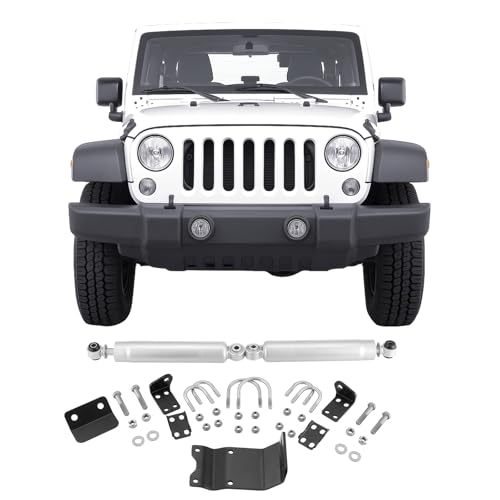
Fox’s 2.0 Performance Series brings race-developed technology to daily driving. The internal floating piston (IFP) separates oil from nitrogen charge, preventing aeration under heavy use. The result: consistent damping whether you’re on the highway or hammering through technical terrain.
Why it’s our top pick:
- Excellent fade resistance under sustained use
- Smooth, progressive damping feel
- Premium seals resist leaking
- Metal impact guard protects body
Best for: JK owners who want premium performance and build quality for lifted rigs with 33”+ tires.
2. Bilstein 5100 Series - Best Factory Feel
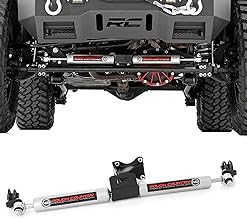
Bilstein’s digressive valve design delivers firm control at low speeds while softening for larger impacts. The result feels remarkably similar to factory steering—just better. OE suppliers to premium brands, Bilstein’s quality is unmatched at this price point.
Bilstein advantages:
- Digressive valving adapts to conditions
- OE-level build quality
- Excellent on-road manners
- Proven durability
Best for: Daily drivers who prioritize refined on-road feel while maintaining off-road capability.
3. Rancho RS5000X - Best Value
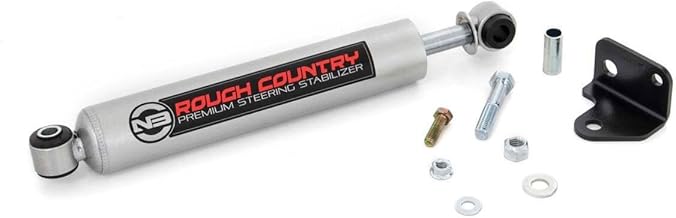
Rancho delivers solid performance at budget-friendly pricing. The RS5000X uses traditional twin-tube design with nitrogen charging to reduce aeration. It won’t match premium monotube damping consistency, but it handles moderate modifications and normal use well.
Budget benefits:
- Significant upgrade over OEM
- Well-priced for the performance
- Proven Rancho reliability
- Wide availability
Best for: JK owners on a budget or those with mildly modified rigs (2-3” lift, 33” tires).
4. Teraflex Falcon Nexus EF 2.2 - Premium Adjustable

Teraflex’s Falcon line represents the pinnacle of JK steering stabilizer technology. The 2.2” bore provides massive dampening capacity, while the adjustable compression lets you tune response for different driving conditions. It’s overkill for many applications but unmatched for serious builds.
Premium features:
- 8-position adjustable compression
- Largest bore available
- Rebuildable and serviceable
- Designed specifically for JK geometry
Best for: Serious off-roaders with heavily modified JKs running 35”+ tires who want tunable, high-capacity dampening.
5. Rough Country Dual Steering Stabilizer - Heavy Duty

When one stabilizer isn’t enough, Rough Country’s dual setup provides twice the damping capacity. The kit includes everything needed to run two stabilizers simultaneously—ideal for builds where steering forces exceed single-stabilizer capability.
Dual advantages:
- Double the damping capacity
- Redundancy if one fails
- Complete bolt-on kit
- Handles extreme tire sizes
Considerations: Requires mounting bracket modifications; not for stock or mildly lifted JKs.
Best for: Builds running 37”+ tires or experiencing steering issues that single stabilizers can’t address.
Single vs Dual Stabilizers
Single stabilizer handles most JK builds adequately:
- Stock to 4” lift
- Up to 35” tires
- Normal driving and moderate trails
Dual stabilizers become necessary when:
- Running 37”+ tires
- Heavy steering loads from aggressive tread patterns
- Racing or hard-core rock crawling
- Single stabilizers fade quickly under use
Don’t automatically jump to dual stabilizers—address underlying steering component wear first. A properly maintained single stabilizer handles more than most owners need.
Installation Considerations
OEM-Style Mount
Direct replacement for factory stabilizer. Bolt-off, bolt-on installation using existing mounting points. Maintains stock geometry.
Pros: Simplest installation, maintains warranty Cons: Limited to certain stabilizer sizes
Relocation/Upgrade Brackets
Aftermarket brackets reposition the stabilizer for improved geometry with lifted suspensions. Many premium stabilizers require or include these brackets.
Pros: Optimized geometry, allows larger stabilizers Cons: More complex installation, may require drilling
Installation Tips
- Support the front axle before removing the old stabilizer
- Clean mounting surfaces thoroughly
- Use specified torque values
- Check for clearance at full steering lock
- Verify secure mounting after initial drive
When a Stabilizer Won’t Help
If you’re experiencing steering problems, a new stabilizer might not solve them:
Death wobble: Usually caused by worn track bar bushings, tie rod ends, ball joints, or unit bearings. The stabilizer masks symptoms but doesn’t fix root causes.
Constant wandering: Check alignment first. Then inspect tie rod ends, track bar, and drag link for wear.
Vibration at specific speeds: Often wheel balance or tire issues rather than stabilizer failure.
Steering play: Worn components in the steering box, joints, or linkage. The stabilizer can’t compensate for mechanical slop.
Address these problems first. Then, if steering still lacks refinement, upgrade the stabilizer.
Maintenance and Lifespan
Typical lifespan: 50,000-80,000 miles for quality stabilizers Shortened by: Large tires, aggressive off-roading, trail impacts
Signs of failure:
- Visible fluid leak around seals
- Steering wheel oscillation after bumps
- Noticeably softer damping than when new
- Physical damage to body or mount
Quality stabilizers (Fox, Bilstein) often last longer due to superior seals and fluid capacity. Budget options may need more frequent replacement.
Our Recommendations
Best overall: Fox 2.0 Performance Series delivers race-proven reliability with excellent damping characteristics for lifted JKs with larger tires.
Best factory feel: Bilstein 5100 maintains that refined OEM steering character while handling modifications better than stock stabilizers.
Budget choice: Rancho RS5000X provides meaningful improvement over worn OEM units at modest cost.
For extreme builds: Teraflex Falcon Nexus EF 2.2 or Rough Country Dual kit when single stabilizers can’t keep up with tire forces.
A steering stabilizer is the polish on a properly maintained steering system. Fix underlying issues first, then upgrade the stabilizer for transformed highway confidence and trail control.
Complementary Upgrades
Explore these related modifications for your Jeep JK:
- JK Lift Kit Guide — your complete starting point
- JK Death Wobble Causes & Fixes — the primary reason to upgrade your stabilizer
- Best JK Track Bar — track bar is the real death wobble fix
- Best JK Control Arms — complete your steering overhaul
- Best JK Lift Kits — lifting changes steering geometry
- Best JK Shocks — shocks affect steering feel
Steering Stabilizer Selection
| Brand | Type | Engagement | Adjustment | Price | Best For |
|---|---|---|---|---|---|
| Fox ATS | Electronic | Real-time | Yes | $400-600 | Advanced control |
| Bilstein | Monotube | Fixed | No | $200-350 | Value |
| Rancho | Dual tube | Fixed | No | $150-250 | Budget option |
| Rough Country | Standard | Fixed | No | $100-200 | Entry level |
Fox ATS Electronic
Pros
- Best wobble control
- Road-friendly
- Trail capable
- Electronic precision
Cons
- Highest cost
- Complex install
- Electronic components
Rancho Dual Tube
Pros
- Good value
- Proven design
- Simple install
- Adequate control
Cons
- Fixed settings
- Less responsive
- One-size-fits-all
Related Guides
Explore more JK upgrade guides to complement your build:
- Best 3.5-4 Inch Lift Kits — mid-range lift options
- Best Sway Bar Disconnect — sway bar disconnect for better articulation
- Best All-Terrain Tires — tire options after lifting
- Wheel Backspacing & Offset Guide — wheel fitment after lift
- Best Diff Covers — differential protection after lifting
- Gear Ratio Guide — regearing after larger tires
Frequently Asked Questions
Will a steering stabilizer fix my death wobble?
No. Death wobble is caused by worn steering and suspension components, not stabilizer failure. A stabilizer might temporarily mask symptoms but won’t fix the root cause.
How do I know if my steering stabilizer is worn out?
Signs include visible fluid leaks, steering wheel oscillation that continues after bumps, and noticeably softer damping than when new. When in doubt, replace it.
Do I need a new stabilizer after installing a lift kit?
Often yes. Larger tires and changed geometry increase forces on the stabilizer. An upgraded stabilizer is common with lift kits larger than 2.5 inches.
Can I run without a steering stabilizer?
Technically yes, but not recommended. The stabilizer significantly improves steering feel, especially with larger tires. Without it, you’ll experience more feedback and fatigue.
What’s the difference between monotube and twin-tube stabilizers?
Monotube designs (Fox, Bilstein) separate oil and gas with a piston, preventing aeration under heavy use. They provide more consistent damping. Twin-tube designs are simpler and more affordable but may fade under aggressive use.
How long does a steering stabilizer last?
Quality stabilizers typically last 50,000-80,000 miles under normal conditions. Large tires, aggressive driving, and trail impacts shorten lifespan significantly.
Get the Free JK Build Planner
Complete PDF with mod checklists, gear ratios, tire sizing charts, and budget worksheets. Everything you need to plan your JK build.
No spam. Unsubscribe anytime. By subscribing, you agree to our Privacy Policy.
Frequently Asked Questions
How do I choose the right product for my Jeep JK?
Consider your primary use case (daily driving vs off-road), budget, and any specific requirements like weight capacity or installation complexity.
Are aftermarket parts as reliable as OEM?
Quality aftermarket parts from reputable brands often match or exceed OEM quality. Research reviews and warranties before purchasing.
Should I install these parts myself or use a professional?
Many JK modifications are DIY-friendly with basic tools. Complex electrical or suspension work may benefit from professional installation.
Will a steering stabilizer fix death wobble on my JK?
No — a steering stabilizer masks death wobble symptoms but doesn't fix the root cause. Death wobble is caused by worn steering components (track bar, ball joints, tie rod ends) or improper alignment. Fix the underlying issue first, then install a quality stabilizer to dampen road feedback and improve steering feel.
Do I need a dual steering stabilizer on my lifted JK?
A single quality stabilizer is sufficient for most lifted JKs up to 4.5 inches. Dual stabilizers are beneficial for JKs running 37-inch or larger tires, heavy front bumper/winch combos, or those used for high-speed desert running. Fox, Bilstein, and Steering Solutions are top choices for both single and dual setups.
Jeep JK Guide
We're JK owners who've been building, breaking, and fixing Wranglers for years. Everything here is tested on our own rigs - no sponsored fluff, just honest recommendations.
Learn more about us →Get the JK Build Planner
Free PDF with complete build checklists, gear ratios, and tire fitment guides.
By subscribing, you agree to our Privacy Policy.
Related Articles

Best Sway Bar Disconnect for Jeep JK: Maximize Articulation
Find the best sway bar disconnect for your Jeep JK. Compare JKS Quicker Disconnect, Teraflex, and electronic options for maximum flex on the trail.

Best Control Arms for Jeep JK: Adjustable Upgrade Guide
Find the best control arms for your Jeep JK. Compare adjustable control arms from Synergy, Teraflex, and Rough Country for lifts and proper geometry.

Best Track Bar for Jeep JK: Fix Wandering & Death Wobble
Find the best track bar for your Jeep JK. Compare adjustable track bars from Synergy, Teraflex, and budget options to fix steering issues after lifting.