Best Gear Ratio for 35 Inch Tires on Jeep JK Manual: Expert Guide
Best Gear Ratio for 35 Inch Tires on Jeep JK Manual: Expert Guide
Affiliate Disclosure: JeepJK Guide earns a commission from qualifying purchases made through links in this article. This comes at no extra cost to you and helps us keep the lights on.
Four months of fighting sluggish throttle response, bogging highway on-ramps, and a transmission that felt like it was working twice as hard as it should — that’s when I finally made the switch. If you’re in that same situation right now, this guide is for you.
The best gear ratio for 35-inch tires on a Jeep JK manual transmission is 4.56. It restores the effective drive ratio closest to the factory feel, keeps your NSG370 happy in the powerband where it belongs, and delivers a noticeable improvement in both off-road crawl ratio and daily driveability. If you plan to go beyond 35s or run aggressive mud terrains that add rotational mass, step up to 4.88 — but for most JK owners running 35s, 4.56 is the sweet spot.
This guide covers every Jeep JK Wrangler produced from 2007 to 2018, including both the 2-door JK and 4-door JKU (Unlimited). It applies to non-Rubicon trims (Sport, Sport S, Sahara) and Rubicon models — though axle differences between those two matter significantly, as you’ll see below.
Before you start shopping, check out our JK wheels and tires fitment guide and JK model year differences (2007-2018) to confirm your specific axle setup.
Why Gear Ratio Matters When You Upgrade to 35-Inch Tires
Every tire rotation moves your Jeep a specific distance. A larger tire covers more ground per revolution. That sounds like a good thing — until you realize your engine and transmission were calibrated around a much smaller tire.
When Jeep engineered the JK, they matched the gear ratios to the stock tire size. Bolt on 35s and you’ve effectively over-geared the entire drivetrain. The engine has to work harder to turn those bigger tires, your RPMs drop at any given speed, and you fall out of the power band right where you need it most: low-end torque.
The symptoms are unmistakable:
- Sluggish acceleration from a stop, especially loaded or towing
- Lugging at highway speeds in top gear
- Excessive clutch slipping on hills (manual-specific)
- Overheating transmission fluid on extended trail runs
- Poor crawl ratio for technical off-roading
Here’s a side-by-side look at what happens to your effective gearing when you jump from stock tires to 35s — and how regearing fixes it:
| Setup | Axle Ratio | Transfer Case Low | 1st Gear | Effective Crawl Ratio |
|---|---|---|---|---|
| Stock ~31” tires, 3.21 gears | 3.21 | 2.72 | 4.46 | 38.9:1 |
| 35” tires, stock 3.21 gears | 3.21 | 2.72 | 4.46 | ~35.3:1 effective |
| 35” tires, 4.56 gears | 4.56 | 2.72 | 4.46 | 55.4:1 |
| 35” tires, 4.88 gears | 4.88 | 2.72 | 4.46 | 59.3:1 |
That drop in effective crawl ratio isn’t just a number — it’s the difference between walking up a ledge and spinning out. Non-Rubicon JKs feel this even more acutely because they don’t have the Rubicon’s factory 4.10 gears or locking differentials to compensate. Check our Rubicon vs Sport vs Sahara trim comparison to understand exactly what your axles are working with from the factory.
Your Gear Ratio Options for 35s on a Manual JK: 4.56 vs 4.88 vs Others
For a manual JK running 35-inch tires, you’re realistically choosing between three axle ratio options. Here’s how they stack up:
| Gear Ratio | Best For | Highway RPM Impact | Crawl Ratio (w/ 2.72 t-case low) | Recommended |
|---|---|---|---|---|
| 3.73 | Mild street use, 32-33” tires | Minimal change | ~45:1 | Not enough for 35s |
| 4.10 | Rubicon stock, borderline 35s | Slight increase | ~50:1 | Minimum viable |
| 4.56 | 35s, balanced on/off-road | Moderate increase | ~55:1 | Best for most JK owners |
| 4.88 | 35s+ or aggressive trail use | Higher increase | ~59:1 | Best for dedicated wheelers |
| 5.13 | 37” tires | Noticeable increase | ~62:1 | Overkill for 35s |
4.56 gears bring your JK back to near-stock feel with 35s. Highway cruising RPM goes up slightly — expect to see roughly 200-300 RPM higher at 65 mph compared to stock gears with stock tires — but the throttle response, clutch engagement, and low-speed crawling improve dramatically.
4.88 gears push the crawl ratio further and make genuine sense if you run aggressive mud terrains (which add rotational mass), frequently wheel technical terrain, or plan to eventually size up to 37s. The tradeoff is slightly higher highway RPM and marginally reduced fuel economy.
3.73 and 4.10 fall short for 35s on a manual JK. You’ll still feel the bog, and the clutch keeps taking unnecessary abuse. 4.10 is the Rubicon’s stock ratio, and even Rubicon owners running 35s often step up to 4.56 to unlock the full benefit.
For non-Rubicon JK owners (Sport, Sport S, Sahara) running Dana 30 front and Dana 44 rear axles, a complete kit approach saves time and headache. The Yukon Gear & Axle complete kit is one of the most popular choices. It includes everything — ring and pinion, carrier bearings, pinion bearings, shims — in a single purchase, which lets the shop focus on setup rather than hunting for parts.

Yukon Gear & Axle - Gear & Install Kit for Jeep JK non-Rubicon 4.88 Ratio
$620
Check Price on Amazon →Note that this kit is specifically for non-Rubicon JK models. The Rubicon uses a Dana 44 front axle (versus the non-Rubicon’s Dana 30), which requires different ring-and-pinion sets. Always confirm your axle configuration before ordering — our JK wheel backspacing and offset guide has axle identification details that help nail this down.
Manual Transmission-Specific Considerations: What Automatic JK Owners Don’t Have to Worry About
The JK’s manual transmission — the NSG370 6-speed — is a solid gearbox with its own set of quirks that make regearing a slightly more nuanced job than it is for automatics.
The NSG370 doesn’t have a torque converter. There’s no hydraulic cushion between the engine and drivetrain. Every gear ratio change hits the powertrain directly and unfiltered. Under-geared with 35s, the manual JK makes you work the clutch harder and more frequently than an automatic owner ever notices. Over months of trail use, that accelerates clutch wear and stresses the throwout bearing in ways that automatics simply don’t experience.
Regearing fixes the core problem — but while the axle is already apart, it’s smart to address a few supporting items. Axle bearings and seals on high-mileage JKs are cheap insurance when the housing is already open. A rear axle bearing and seal kit is a straightforward add-on that prevents an expensive comeback visit.

2pcs Rear Axle Bearing and Seal Kit Compatible with Jeep Wrangler JK/JKU 2007-2018
$77.88
Check Price on Amazon →Similarly, if your NSG370 has crossed 60,000-70,000 miles, this is the logical time to refresh the transmission bearings. A complete bearing kit like the USA Standard NSG370 unit covers the internal bearings and synchro rings that take the most wear.

After any regear, gear oil selection matters more than most people realize. The new ring-and-pinion needs a proper break-in procedure, and the oil you use during that critical period affects how the gears seat and function long-term. Full synthetic 75W-90 is the standard for Dana 30 and Dana 44 axles on the JK.

Valvoline FlexFill Advanced Full Synthetic 75W-90 Gear Oil 1 Quart Pouch
$15.48
Check Price on Amazon →Valvoline’s full synthetic 75W-90 shows up on a lot of JK builds for good reason — it’s easy to find, reasonably priced, and meets the GL-5 specifications required for Dana axles. Plan on two fluid changes: one at 500 miles after the regear (break-in drain), then fresh oil again at 1,000 miles to clear any metallic particles from the initial seating process.
Manual JK owners should also stay on top of NSG370 service intervals after the regear. Keep tabs on those right alongside your axle fluid — our common JK problems by year covers the known NSG370 failure points worth watching.
How to Calculate the Right Gear Ratio for Your JK Setup
You don’t need a spreadsheet to figure out whether 4.56 or 4.88 makes sense for your specific build. The math is straightforward, and it takes about five minutes.
Gear Ratio Formula:
New Gear Ratio = (New Tire Diameter ÷ Stock Tire Diameter) × Stock Axle Ratio
Walk through it step by step with your actual numbers:
-
Find your stock tire diameter. Most non-Rubicon JKs came with 255/75R17 tires, which measure approximately 31.1 inches in actual diameter.
-
Measure your new tire diameter. A true 35-inch tire (like a 315/70R17) measures approximately 34.4 inches in actual diameter. Use the real measurement, not the marketing name — that’s where most people go wrong.
-
Find your stock axle ratio. Non-Rubicon JKs (Sport, Sahara) came with 3.21 gears. Rubicon models came with 4.10 gears. Check the door sticker or axle tag if you’re unsure.
-
Plug in the numbers:
- (34.4 ÷ 31.1) × 3.21 = 1.106 × 3.21 = 3.55
-
Round up to the next available ratio. Axle gears come in fixed increments — 3.73, 4.10, 4.56, 4.88. Your calculated ideal is 3.55, but that’s not available. Round up to 4.10 as an absolute minimum, 4.56 for real-world performance.
-
Account for lift height. A 2.5-inch lift (like a Rough Country 2.5” kit for 2007-2018 JK) can accommodate slightly taller tires than the base calculation suggests — but the gear ratio math stays the same. Bigger tires still need more gear.
For JK owners running best mud terrain tires for JK Wrangler, bump up one ratio increment to account for the extra rotational mass. If the formula says 4.56, go with 4.88. Mud terrains are heavier and have more aggressive tread that increases the effective load on your drivetrain. Still deciding between mud and all-terrain rubber? Our best all-terrain tires for JK Wrangler comparison is a good starting point.
What Happens If You Don’t Regear Your JK After Installing 35s
Plenty of JK owners run 35s on stock gears. Some know exactly what they’re sacrificing. Many don’t realize the mechanical cost until something breaks.
That first weekend in the Cederberg with 35s and stock 3.21 gears taught me the limits fast. The Pentastar was working constantly above its comfort zone. Lines I’d expected to crawl turned into a fight with traction. At highway speeds, the engine was pulling from too low in the rev range just to maintain speed. By mile four of the drive home, I knew this wasn’t sustainable long-term.
Here’s what’s happening mechanically when you skip the regear:
The crawl ratio problem. With stock 3.21 gears and 35s, your effective crawl ratio drops from roughly 38.9:1 to an estimated ~35:1. That may not sound like much on paper, but on technical terrain — rock crawling, steep descents, slick surfaces — that reduction in mechanical advantage is the difference between controlled progress and a recovery situation.
The highway driving problem. Your engine spins at lower RPM than it was designed to at highway speeds. To maintain speed, you’re either downshifting constantly (more clutch and transmission wear) or asking the engine to pull from too low in the rev range (stress on rotating components you really don’t want to replace).
The long-term wear problem. Over-geared manual JKs show accelerated clutch wear, increased transmission bearing fatigue, and elevated engine temperatures on sustained trail runs. The NSG370 wasn’t engineered to spend hours slipping the clutch on slow technical trails with the wrong axle ratio.
Many JK owners compare this against how Jeep addressed it in newer generations — if you’re curious, our JK vs JL Wrangler comparison covers some of those differences. Spoiler: the JL came with standard 3.45 or 4.10 gears depending on trim, which tells you something about how Jeep thinks about tire size and gear ratio matching.
Regearing Your JK: Cost, Timeline, and What to Expect
Regearing a Jeep JK is not a DIY job for most owners. Setting ring-and-pinion backlash and bearing preload requires specialized tools — a dial indicator, bearing press, and inch-pound torque wrench at minimum — and getting it wrong leads to gear whine, premature wear, or catastrophic failure. That said, understanding the cost helps you plan and negotiate.
Typical cost breakdown:
- Front axle gear set + install kit: $250–$400 for parts
- Rear axle gear set + install kit: $300–$450 for parts
- Labor (both axles): $400–$700 depending on shop and region
- Fluid, gaskets, misc: $50–$100
- Total range: $1,000–$1,600 for both axles
Complete gear-and-install kits like the Yukon Gear & Axle package simplify this significantly. A kit that includes the ring and pinion, carrier bearings, pinion bearings, shims, and a crush sleeve means the shop isn’t hunting for individual components — that reduces labor time and the risk of a technician substituting the wrong bearing specification.
Yukon Gear & Axle - Gear & Install Kit for Jeep JK non-Rubicon 4.88 Ratio
$620
Check Price on Amazon →Timeline: Expect 1-2 days at a shop for a complete two-axle regear. A reputable 4x4 shop may book out 1-2 weeks, so plan ahead. Don’t rush the job — a regear done under time pressure is more likely to have setup errors that show up thousands of miles later.
Finding a shop: Look for shops that specialize in Jeep or 4x4 work, not general automotive. A shop that does one regear a month doesn’t have the same dialing-in experience as one that does several a week. Ask specifically if the technician has experience with Dana 30 and Dana 44 axles. Our JK buyer’s guide has additional notes on finding qualified JK-specific service shops.
Supporting Modifications to Pair With Your Regear and 35s
A regear solves the drivetrain mismatch — but it’s rarely the only modification a JK needs when stepping up to 35-inch tires. Clearing those tires properly, maintaining steering geometry, and getting wheel fitment right are all part of the same build conversation.
Lift Kit: Your First Priority
Most JK models need at least a 2.5-inch lift to run 35s without rubbing under full articulation or turning lock-to-lock. The Rough Country 2.5” lift for 2007-2018 JK Unlimited is a solid entry point — it provides adequate clearance for 35s at a price that leaves budget for the regear.

Wheel Spacers: Solving Fitment Issues
Even with a lift, some 35-inch tire and wheel combinations sit slightly inside the fender opening. A set of hub-centric wheel spacers like the Orion Motor Tech 5x5 1.5” spacers pushes the tire out to a natural, flush position. Hub-centric spacers (71.5mm bore) eliminate highway vibration better than standard designs.

Orion Motor Tech 5x5 Wheel Spacers Compatible with Jeep Wrangler JK Grand Cherokee Commander, 1.5" W
$102.99
Check Price on Amazon →Steering Stabilizer: Managing the Added Weight
35-inch tires add unsprung weight and change the handling characteristics at the steering wheel. A dual steering stabilizer like the Rough Country N3 Dual Steering Stabilizer (fits 2007-2018 JK) dampens the increased feedback and reduces the death wobble risk that plagues many lifted JKs. It’s a straightforward bolt-on that most owners notice immediately.
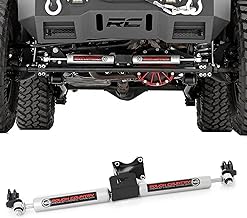
Rough Country N3 Dual Steering Stabilizer for 07-18 Jeep Wrangler JK - 8734930
$149.95
Check Price on Amazon →For more on getting your fitment right, see our guides on JK wheel backspacing and offset explained and best mud terrain tires for your JK.
Frequently Asked Questions: Gear Ratios for 35-Inch Tires on Jeep JK Manual
What gear ratio do I need for 35 inch tires on a Jeep JK?
For a Jeep JK running 35-inch tires, 4.56 gears are the standard recommendation for most builds. This ratio corrects the drivetrain over-gearing caused by the larger tire diameter, restoring throttle response and improving both street drivability and off-road crawl ratio. If you plan to run aggressive mud terrain tires or eventually size up to 37s, 4.88 gears are worth considering instead.
Can I run 35s without regearing my Jeep JK?
Technically yes — 35s will bolt on and the JK will drive without regearing. But you’ll notice sluggish acceleration, reduced crawl ratio, and increased strain on the clutch, transmission, and engine, especially during trail use or highway passing. Over time, the added mechanical stress accelerates wear on drivetrain components, making regearing a worthwhile investment rather than an optional upgrade.
Is 4.56 or 4.88 better for 35s on a manual JK?
4.56 is the better choice for most manual JK owners running 35s on a mix of street and trail. It restores near-stock driveability, keeps highway RPM reasonable, and provides meaningful crawl ratio improvement. Choose 4.88 if you wheel aggressively, run heavy mud terrain tires, or anticipate moving to 37-inch tires in the near future — the extra gear gives you more low-end mechanical advantage at the cost of slightly higher highway RPMs.
Do I need to regear both axles on my JK?
Yes. You must regear both the front and rear axles to matching ratios. Running mismatched gears — for example, 4.56 in the rear and 3.21 in the front — will cause binding and severe drivetrain damage when four-wheel drive is engaged. Both axles need to turn at the same rate in 4WD, which requires identical gear ratios front and rear. This is true for all JK models regardless of trim level. See our Rubicon vs Sport vs Sahara trim differences for axle specs by trim.
How much does it cost to regear a Jeep JK?
A complete two-axle regear on a Jeep JK typically costs between $1,000 and $1,600, including parts and labor at a qualified 4x4 shop. Parts alone — a complete ring-and-pinion kit with bearings for both axles — run $600–$850 depending on brand and ratio. Labor adds $400–$700 depending on your region and shop. Using a complete gear-and-install kit reduces labor time and the risk of missing components, which can lower the total cost.
The Bottom Line: Best Gear Ratio for 35s on a Manual JK
After four months on stock gears with 35s, the switch to 4.56 made the JK feel like a completely different vehicle. The transformation in low-end response, clutch feel, and trail performance was immediate and significant. That investment paid off within the first week of driving.
For the vast majority of 2007-2018 Jeep JK manual transmission owners running 35-inch tires, 4.56 is the right answer. If you wheel hard, run mud terrains, or have 37s on the horizon, step to 4.88. Either way, running stock 3.21 gears with 35s long-term is a compromise that costs you performance, drivability, and potentially drivetrain components.
Start by confirming your axle configuration (Dana 30/44 non-Rubicon or Dana 44/44 Rubicon), get a quote from a reputable 4x4 shop, and order a complete gear kit so the job goes smoothly. While you’re planning the build, our complete JK wheels and tires guide and best all-terrain tires for Jeep JK are solid next reads. The regear is one of those modifications that Jeep JK owners universally wish they’d done sooner.
Get the Free JK Build Planner
Complete PDF with mod checklists, gear ratios, tire sizing charts, and budget worksheets. Everything you need to plan your JK build.
No spam. Unsubscribe anytime. By subscribing, you agree to our Privacy Policy.
Allan
I'm Allan. I bought a 2014 Jeep Wrangler JKU and I research the hell out of every mod before I touch it. Everything here is tested or deeply researched on my own rig - no sponsored fluff, just honest findings.
Learn more about me →Get the JK Build Planner
Free PDF with complete build checklists, gear ratios, and tire fitment guides.
By subscribing, you agree to our Privacy Policy.
Related Articles
Best Wheels for Jeep Wrangler JK: Top 8 Picks for 2026
Find the best wheels for Jeep JK with expert picks for beadlocks, daily drivers, and budget builds. 4.5-inch backspacing, 1,500+ lb load ratings, verified fitment.
Best All-Terrain Tires for Jeep Wrangler JK: 2026 Top Picks
Find the best all-terrain tires for your Jeep Wrangler JK with our expert guide. Real-world testing, honest reviews, and size recommendations for stock to 35-inch builds.
Best 35 Inch Tires for Jeep Wrangler JK: Top 8 Picks for 2026
Discover the best 35 inch tires for Jeep JK with our expert comparison of 8 top options. Complete fitment guide, real-world reviews, and installation requirements.