Drivetrain & Axles

Dana 44 Upgrade for Jeep JK: Complete Axle Swap Guide
36 min read
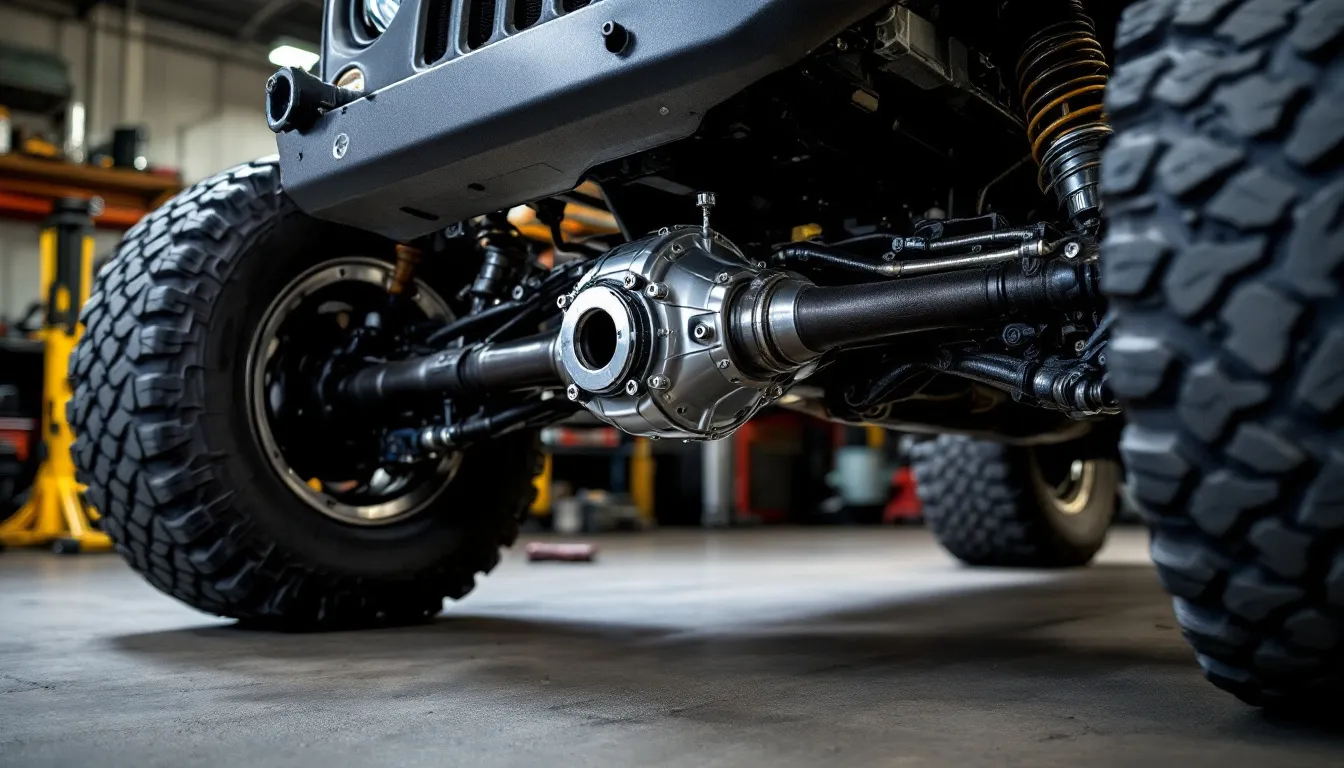
Jeep Wrangler JK Dana 44 front axle assembly showing differential housing, steering knuckles, and CV axle shafts in workshop setting

Why Upgrade to Dana 44?

Dana 44 upgrade makes sense for Jeep JK Sport and Sahara models running 35” or larger tires. If you’re planning serious off-road use with a lifted rig, the factory Dana 30 front axle becomes the weakest link in your drivetrain.

Rubicon comes with Dana 44s front and rear from the factory, while Sport and Sahara models get a Dana 30 front and Dana 44 rear. That Dana 30 front has a 7.2” ring gear, thin axle tubes, and 27-spline shafts.

Upgrading involves either swapping the complete front axle ($2,500-4,500 installed) or strengthening existing Dana 44s with chromoly shafts ($500-1,400), regearing ($1,500-2,000), and lockers ($240-1,100+). Neither path is cheap, but both address the factory weakness.

Every guide here starts because someone needed to figure it out themselves. When forum veterans report breaking Dana 30 C-clips on 35” tires, or bending axle tubes on moderate trails, those patterns matter more than manufacturer marketing claims.

The two main paths forward: buy a used Rubicon (which gives you Dana 44 front and rear plus electronic lockers), or upgrade your Sport/Sahara with aftermarket components. We’ll cover both, along with the incremental upgrade path that lets you strengthen what you already have.

Budget $2,500-4,000 for comprehensive component upgrades, or $3,500-6,500 for a complete front axle swap with professional installation.

Which JK Models Have Dana 44 Axles?

Factory axle configuration matters because it determines your upgrade path.

Rubicon models (2007-2018) came with Dana 44 front and Dana 44 HD rear from the factory. The HD designation on the rear means a stronger housing and 32-spline axle shafts instead of the standard 30-spline. If you own a Rubicon, you’re already running Dana 44s — your upgrade focus shifts to chromoly shafts, regearing for larger tires, and potentially upgrading to ARB lockers.

Sport and Sahara models (2007-2018) got Dana 30 front and Dana 44 rear. That Dana 44 rear is the same axle used under non-Rubicon JKs across the entire production run. It’s a capable axle that handles 35” tires with upgraded shafts. The Dana 30 front is the problem child.

Factory gear ratios varied by trim and transmission: 3.21 (highway-focused), 3.73 (most common), and 4.10 (Rubicon and tow packages). Knowing your current ratio matters because any regearing project requires matching front and rear differentials for proper 4WD operation.

If you’re shopping for a used JK with plans to build it, understanding which years came with which axles helps you make informed decisions. A 2012 Rubicon gives you Dana 44 front and rear plus the 3.6L Pentastar — a solid foundation for a 35”-37” tire build without immediate axle upgrades.

The best years to buy a JK depends partly on whether you want factory Dana 44s or plan to upgrade later. That decision affects everything from initial purchase price to total build cost.

Sport and Sahara owners face a choice: strengthen the Dana 30 front (which buys time but doesn’t eliminate the failure risk), or bite the bullet and swap to Dana 44. Rubicon owners get to skip that debate entirely — you’re already running the stronger axle.

Revolution Gear Fits 2007-18 JK Dana 44 4340 Chromoly Front Axle Kit, 30 Spline

Revolution Gear Fits 2007-18 JK Dana 44 4340 Chromoly Front Axle Kit, 30 Spline

$755.99

★★★★☆ Verified Amazon Product

Check Price on Amazon →

Dana 30 vs Dana 44: What’s the Difference?

The numbers tell the strength story. Dana 30 runs a 7.2” ring gear. Dana 44 runs an 8.5” ring gear. That extra 1.3 inches of diameter translates to more tooth contact area, better load distribution, and less stress per tooth under power.

Axle tube diameter matters just as much. Dana 30 uses thinner-wall tubes that flex and eventually bend under the combined stress of larger tires, articulation, and trail obstacles. Dana 44 tubes are thicker and resist bending.

Spline count reveals shaft strength. Dana 30 shafts have 27 splines where they connect to the differential. Dana 44 shafts have 30 splines. More splines means more surface area transmitting torque and lower failure risk.

SpecDana 30Dana 44
Ring gear diameter7.2 inches8.5 inches
Axle shaft splines2730 (32 on Rubicon rear)
Tube wall thicknessThinThick
Safe tire size limit33” (conservatively)37”+ with upgrades
Common failure pointsU-joints, C-clips, bent tubesU-joints under extreme stress

The Dana 30’s weak point is the C-clip axle shaft design. The axle shaft is held in place by a small C-shaped clip inside the differential. Break that shaft or lose that clip on the trail, and your wheel separates from the axle. Dana 44 uses a more robust retention system.

U-joints fail on both axles, but Dana 30 u-joints take more abuse per revolution because the axle tubes bend slightly under load. That constant flexing and binding accelerates wear.

Dana 30 handles 33” tires adequately for weekend wheeling. Push to 35” tires with aggressive driving, and you’re on borrowed time. At 37” tires, Dana 30 becomes a trail liability.

Dana 44 handles 35” tires confidently with stock shafts. Upgrade to chromoly shafts, and you’re solid through 37” tires and moderate rock crawling. Push to 40” tires, and you’ll want RCV CV axles and axle trusses.

When Do You NEED a Dana 44 Upgrade?

The 35” tire threshold is where this conversation gets real. Below that, Dana 30 remains viable — potentially unreliable, but not immediately catastrophic. At 35” and above, you’re testing the axle’s limits every time you hit an obstacle.

Consider your use case. Daily driver with occasional mild trails? You can run 35s on Dana 30 with upgraded ball joints and chromoly shafts, accepting that you’re still operating near the axle’s design limit. Weekend wheeler hitting moderate trails monthly? Dana 44 front upgrade eliminates worry. Hardcore rock crawler with 37” tires and lockers? Dana 44 isn’t optional.

The cost-benefit analysis: a complete Dana 44 front axle swap runs $3,500-6,500 installed. A used Rubicon sells for roughly $5,000-8,000 more than an equivalent Sport or Sahara in most markets. If you’re shopping for a JK and know you’ll eventually need Dana 44 front, buying the Rubicon upfront saves money — you also get electronic lockers and a 4:1 transfer case.

If you already own a Sport or Sahara, the math changes. You’d take a depreciation hit selling your current Jeep, then pay the Rubicon premium on the replacement. At that point, upgrading your existing rig makes more financial sense.

Many Sport and Sahara owners run 35” tires on Dana 30 front without immediate failure. Forum threads document this consistently. The pattern: they limp along for months or even years, replacing u-joints regularly, babying the throttle on steep climbs, avoiding aggressive line choices that load the front axle. Then one day — usually at the worst possible moment — something lets go.

The decision framework: If you’re committed to 35”+ tires and you wheel more than twice a year on anything beyond gravel roads, upgrade to Dana 44. If you’re running 33” tires on easy trails, keep the Dana 30 and spend your money on a winch or better suspension. If you’re building a 37”+ rig with lockers, Dana 44 isn’t even a question.

The Sport and Sahara already have Dana 44 rear from the factory, which means you’re only swapping or upgrading the front. That cuts the project scope and cost compared to full front-and-rear upgrades.

Common JK problems often circle back to the same axle weak points. Ball joint failures, u-joint failures, and bent axle tubes dominate the Sport/Sahara threads once owners exceed 33” tires.

Option 1: Buy a Used Rubicon Instead

Let’s run the numbers honestly. A used 2015 Sport with 80,000 miles sells for roughly $22,000 in average condition (prices vary by region and market conditions). An equivalent 2015 Rubicon with similar mileage sells for $27,000-30,000. That’s a $5,000-8,000 premium.

Now price out a Dana 44 front axle swap on your Sport: $2,500-3,500 for a used Rubicon axle assembly from a salvage yard, plus $1,000-2,000 in labor if you’re not swapping it yourself. You’re at $3,500-5,500 just for the axle — and you still don’t have electronic lockers ($1,200+ per axle), a 4:1 transfer case ($1,500 used, $2,500+ new), or factory sway bar disconnects.

The Rubicon package includes parts you’d buy separately anyway. The math tilts heavily toward buying the Rubicon upfront if you’re shopping for a JK right now.

But here’s where it gets complicated: if you already own a Sport or Sahara, selling it means taking a depreciation hit, paying sales tax again in most states, and losing whatever emotional attachment or modification investment you’ve made. At that point, upgrading your existing Jeep becomes the more practical path.

The used Rubicon market offers solid values on 2012-2018 models. The 2012+ Pentastar V6 is more reliable than the earlier 3.8L, which makes those years particularly attractive. What to look for when buying a used Rubicon includes verifying the Dana 44 front hasn’t been damaged by a previous owner running 40” tires with stock axle shafts.

Check for front diff cover damage, axle seal leaks, and u-joint play. Rubicon models see harder use than Sport or Sahara trims on average — the previous owner bought it specifically to wheel it. That means more trail miles, more abuse, and potentially more deferred maintenance.

Salvage yard Rubicon axles provide another option. A complete front Dana 44 assembly with 100,000 miles sells for $1,500-2,500 depending on condition and whether it includes brakes and steering components. You’ll rebuild it with new bearings and seals ($300-500), but you’re still under the cost of a new aftermarket axle housing ($3,500-5,000 for brands like Dynatrac or Currie).

If you’re starting from scratch — no JK yet, planning a 35”-37” build — buying a used Rubicon eliminates most axle upgrade decisions immediately. You focus budget on suspension, tires, armor, and recovery gear instead of replacing axles.

If you already own a Sport or Sahara and you’re deep into the build, upgrading makes more sense than swapping vehicles. The next sections cover how to do exactly that.

Option 2: Complete Dana 44 Front Axle Swap

A complete axle swap means pulling your entire Dana 30 front assembly and replacing it with a Dana 44 from a Rubicon or aftermarket manufacturer. You’re swapping the housing, differential, axle shafts, brakes, hubs, and steering knuckles as a single unit.

The bolt-in nature of this swap is both good news and bad news. Good: the frame mounts, shock mounts, and track bar mount are identical between Dana 30 and Dana 44 — you’re not fabricating brackets or drilling new holes. Bad: you’ll still spend hours transferring brake lines, bleeding brakes, setting up steering geometry, and getting an alignment.

Sourcing options:

Used Rubicon axles from salvage yards run $1,500-2,500 for a complete assembly. You’re buying someone else’s 50,000-150,000 mile axle with unknown maintenance history. Plan to replace all bearings, seals, and u-joints during installation — add $500-800 for a complete rebuild kit. Total investment: $2,000-3,300 in parts before labor.

Remanufactured axles from companies like G2 or Alloy USA cost $2,500-3,500 and include new bearings, seals, and u-joints. You get a warranty and known condition, but you’re still running 30-spline shafts and cast iron housing. These work well for 35” tire builds.

Aftermarket performance housings from Dynatrac, Currie, or TeraFlex run $3,500-6,000 depending on spec. You get thicker tubes, reinforced differential mounts, and often upgraded shaft options from the factory. These are overkill for most Sport and Sahara builds unless you’re planning 40” tires and full hydro steering.

Installation labor varies depending on your shop’s hourly rate and whether you’re doing additional work during the swap. A competent shop charges $1,000-2,000 for axle-out-axle-in work including brake lines, steering, and alignment. Add another $500-1,000 if you’re also regearing and installing a locker at the same time.

DIY installation is possible if you have the tools and space. You’ll need a floor jack, jack stands rated for the weight, basic hand tools, a torque wrench, and a way to move a 200+ pound axle assembly. Budget a full weekend minimum.

The biggest gotcha: gear ratio matching. Your Dana 44 front must have the same gear ratio as your rear axle. If you’re buying a used Rubicon axle with 4.10 gears but your Sport has 3.73 gears in the rear, you’ll need to regear one axle to match the other. That adds $800-1,500 to the project cost immediately.

Brake line modifications are unavoidable. Dana 44 brake calipers mount differently than Dana 30 calipers, which means your existing hard lines likely won’t reach. You’ll fabricate new hard lines or install braided flex lines — budget $100-200 for quality lines and fittings.

Upgrading your brakes at the same time makes sense since you’re already into the hub assemblies. Larger rotors and upgraded pads transform braking performance, particularly with heavier tires and armor.

Alignment after the swap is non-negotiable. Dana 44 places the steering knuckles at slightly different angles than Dana 30, which changes your caster and camber settings. A quality 4WD alignment shop will dial this in properly — expect to pay $100-150 for a four-wheel alignment.

Is a complete axle swap worth it? If you’re planning 37” tires, need maximum strength, and want to do it once, yes. If you’re running 35” tires and moderate trails, upgrading individual components on your existing Dana 44 rear and keeping the Dana 30 front with chromoly shafts buys you most of the strength at half the cost.

Option 3: Upgrade Dana 44 Components (Shafts, Gears, Lockers)

The incremental upgrade path costs less upfront and lets you prioritize what matters most for your specific build. Sport and Sahara models already have Dana 44 rear from the factory — that’s your foundation. Rubicon owners have Dana 44 front and rear — you’re upgrading components, not swapping entire axles.

Start with chromoly axle shafts. This is the single most effective upgrade for 35”+ tires. Factory shafts use lower-grade steel that flexes under load. Chromoly shafts (4340 alloy) resist bending and twisting, which means fewer u-joint failures and no catastrophic shaft breaks.

Expect to pay $500-750 for a pair of rear chromoly shafts, or $750-1,400 for front chromoly shafts with upgraded u-joints. Installation is straightforward if you’re comfortable pulling axle shafts — rear shafts take two hours with basic tools, front shafts take four hours because you’re also dealing with unit bearings and hubs.

Regearing comes next when you increase tire size. Larger tires increase rolling circumference, which changes your effective gear ratio. Your 3.73 gears feel like 4.30 gears with stock 32” tires but feel like 3.21 gears with 35” tires. You lose power, acceleration suffers, and transmission shift points fall out of the optimal range.

The 4.56-4.88 gear ratio range works well for 35” tires on the 3.6L Pentastar. The 4.88 ratio is the sweet spot — it restores the power curve you had with stock tires and keeps the transmission in its torque band during climbs. Expect to pay $400-800 for ring and pinion sets (front and rear), plus $800-1,200 in labor for a shop to install and set them up properly.

Regearing both axles at the same time saves labor costs since the shop has everything apart anyway. It also ensures your front and rear ratios match exactly — critical for proper 4WD operation and component longevity.

Lockers dramatically improve traction but aren’t mandatory for every build. If you’re wheeling with a spotter and taking technical lines, lockers let you crawl obstacles that would otherwise require momentum runs. If you’re sticking to forest service roads and mild trails, open differentials with good tires get the job done.

Budget $250-1,200 per axle for lockers depending on type. Automatic mechanical lockers like the Detroit Locker or Spartan Locker cost $240-400 but engage automatically — you get tire chirping in parking lots and slightly unpredictable handling on slick roads. Selectable lockers like ARB air lockers cost $1,100+ per axle but you control when they engage.

Most JK owners prioritize rear locker first, front locker second. The rear does most of the work putting power to the ground. Adding front later gives you the option of more aggressive line choices but isn’t mandatory for competent trail driving.

Which components provide the most bang for buck? Chromoly shafts first — they prevent catastrophic failure. Regearing second — it makes the Jeep drivable with larger tires. Locker third — it’s the capability upgrade rather than the reliability upgrade.

If budget forces you to pick one upgrade this year, choose chromoly axle shafts. Running 35” tires on stock shafts is gambling every time you hit the trail.

Best Chromoly Axle Shafts for Dana 44

Chromoly shafts represent the single most effective upgrade for 35”+ tires. Factory shafts use lower-grade steel that flexes under load. Chromoly shafts (4340 alloy) resist bending and twisting, which means fewer u-joint failures and no catastrophic shaft breaks.

Revolution Gear & Axle 4340 Chromoly Rear Axle Kit (Non-Rubicon)

The Revolution Gear rear shaft kit is the go-to upgrade for Sport and Sahara owners running 35”+ tires on the factory Dana 44 rear. These are 30-spline shafts that match the factory spline count — you’re replacing the material, not changing the differential setup.

Direct fitment for 2007-2018 non-Rubicon models means no surprises during installation. Pull your factory shafts, slide these in, torque the axle nuts, and you’re done. The 4340 chromoly construction handles heavy wheeling that would bend or break factory shafts within a season.

At $506.92 for the pair, you’re paying roughly $250 per shaft — reasonable for chromoly construction. This isn’t the cheapest option (factory Mopar replacement shafts run $300-400 per pair), but it’s not premium pricing either.

Pros:

  • High-strength 4340 chromoly construction handles larger tires and heavy wheeling
  • Direct fit for Sport/Sahara models with factory Dana 44 rear
  • Stronger than factory shafts for lifted JKs with 35”+ tires
  • 30-spline design matches common locker upgrades

Cons:

  • Price point higher than OEM replacement shafts
  • Requires existing Dana 44 rear axle
  • No front axle shafts included (separate purchase needed)

Best for: Sport or Sahara owner with 3-4” lift and 35” tires who needs bulletproof rear shafts without Rubicon pricing.

Revolution Gear & Axle 4340 Chromoly Rear Axle Kit Non-Rubicon Compatible with 2007-2018 Jeep Wrangler

Revolution Gear & Axle 4340 Chromoly Rear Axle Kit Non-Rubicon Compatible with 2007-2018 Jeep Wrangler

$506.92

★★★★☆ Verified Amazon Product

Check Price on Amazon →

Revolution Gear 4340 Chromoly Front Axle Kit (Dana 44)

Front shafts take more abuse than rear shafts because they handle steering loads in addition to torque loads. Every time you articulate off-camber with the wheels turned, your front u-joints bind and your axle shafts twist. Chromoly construction prevents the bending and twisting that leads to premature u-joint failure.

This kit fits 2007-2018 JK models with Dana 44 front — meaning Rubicon models from the factory, or Sport/Sahara models where someone already swapped to Dana 44 front. If you’re still running Dana 30 front, these won’t fit.

At $755.99 for the pair, front chromoly shafts cost more than rear shafts because they’re longer, more complex, and take more engineering to get right. The 30-spline count works with factory or aftermarket lockers without modification.

Pros:

  • Handles the stress of larger tires and aggressive wheeling
  • Direct replacement for Rubicon Dana 44 front axles
  • 4340 chromoly construction prevents bending under load
  • Works with factory or aftermarket lockers

Cons:

  • Only fits models with Dana 44 front (Rubicon or swapped Sport/Sahara)
  • Higher price point than some alternatives
  • Requires professional installation for most DIYers

Best for: Rubicon owner running 37” tires with lockers who needs bomb-proof front shafts for hard trails.

Revolution Gear Fits 2007-18 JK Dana 44 4340 Chromoly Front Axle Kit, 30 Spline

Revolution Gear Fits 2007-18 JK Dana 44 4340 Chromoly Front Axle Kit, 30 Spline

$755.99

★★★★☆ Verified Amazon Product

Check Price on Amazon →

RCV Performance CVJ44-JK Dana 44 CV Axle Set

RCV Performance CV axles represent the premium end of the axle shaft market. These aren’t upgraded u-joint shafts — they’re a completely different design using constant velocity (CV) joints instead of universal joints.

The CV joint advantage shows up at extreme steering and articulation angles. U-joints bind when the shaft operates at steep angles, which loads the shaft unevenly and accelerates wear. CV joints maintain smooth operation through the entire range of motion. If you’re running 40” tires and taking lines that push your suspension to full droop at 45-degree angles, CVs eliminate binding stress.

The lifetime warranty from RCV backs up their engineering confidence. Break a shaft, and they’ll replace it. That warranty matters when you’re $7,000 deep in a front axle build and contemplating 40” tires.

At $1,392.18, these cost nearly twice what the Revolution Gear chromoly shafts cost. You’re paying for CV joint engineering, lifetime warranty, and Ultra4-proven durability.

Pros:

  • Lifetime warranty — buy once, cry once
  • CV joint design eliminates u-joint binding at extreme angles
  • Strongest front axle option for 40”+ tire builds
  • Proven track record in Ultra4 racing and extreme rock crawling

Cons:

  • Premium price point — most expensive axle shaft option
  • Overkill for mild lifts and 35” tire builds
  • Requires Rubicon Dana 44 front or complete axle swap

Best for: Hardcore wheeler running 40”+ tires who demands zero axle failures and values lifetime warranty.

vs competitors: Nearly 2x the price of Revolution Gear chromoly shafts but includes lifetime warranty and CV design.

RCV Performance CVJ44-JK Dana 44 Cv Axle Set For Jeep Jk Rubicon

RCV Performance CVJ44-JK Dana 44 Cv Axle Set For Jeep Jk Rubicon

$1,392.18

★★★★☆ Verified Amazon Product

Check Price on Amazon →
ProductPriceBest ForTire Size
Revolution Rear$506.92Sport/Sahara Dana 44 rear35”-37”
Revolution Front$755.99Rubicon Dana 44 front35”-37”
RCV CV Axles$1,392.18Extreme builds40”+

For 35” tires and moderate wheeling, Revolution Gear chromoly shafts provide excellent value. For 37”-40” tires and technical rock crawling, RCV CVs eliminate the strongest failure point in your drivetrain.

Regearing Your Dana 44: Ratios and Install Kits

Larger tires change your effective gear ratio by increasing rolling circumference. Your engine makes the same power, but now it has to rotate a larger diameter tire through the same distance. The result: sluggish acceleration, transmission hunting for gears, and less power available for climbs.

Here’s the gear ratio recommendation breakdown based on tire size:

  • 33” tires: 3.73-4.10 gears
  • 35” tires: 4.56-4.88 gears
  • 37” tires: 4.88-5.13 gears

The 3.6L Pentastar V6 (2012-2018 models) works particularly well with 4.88 gears on 35” tires. That ratio keeps the engine in its torque band during normal driving and provides enough mechanical advantage for trail climbs without over-revving on the highway.

Matching front and rear gear ratios is non-negotiable. Your transfer case splits power between front and rear axles in 4WD mode. If your front and rear differentials have different gear ratios, one axle tries to turn faster than the other. That constant speed mismatch eats u-joints, stresses axle shafts, and binds the drivetrain.

Motive Gear D44-488JK Ring and Pinion Set

Motive Gear occupies the middle ground between budget brands and premium options. Their 4.88:1 ring and pinion set for Dana 44 rear fits the bill for most 35” tire builds — it’s not the cheapest option, but it’s not premium pricing either.

The 39-8 tooth count (39 teeth on the ring gear, 8 teeth on the pinion) delivers the 4.88:1 ratio through high-performance alloy steel construction. These gears handle the added stress of 35”-37” tires without premature wear.

At $206.77 per axle, you’re looking at $413.54 for front and rear ring and pinion sets. That’s parts only — installation requires a master install kit (bearings, seals, shims) and professional setup.

Pros:

  • Restores power and drivability with 35”-37” tires
  • 4.88 ratio is optimal for 3.6L Pentastar with 35s
  • High-performance construction handles added stress of larger tires
  • Compatible with factory or aftermarket carriers

Cons:

  • Requires professional installation and setup (not DIY-friendly)
  • Must regear front axle to match for proper 4WD operation
  • Additional costs: master install kit, labor, front gears

Best for: JK owner with 35” tires who needs to regear rear Dana 44 after lift kit installation.

vs competitors: Motive Gear is mid-tier pricing between budget brands (G2, $150-180) and premium (Yukon, $250-300).

Motive Gear D44-488JK High Performance Ring and Pinion Gear Set for Jeep JK Dana 44 Rear Differential

Motive Gear D44-488JK High Performance Ring and Pinion Gear Set for Jeep JK Dana 44 Rear Differential

$206.77

★★★★☆ Verified Amazon Product

Check Price on Amazon →

Yukon Gear & Install Kit Package for Dana 44

The Yukon complete package eliminates the parts-hunting frustration. You get front and rear ring and pinion sets, master install kits with bearings and seals, shims, and everything needed for a complete front-and-rear regear on a Rubicon.

This package is Rubicon-specific because it includes components for both Dana 44 front and Dana 44 rear. Sport and Sahara models have Dana 30 front, which means this kit won’t fit without a complete axle swap first.

At $767.89, you’re paying more upfront than buying individual components, but you’re also getting Yukon’s premium quality control and the confidence that everything fits together properly. No surprises when the shop opens the boxes.

Pros:

  • Complete package includes everything needed for front and rear regear
  • Yukon is premium brand with excellent quality control
  • No hunting for individual components or install kits
  • Includes premium bearings and seals for long-term durability

Cons:

  • Higher upfront cost than buying gears separately
  • Still requires professional installation ($800-1,200 labor)
  • Only fits Rubicon models with factory Dana 44 front and rear

Best for: Rubicon owner who wants premium quality and complete kit convenience for front/rear regear.

vs competitors: More expensive than piecemeal approach (Motive gears + install kits = $500-600) but includes premium components.

Yukon Gear & Install Kit Package for Dana 44 Diffs, Jeep JK Rubicon, 4.88 Ratio.

Yukon Gear & Install Kit Package for Dana 44 Diffs, Jeep JK Rubicon, 4.88 Ratio.

$767.89

★★★★☆ Verified Amazon Product

Check Price on Amazon →

Professional installation isn’t optional unless you have differential setup experience. Ring and pinion installation requires specialized tools (case spreader, dial indicator, bearing pullers), precise measurements (backlash, pinion depth, bearing preload), and pattern checking. Get it wrong, and your gears whine, overheat, or fail prematurely.

Expect to pay $800-1,200 in labor for front and rear differential setup. Most shops charge 8-12 hours of labor at $100-150/hour depending on your region. Add another $300-500 if you’re installing lockers at the same time — the shop has everything apart anyway, which saves reassembly labor.

Total regear cost (both axles): $1,500-2,000 installed with quality components.

Adding a Locker to Your Dana 44

Lockers force both wheels on an axle to spin at the same speed regardless of traction. In an open differential, power follows the path of least resistance — which means the wheel in the air spins uselessly while the wheel with traction sits still. Lockers solve that problem.

Two main types dominate the JK market: automatic mechanical lockers and selectable lockers.

Automatic mechanical lockers (Detroit Locker, Spartan Locker, Lock-Right) engage whenever you’re on throttle and disengage when you lift off. They’re simple, reliable, and inexpensive. The downside: they’re always working, which means tire chirping in parking lots, slightly unpredictable handling on wet roads, and increased tire wear during street driving.

Selectable lockers (ARB air lockers, Eaton E-Lockers, OX cable lockers) engage only when you flip a switch. You drive normally on the street, then lock up when you need traction on the trail. They cost significantly more and add complexity (air compressors, solenoids, wiring), but they’re transparent during normal driving.

USA Standard Gear Spartan Locker for Dana 44

The Spartan Locker represents the budget-friendly end of the locker market. At $240, it’s the cheapest way to add locking differential capability to your Dana 44 without compromising on core functionality.

This is an automatic mechanical locker that replaces the spider gears inside your differential carrier. Installation requires pulling the carrier, disassembling it, installing the Spartan internals, and reassembling everything. It’s more involved than swapping a selectable locker (which replaces the entire carrier), but it’s still a manageable weekend project for DIYers with mechanical experience.

The 30-spline design matches standard Dana 44 axle shafts. Important note: this does NOT fit Dana 44 HD (Rubicon rear), which uses 32-spline shafts and a different carrier design. Verify your application before ordering.

Pros:

  • Budget-friendly locker option under $250
  • Always-on traction without air compressor or electronics
  • Simple mechanical design with fewer failure points
  • Works with 30-spline axle shafts

Cons:

  • Not compatible with Dana 44 HD (Rubicon rear)
  • Automatic engagement causes tire chirping in parking lots
  • Less refined on-road manners than selectable lockers
  • Cannot be disengaged for street driving

Best for: Weekend wheeler on a budget who wants improved traction without air locker cost.

vs competitors: Fraction of ARB air locker cost ($1,100+) but lacks selectable engagement.

USA Standard Gear Spartan Locker for Dana 44, (not D44-HD) 30 Spline Axles, with Cross Pin Shaft

USA Standard Gear Spartan Locker for Dana 44, (not D44-HD) 30 Spline Axles, with Cross Pin Shaft

$240.00

★★★★☆ Verified Amazon Product

Check Price on Amazon →

For most JK owners, I recommend adding a locker to your Dana 44 rear first, front second. The rear axle does most of the work putting power to the ground during climbs. Adding rear locker eliminates most traction-limited situations you’ll encounter on moderate trails.

Front locker becomes valuable when you’re taking technical lines where keeping the front end planted matters — steep off-camber obstacles, ledges where the front tires need equal power to pull the Jeep up and over. For forest service roads and gravel trails, front locker is overkill.

Install lockers during a regear if possible. The shop already has the carrier out, the gears apart, and everything set up on the bench. Adding a locker during that process costs $200-400 in additional labor versus $600-800 if you’re doing it as a standalone job later.

Dana 44 Rear Axle Upgrades for Sport/Sahara

Sport and Sahara owners don’t realize this: you already have Dana 44 rear from the factory. Every 2007-2018 JK Sport and Sahara rolled off the line with the same Dana 44 rear axle used under non-Rubicon models. That axle is perfectly capable of handling 35” tires with a few key upgrades.

The weak points on the factory Dana 44 rear aren’t the housing or differential — they’re the axle shafts. Factory shafts use lower-grade steel that flexes under load. Upgrade to chromoly shafts and you’ve eliminated the most common failure point.

Revolution Gear & Axle 4340 Chromoly Rear Axle Kit

This is the same kit discussed earlier, but it bears repeating for Sport and Sahara owners specifically: if you’re running 35” tires and you haven’t upgraded your rear shafts yet, do it before something breaks on the trail.

The Revolution Gear rear chromoly shaft kit fits 2007-2018 non-Rubicon models directly. No modification, no adapter brackets, no compatibility issues. Pull your factory shafts, slide these in, and you’ve upgraded your rear axle strength significantly for $506.92.

Installation takes two hours with basic tools. You’ll need a floor jack, jack stands, a socket set, and a torque wrench. Pull the wheels, remove the brake calipers, pull the axle shafts, clean the axle tubes, install new shafts, reassemble.

The 30-spline count matches your factory differential, which means you can add a locker later without replacing shafts again. If you’re planning to add a Spartan Locker or ARB air locker, these shafts handle the increased stress without issue.

Early Sport models (pre-2007) came with Dana 35 rear, which is a weaker axle that shouldn’t run anything larger than 31” tires. If you own a TJ or early JK Sport with Dana 35, you need a complete axle swap — not just shaft upgrades. Verify which rear axle you have before ordering parts.

The Dana 35 vs Dana 44 rear identification is straightforward: Dana 35 has a differential cover with a rounded top and 10 bolts. Dana 44 has an angular differential cover and 10 bolts in a different pattern. Dana 44 HD (Rubicon rear) has the same cover shape but uses 12 bolts instead of 10.

For Sport and Sahara owners with factory Dana 44 rear, the upgrade path is simple: chromoly shafts first, regear when you increase tire size, locker when budget allows. You don’t need to swap the entire axle.

Rubicon rear axles (Dana 44 HD) use 32-spline shafts and a different carrier design. If you’re hunting salvage yards for a Rubicon rear axle to swap into your Sport, you’ll gain marginally stronger shafts and a 12-bolt cover, but the cost rarely justifies the upgrade unless your factory housing is damaged.

Protecting Your Dana 44 Investment

You’ve spent $2,500-6,500 upgrading to Dana 44 or strengthening your existing Dana 44s with chromoly shafts, gears, and lockers. Protect that investment with proper maintenance and trail armor.

Differential fluid changes matter more than most JK owners realize. Factory fill is 75W-90 gear oil, which breaks down over time — particularly if you’re running a locker and subjecting the differential to heat cycles from engagement and disengagement. Change differential fluid every 30,000 miles for street driving, every 15,000 miles if you wheel regularly. [CITATION: manufacturer service interval specifications needed]

Synthetic gear oil handles heat better than conventional fluid. Royal Purple, Amsoil, and Mobil 1 all make excellent 75W-90 synthetic gear oils. Budget $40-60 per differential for fluid and a new gasket. Do both axles at the same time.

U-joint inspection should happen every 10,000 miles or after any particularly rough trail ride. Grab each driveshaft at the u-joint and feel for play. Any clunking, binding, or excessive movement means it’s time to replace that joint before it fails. U-joint replacement costs $30-80 per joint in parts, 1-2 hours in labor if you’re paying a shop.

Chromoly shafts still use u-joints (unless you’ve upgraded to RCV CV axles), which means u-joints remain a wear item. The good news: chromoly shafts prevent the shaft itself from bending, which keeps the u-joint operating at its designed angle. That extends u-joint life compared to running flexed factory shafts.

Differential covers provide two benefits: increased fluid capacity (which reduces operating temperature) and impact protection on the trail. Factory diff covers are thin stamped steel that dent easily when you drag over rocks. Upgraded differential covers use cast aluminum or nodular iron construction that shrugs off impacts and often includes cooling fins.

Expect to pay $150-300 per differential cover for quality options from Dynatrac, ARB, or TeraFlex. Install is straightforward — drain fluid, remove factory cover, clean mating surface, install new cover with gasket or RTV, refill with fresh fluid.

Axle truss kits weld to the top of the axle tubes and add rigidity to prevent tube bending under extreme stress. These are overkill for 35”-37” tire builds on moderate trails, but they become valuable insurance for 40” tire builds or high-speed desert running. Budget $400-800 for a quality truss kit, plus $500-1,000 in professional welding labor.

Inspect axle seals during any axle work. Leaking seals contaminate brake pads and waste differential fluid. Replace worn seals immediately — they’re $15-30 per seal and take 30 minutes to swap once you have the axle shaft out.

Keep spare u-joints and axle shaft in your trail spares kit if you’re running aggressive lines far from civilization. A broken u-joint or snapped shaft can happen — it’s rare with chromoly, but it ends your day if you can’t fix it trailside. Basic trail repairs require a socket set, hammer, and the physical parts.

Cost Breakdown: What to Budget

Real numbers matter when planning a Dana 44 upgrade. Here’s what each path actually costs with parts and labor included.

Path 1: Complete front axle swap (Sport/Sahara to Dana 44 front)

  • Used Rubicon axle assembly: $1,500-2,500
  • Rebuild kit (bearings, seals, u-joints): $500-800
  • Brake lines and fittings: $100-200
  • Labor (axle swap, alignment): $1,000-2,000
  • Total: $3,100-5,500

Path 2: Chromoly shafts only (strengthen existing Dana 44s)

  • Revolution Gear rear chromoly shafts: $506.92
  • Revolution Gear front chromoly shafts (Rubicon): $755.99
  • DIY installation (tools and supplies): $50-100
  • Total: $1,312.91-1,362.91

Path 3: Comprehensive upgrade (shafts + regear + locker)

  • Chromoly shafts (front and rear): $1,262.91
  • Ring and pinion sets (front and rear): $413.54
  • Master install kits: $300-500
  • Spartan locker (rear): $240.00
  • Labor (regear and locker installation): $1,200-1,800
  • Total: $3,416.45-4,216.45

Path 4: Buy used Rubicon instead

  • Price premium vs equivalent Sport/Sahara: $5,000-8,000
  • Includes: Dana 44 front and rear, electronic lockers, 4:1 transfer case
  • No installation labor, immediate capability
  • Total: $5,000-8,000 over comparable Sport

Hidden costs pop up in every project. Factor in:

  • Alignment after any axle work: $100-150
  • Differential fluid for both axles: $80-120
  • Driveshaft modifications if running aftermarket transfer case: $200-500
  • New brake pads if upgrading to larger calipers: $100-200

The cheapest viable path for Sport and Sahara owners is upgrading rear shafts only ($506.92) and living with Dana 30 front on 33” tires. It’s not ideal, but it addresses the immediate weak point without committing thousands.

The most cost-effective path for comprehensive strength is buying a used Rubicon upfront if you’re shopping for a JK right now. The $5,000-8,000 premium seems steep until you price out Dana 44 front swap ($3,500-5,500), electronic lockers ($2,400), and 4:1 transfer case ($1,500+). At that point, the Rubicon costs less and includes factory integration.

For existing Sport and Sahara owners committed to 35”+ tires, budget $3,500-4,500 for shafts, regear, and locker. That’s the realistic all-in cost to strengthen your drivetrain for larger tires without swapping axles.

FAQ: Dana 44 Upgrade Questions

Can I run 37s on a stock Dana 44?

Yes, but upgrade shafts first. Stock Dana 44 shafts handle 35” tires adequately, but 37” tires increase stress significantly. Chromoly shafts ($500-1,400 depending on front or rear) prevent shaft failure. Also regear to 4.88-5.13 to restore power and drivability. The housing itself handles 37” tires fine.

Do I need to regear if I upgrade axle shafts?

Not necessarily. Chromoly shafts don’t change your gear ratio — they just handle more stress. However, if you’re installing chromoly shafts because you increased tire size, you probably need to regear. The shaft upgrade and regear often happen together because larger tires change your effective gear ratio regardless of shaft material.

Can I swap Dana 44 from JK to TJ?

No, not directly. JK uses different spring perches, shock mounts, track bar mounts, and brake calipers than TJ. You’d need to weld new brackets and modify steering — at that point, you’re fabricating a custom axle rather than swapping. Buy a TJ-specific Dana 44 instead, or purchase an aftermarket housing designed for TJ.

What gear ratio for 35” tires?

4.56-4.88 for the 3.6L Pentastar V6 (2012-2018). The 4.88 ratio is optimal — it keeps the engine in its powerband and restores acceleration similar to stock gearing with factory tires. The 3.8L V6 (2007-2011) works better with 4.88-5.13 gears because it makes less torque at lower RPMs.

Are chromoly shafts necessary?

For 35”+ tires and regular wheeling, yes. Factory shafts flex and eventually fail under the stress of larger tires, articulation, and trail obstacles. Chromoly shafts ($500-1,400) eliminate the most common axle failure point. If you’re running 33” tires on easy trails, factory shafts are adequate, but you’re operating near their design limit.

Can I install Dana 44 myself?

Complete axle swap is advanced but doable for experienced DIYers. You need tools, space, and a full weekend minimum. Chromoly shaft replacement is intermediate — rear shafts take 2 hours, front shafts take 4 hours with basic hand tools and a torque wrench. Regearing requires professional setup unless you have differential experience — the precision measurements aren’t beginner-friendly.

How much does Dana 44 swap cost?

$3,100-5,500 for complete front axle swap (parts and labor). Add another $1,500-2,000 for regearing both axles to match ratios. Budget $500-1,400 for chromoly shafts if upgrading existing Dana 44 components instead of swapping entire axles. Total depends on new vs used parts and whether you DIY installation.

Is Dana 44 Upgrade Worth It?

The decision framework comes down to three factors: tire size, use case, and budget.

If you’re committed to 35” tires and you wheel more than twice a year on anything beyond gravel roads, Dana 44 upgrade eliminates the weakest link in your drivetrain. Sport and Sahara owners benefit most because the Dana 30 front becomes a liability at 35” tires.

If you’re running 33” tires on easy trails, the Dana 30 front remains viable. Spend your money on a winch, better suspension, or recovery gear instead. The Dana 44 upgrade is insurance against failure, but you may never collect on that insurance with smaller tires and conservative line choices.

Buying a used Rubicon remains the smartest financial move if you’re shopping for a JK right now and planning a 35”-37” build. The price premium over Sport/Sahara gets you Dana 44 front and rear, electronic lockers, 4:1 transfer case, and factory integration. Piece those components together aftermarket and you’ll spend more than the Rubicon premium.

If you already own a Sport or Sahara and you’re deep into the build, upgrading makes more sense than trading vehicles. Start with chromoly shafts if budget is limited — they prevent the most common failure modes for roughly $1,300 installed. Add regearing when you increase tire size to restore drivability. Add a locker when budget allows for improved traction.

Dana 44 upgrade is a significant investment. It makes sense for larger tire builds, but it’s not necessary for every JK owner. Run the numbers, evaluate your use case honestly, and make the decision that fits your build goals.

If you’re ready to start upgrading, prioritize chromoly axle shafts first. They’re the highest-value modification for 35”+ tire reliability.

Free PDF Guide

Get the Free JK Build Planner

Complete PDF with mod checklists, gear ratios, tire sizing charts, and budget worksheets. Everything you need to plan your JK build.

No spam. Unsubscribe anytime. By subscribing, you agree to our Privacy Policy.

JK

Jeep JK Guide

We're JK owners who've been building, breaking, and fixing Wranglers for years. Everything here is tested on our own rigs - no sponsored fluff, just honest recommendations.

Learn more about us →

Get the JK Build Planner

Free PDF with complete build checklists, gear ratios, and tire fitment guides.

By subscribing, you agree to our Privacy Policy.