Teraflex vs Rock Krawler JK Lift Kit: Which is Better?
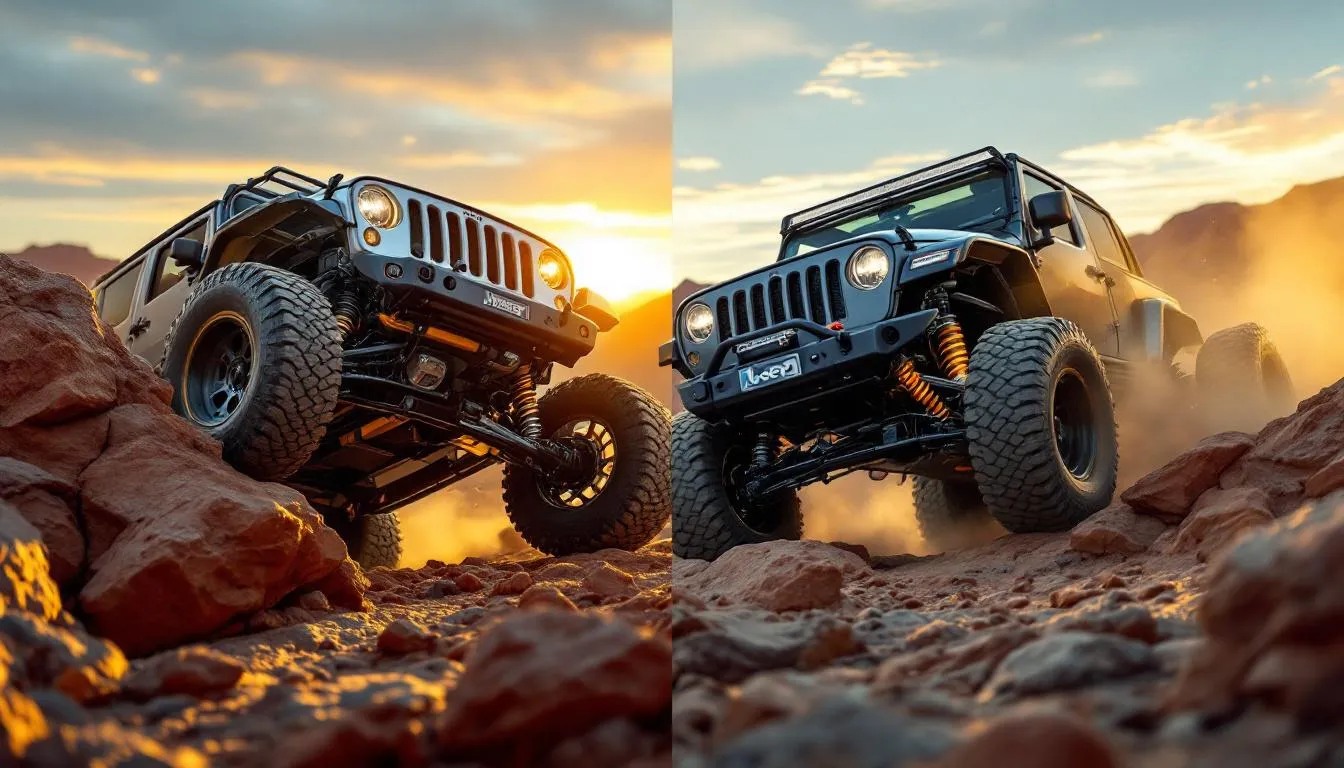
I spent three months researching lift kits before pulling the trigger on a 2.5-inch setup with adjustable control arms. Those twelve weeks included reading hundreds of forum posts, watching installation videos at 2 AM, and bouncing between Teraflex and Rock Krawler product pages so many times I could recite part numbers from memory. The decision paralyzed me because both brands have vocal supporters who swear their choice is superior, and dropping $2,000+ on suspension feels permanent in a way that swapping bumpers never does.
For most JK owners, Teraflex offers better daily driving comfort and easier installation, while Rock Krawler delivers superior articulation and durability for serious rock crawling. Your choice depends on how you actually use your Jeep, not which brand wins internet arguments. A daily-driven Sport on 33s has fundamentally different needs than a dedicated trail rig running 37s with chromoly axles. Understanding those differences means choosing based on engineering rather than marketing.
The Teraflex vs Rock Krawler JK debate matters because these two brands dominate the premium lift kit market, but they approach suspension design from opposite philosophies. This creates real performance differences you’ll feel every time you drive. We’ll compare build quality component by component, examine how each setup behaves on-trail and on pavement, break down the true installed cost including supporting modifications, and give you clear recommendations based on specific use cases. You’ll also understand why the specific JK model year you own affects compatibility and installation complexity. By the end, you’ll know exactly which suspension matches your Jeep’s mission.
Brand Philosophy: How Teraflex and Rock Krawler Approach Suspension Design
Teraflex builds suspension systems for Jeep owners who want improved capability without sacrificing daily driving comfort. Their engineering philosophy centers on maintaining near-stock ride quality while adding lift height and wheel travel. Think of Teraflex like a sport-tuned suspension — firmer than factory but still refined enough for highway commutes and grocery runs. They achieve this through carefully selected spring rates, premium bushings that absorb road vibration, and shock tuning that prioritizes smooth damping over raw performance.
Rock Krawler takes the opposite approach. They design suspension systems for maximum articulation and extreme terrain capability, accepting compromise in daily driving manners as the price for elite performance. This is trophy truck engineering adapted for Wranglers. Their components prioritize strength over weight, use stiffer springs that allow more droop travel, and spec shocks with aggressive damping that keeps tires planted on unpredictable surfaces. If your Jeep spends weekends on technical trails where three-wheel situations are normal, Rock Krawler’s philosophy makes sense.
These different approaches show up immediately in component selection. Teraflex uses FlexArms with specific durometer polyurethane bushings that isolate road noise and vibration. Rock Krawler’s X-Factor joints eliminate bushings entirely, replacing them with Johnny Joints that articulate freely but telegraph more road feel into the cabin. Neither approach is wrong — they serve different masters.
The pricing reflects these philosophies too. Teraflex kits typically cost 15-20% less than comparable Rock Krawler setups because they use fewer exotic materials and simpler geometry. Rock Krawler charges premium prices for DOM tubing, chromoly components, and engineering that targets professional-level wheeling. You’re not just paying for parts — you’re paying for the specific type of capability each brand prioritizes.
Understanding this philosophical divide helps you skip past brand loyalty arguments and focus on what actually matters: which engineering approach matches how you use your JK.
Build Quality & Component Comparison: What You’re Actually Buying

Control arms determine how your axles move through their travel and handle the enormous forces generated during wheeling. Teraflex’s FlexArms use formed steel tubing with powder-coated finish and greaseable polyurethane bushings at each joint. The bushings are formulated to specific durometers — softer at the frame mounts for comfort, firmer at the axle mounts for control. This dual-durometer approach reduces noise, vibration, and harshness while maintaining geometry. Rock Krawler’s X-Factor arms are constructed from DOM (drawn over mandrel) tubing that’s stronger and more concentric than standard ERW tubing. They use Johnny Joints — massive articulating spherical bearings that allow unrestricted movement but require regular greasing and create more road feedback.
Coil springs define your ride height and load capacity. Quality springs use consistent wire diameter, proper heat treatment, and precision coiling that prevents sagging. Teraflex specs their springs conservatively, targeting advertised lift heights with some room for settling under accessory weight. Rock Krawler uses dual-rate springs in many kits — softer initial rate for small bumps, stiffer secondary rate for heavy compression. This gives you plush ride quality over washboard but prevents bottoming on big hits. The downside? Dual-rate springs cost 40% more and create a progressive feel some drivers find unpredictable.
Shock absorbers control how quickly springs compress and rebound. Cheap shocks have inconsistent damping that creates bouncy, unsettled ride quality. Teraflex includes 9550 VSS shocks in most kits — nitrogen-charged monotube design with velocity-sensitive valving. They adjust damping force based on shaft speed, so small bumps feel compliant while hard hits get aggressive damping. Rock Krawler often pairs with Fox or King shocks that use digressive valving — the opposite approach. Initial damping is firm to control body motion, then it tapers off during sustained compression. This feels harsher over small impacts but shines during high-speed desert running.
Track bars and drag links center your axles and connect steering. Both brands offer adjustable versions, but Rock Krawler uses larger 1.25-inch diameter FK rod ends rated for higher loads. Teraflex sticks with 1-inch rod ends that meet JK requirements with less weight. The beefier Rock Krawler components add durability for 37-inch tires and aggressive wheeling, but they’re overkill for street-driven JKs on 33s.
Sway bar disconnects allow more articulation off-road by removing the anti-roll bar from the equation. Teraflex pioneered the quick-disconnect design that became industry standard. Rock Krawler often eliminates front sway bars entirely in their kits, which maximizes flex but creates noticeable body roll on pavement.
Material quality separates premium kits from budget options. Both brands use quality powder coating, stainless hardware, and proper heat treatment. The differences come down to philosophy — Teraflex optimizes for balanced performance while Rock Krawler maximizes capability. You’ll feel these choices every time you drive.
On-Trail Performance: How They Actually Wheel

Now run the same obstacle with Rock Krawler suspension. The stiffer spring rates mean less initial compression — the suspension wants to droop rather than compress. When weight transfers, you feel it more directly through the chassis because Johnny Joints transmit forces with minimal isolation. The aggressive shock valving keeps your tires planted against the rock face, but you feel every texture change through the steering wheel. Articulation is noticeably greater — the opposite corner lifts higher before engaging the shock’s travel limit. It’s rawer, more connected, and ultimately more capable in extreme situations.
These differences compound during high-speed washboard sections. Teraflex’s tuning prioritizes keeping the cabin comfortable while maintaining tire contact. You’ll cruise washboard at 35-40 mph with controlled head toss and minimal steering vibration. Rock Krawler’s setup tolerates higher speeds — 45-50 mph — because the aggressive damping controls wheel hop better, but your fillings will know you’re pushing hard. The trade-off is real and measurable.
Off-camber situations reveal suspension geometry differences. A steep off-camber traverse loads the downhill suspension while unloading the uphill side. Rock Krawler’s increased droop travel keeps uphill tires in contact with terrain longer, giving you more traction options. Teraflex reaches droop limits sooner, but the progressive spring rate prevents harsh top-out when you transition back to level ground.
I learned about geometry importance the hard way. Years ago, I experienced death wobble at 65 mph with my wife and kids in the back seat. The violent oscillation was terrifying — steering wheel ripping back and forth, entire front end shaking hard enough to blur vision. I pulled over, heart pounding, and called my install shop. Turned out a worn track bar bushing combined with loose tie rod ends created the perfect storm. After replacing the track bar and aligning everything to spec, the wobble disappeared. That incident taught me that installation quality and component condition matter as much as brand choice. Now I check steering components every oil change, grease Johnny Joints religiously, and never ignore new vibrations.
Articulation tests show measurable differences. Rock Krawler setups typically achieve 20-25% more droop travel in RTI (ramp travel index) testing compared to equivalent Teraflex kits. That translates to keeping more tires on the ground during diagonal situations. But most JK owners rarely encounter terrain that demands maximum articulation. If you’re crawling Moab slickrock or running King of the Hammers, that extra flex matters. If you’re exploring forest service roads and mild rock gardens, Teraflex’s articulation suffices.
The Rubicon’s factory suspension setup already offers impressive capability. Both Teraflex and Rock Krawler improve on that baseline, but in different directions — one toward refined capability, the other toward maximum performance.
Highway Manners & Daily Driving: Living with Your Lift

Teraflex setups maintain steering weight close to stock. Turn into a parking spot and you’ll barely notice increased effort. Highway lane changes feel predictable with minimal body roll for a lifted vehicle. The polyurethane bushings do their job isolating road imperfections — expansion joints create a muted thump rather than harsh impact. Wind noise and tire noise dominate the cabin, but that’s inherent to Wrangler aerodynamics, not suspension choice. You can comfortably cruise at 75 mph without white-knuckling the wheel or fighting wandering tendencies.
Rock Krawler’s heavier steering shows up immediately in parking lots. The firmer bushings and Johnny Joint geometry require more effort to turn the wheel at low speeds. Parallel parking means putting actual muscle into it. Some drivers love this — they interpret the feedback as connected and precise. Others find it exhausting during daily errands. Highway stability is excellent once you’re moving, but crosswinds create more correction input because the suspension telegraphs every force to the steering wheel.
Ride quality over expansion joints and potholes differs noticeably. Teraflex’s damping philosophy smooths out sharp impacts. You hear the thump, feel a muted jolt, and move on. Rock Krawler transmits more of that impact energy into the cabin. It’s not harsh enough to be punishing, but passengers will notice the difference compared to stock suspension or Teraflex setups.
Body roll during aggressive cornering increases with any lift kit because you’ve raised the center of gravity. Teraflex minimizes this through sway bar tuning and bushing compliance. Rock Krawler accepts more roll as the price for maximum articulation — remember, many of their kits eliminate the front sway bar entirely. On twisty mountain roads, Teraflex feels more planted through switchbacks. Rock Krawler requires earlier braking and smoother steering inputs.
Fuel economy takes a small hit with both brands, primarily from increased rotating weight and aerodynamic drag from larger tires. Expect to lose 1-2 mpg regardless of which suspension you choose. The suspension itself doesn’t significantly impact economy — tire size drives that penalty.
For daily-driven JKs that see occasional trail use, Teraflex’s highway manners make more sense. You won’t dread your commute or arrival at crowded parking lots. For weekend warriors who trailer to trails or don’t mind trading comfort for capability, Rock Krawler’s compromises feel acceptable.
Installation Difficulty: What to Expect During the Install

Both Teraflex and Rock Krawler kits require similar steps: remove wheels, disconnect sway bar links, compress and remove springs, unbolt factory control arms, install new components, torque everything to spec, and perform initial alignment. The devil lives in the details. Spring compression demands a quality spring compressor and careful technique — compressed coils store enormous energy. Rushing this step causes injuries every year. Upper control arm bolts require removing interior panels to access frame-side mounts. Some JK model years have factory thread locker that fights removal.
Teraflex kits typically include clearer instructions with torque specifications printed on multiple pages. Their components install with common hand tools plus a spring compressor and torque wrench. Expect 12-16 hours for a complete install if you’re mechanically inclined but inexperienced with suspension work. The hardest parts are spring compression, getting alignment close enough to drive to a shop, and wrestling upper control arms into position while balancing on a jack stand.
Rock Krawler installations add complexity through Johnny Joint preload requirements and geometry-specific torque sequences. Some kits require frame-side bracket modifications or welding for maximum performance. The instructions assume more mechanical knowledge and provide less hand-holding. Budget 16-20 hours for first-time installers. You’ll also need specialty tools for certain adjustments that Teraflex handles with simpler hardware.
Professional installation costs $800-1,200 depending on your region and shop rates. This includes proper spring compression, torque specifications, initial alignment, and test drive. Good shops will also inspect other front-end components during installation and flag worn parts before they cause problems. If you’re not confident in your skills, this cost is worth every penny — improperly installed suspension causes death wobble, premature wear, and dangerous handling.
Budget alternatives exist, but they cut corners that premium kits don’t. Consider these options for context:
{{PRODUCT_CARD:281}}
{{PRODUCT_CARD:300}}
These budget kits use spacers and shock extenders rather than replacing components. They’ll lift your JK mechanically, but they don’t improve suspension geometry or add articulation. The shocks are extended beyond optimal damping range. Control arm angles get steeper, creating bind during articulation. Spring isolators compress under load. You save $1,500-2,000 upfront, but you’re getting lift height without the engineering that makes premium kits perform properly.
The real installation challenge isn’t bolting parts on — it’s setting geometry correctly. Caster angle, track bar alignment, drag link angle, and shock positioning all affect how your JK drives. Teraflex and Rock Krawler provide components engineered to restore proper geometry at lifted heights. Budget kits just space everything up and hope for the best.
If you choose professional installation, find a shop experienced with your specific lift brand. Teraflex dealers understand FlexArm installation nuances. Rock Krawler specialists know Johnny Joint preload settings. Generic 4x4 shops can install either kit, but specialists catch brand-specific gotchas before they become problems.
Warranty Coverage & Customer Support

Warranty quality determines what happens when a control arm bushing tears at 15,000 miles or a shock develops a leak after two years. Both Teraflex and Rock Krawler offer warranties, but the experience of actually using them differs.
Teraflex provides limited lifetime warranty on structural components like control arms, track bars, and brackets. Wear items including bushings, joints, and shocks receive 2-3 year coverage depending on the specific component. The warranty excludes installation errors, abuse, and modifications to their components. In practice, Teraflex’s dealer network makes warranty claims relatively straightforward — you contact the dealer who sold the kit, they verify the issue, and they handle replacement parts. Turnaround typically runs 1-2 weeks for common components.
Rock Krawler offers similar coverage structure: lifetime on structural components, limited warranty on wear parts. Their smaller dealer network means you often work directly with Rock Krawler customer service rather than through a local shop. This creates longer turnaround times but more direct communication with engineers who designed the components. They’re more likely to ask detailed questions about usage, installation, and symptoms before approving warranty claims.
Both brands exclude the obvious things: running into rocks isn’t warranty coverage, improper installation voids everything, and using components outside their design parameters (like running 40s on a kit rated for 35s) eliminates your protection. These exclusions are standard industry practice, not brand-specific limitations.
The practical difference comes down to support accessibility. Teraflex’s larger market presence means more shops stock common replacement parts. If a FlexArm bushing tears during a weekend trip, you can often find a dealer within driving distance who has the part in stock. Rock Krawler components typically require ordering, which means waiting for shipping when something fails.
Customer support responsiveness favors Teraflex during business hours — their phone support answers quickly and can troubleshoot common issues. Rock Krawler’s smaller team means longer hold times but more in-depth technical knowledge when you reach someone. For complex geometry questions or unusual problems, Rock Krawler’s direct access to engineering expertise helps.
Neither brand warranties installation labor, so if a component fails under warranty, you’re paying shop rates to remove and replace it unless you DIY. This creates a hidden cost in warranty claims that many buyers overlook.
Parts availability matters more than warranty length. Teraflex’s market dominance means their components appear in salvage yards and used parts markets regularly. Rock Krawler parts are harder to find used, making you more dependent on warranty coverage when something eventually wears out.
Price Comparison & Value Analysis

Base kit pricing for comparable 2.5-inch lifts starts around $1,600-1,800 for Teraflex systems with shocks, control arms, track bar, and hardware. Rock Krawler equivalent kits run $1,900-2,200 depending on shock choice and Johnny Joint specifications. That’s your starting point, but you’re nowhere near total investment.
Professional installation adds $800-1,200 as discussed earlier. DIY saves this cost but demands tools and time. Factor in spring compressor rental ($25-50) and alignment shop visit ($120-180) even if you install everything yourself.
Required supporting modifications include:
- Adjustable track bar if not included in kit: $250-400
- Brake line extensions: $80-120
- Exhaust spacer (some JKs): $40-60
- Shock extensions if needed: $60-100
Strongly recommended additions that prevent problems:
- Steering stabilizer upgrade: $100-200
- Adjustable front track bar: $250-350
- Drive shaft modifications (3”+ lifts): $400-600
Alignment and geometry correction runs $120-180 for basic alignment, but many shops charge $200-250 for lifted vehicles because achieving proper caster requires more time and shim adjustments.
Hidden costs discovered after installation:
- Speedometer recalibration: $150-300
- Tire upgrade to match lift: $800-1,600
- Wheel spacers if needed: $200-400
- Extended brake lines (often forgotten): $80-120
Add it all together and a “$1,800 Teraflex lift” actually costs $3,000-3,500 installed with supporting mods. Rock Krawler’s higher base price pushes that to $3,400-4,000. This isn’t criticism — it’s reality. Premium suspension systems deliver their performance only when installed correctly with proper supporting components.
Budget alternatives illustrate what you sacrifice at lower price points:
{{PRODUCT_CARD:255}}
{{PRODUCT_CARD:270}}
{{PRODUCT_CARD:290}}
These $85-100 kits are pure spacers. You’re not getting engineered suspension components — you’re getting height. Spring spacers compress under load. Shock extenders push dampers beyond optimal travel. Control arm geometry gets worse, not better. They work mechanically, but they create more problems than they solve. The $1,500 savings becomes expensive when you replace them with proper suspension 18 months later.
One often-overlooked cost is regearing. Larger tires create effective gear ratio changes that hurt acceleration and fuel economy. If you’re running 35-inch tires on stock 3.21 or 3.73 gears, regearing to 4.88 or 5.13 restores drivability and reduces transmission strain:
{{PRODUCT_CARD:313}}
That Yukon gear package costs $768, but you’ll spend $800-1,200 in labor for professional installation. Total regearing investment: $1,600-2,000. This isn’t technically part of lift kit cost, but it’s a reality for most builds running 35s or larger.
Value analysis comes down to intended use. If you wheel hard regularly, Rock Krawler’s $400 premium delivers measurable capability that justifies the cost. If you daily drive and weekend trail, Teraflex provides 90% of the capability for less money and better manners. Neither brand represents poor value — they serve different missions.
The worst value? Budget kits that seem like smart compromises but deliver compromised performance. Save longer for Teraflex/Rock Krawler or stick with stock suspension until you can afford components that actually improve your JK.
Which Should You Choose? Recommendations by Use Case
Stop reading reviews and identify which scenario describes your actual usage. The right suspension matches your mission, not internet opinions.
Choose Teraflex if:
- Your JK is your daily driver that sees trail duty 4-8 times per year
- You value comfortable highway manners and easy parking lot steering
- You run 33-inch tires and plan to stay at or below 35s
- You want installation you can tackle yourself with moderate mechanical skills
- Your wheeling focuses on forest service roads, mild rock gardens, and overland routes
- You’re building a balanced Jeep that does everything reasonably well
- You prefer slightly lower upfront cost with easier parts availability
Choose Rock Krawler if:
- Your JK is a dedicated weekend wheeler or you trailer to trails
- You regularly encounter technical terrain that demands maximum articulation
- You run 35s or larger and plan to upgrade to 37s eventually
- You accept firmer ride quality and heavier steering as capability trade-offs
- You have professional installation available or advanced mechanical skills
- You prioritize extreme performance over daily driving comfort
- You value component durability for aggressive wheeling
Choose stock suspension if:
- You mainly use your JK for street driving with occasional graded dirt roads
- You want to test your usage patterns before committing to permanent modifications
- Your budget doesn’t allow for proper installation and supporting mods
- You own a Rubicon and want to experience its capability before adding complexity
Consider budget kits if:
- You understand and accept their limitations as temporary solutions
- You’re building a project JK and need cheap lift for mock-up purposes
- You plan to replace them with proper suspension within 6-12 months
My research philosophy evolved from reading spec sheets to seeking real-world community knowledge. Forum build threads from owners who documented 30,000 miles with their suspension taught me more than manufacturer marketing. I learned to value the guy who ran the same trails I run, in similar conditions, with honest reporting about what worked and what didn’t. Spec sheets tell you what components are made from. Community knowledge tells you how they actually perform.
Understanding whether to buy a JK or newer JL affects suspension choice too — JL suspension design differs significantly, making JK-specific knowledge critical. Similarly, finding the right JK to build should precede suspension decisions because certain model years have better aftermarket support.
The honest answer is that both Teraflex and Rock Krawler build excellent suspension systems that serve different masters. Neither is universally “better.” Choose the one that matches how you actually drive, not how you dream about wheeling. Your daily reality matters more than weekend ambitions.
Supporting Modifications You’ll Need
No lift kit performs properly in isolation. Here’s your shopping list organized by necessity level:
Required modifications (don’t skip these):
-
Extended brake lines: Factory lines stretch at full droop, creating potential failure points. Budget $80-120 for quality stainless lines. Why: Prevents brake line damage and maintains proper hydraulic pressure throughout suspension travel.
-
Track bar adjustment: Lifts change axle centering, causing off-center steering wheel and tire rub. Adjustable track bar or centering kit costs $250-400. Why: Centers your axle properly and eliminates steering wheel offset that drives you crazy.
-
Alignment: You cannot skip this. Budget $120-180 for shops familiar with lifted JKs. Why: Improper caster causes death wobble, poor handling, and dangerous instability.
Strongly recommended (skip at your own risk):
- Steering stabilizer upgrade: Stock stabilizers barely handle lifted geometry. Quality upgrade runs $100-200. Why: Dampens steering inputs and reduces feedback from oversized tires hitting obstacles.
{{PRODUCT_CARD:306}}
-
Adjustable control arms: If your kit doesn’t include them, budget $400-600 per set. Why: Allows proper geometry correction that fixed-length arms can’t achieve.
-
Drive shaft modifications: Necessary for 3”+ lifts to prevent vibration and u-joint failure. Costs $400-600 for front drive shaft work. Why: Stock drive shaft angles create binding and wear at lifted heights.
-
Sway bar disconnect: Quality quick-disconnect adds $150-250. Why: Allows maximum articulation off-road while maintaining on-road stability when connected.
Optional but beneficial:
-
Bump stop extensions: Prevents metal-to-metal contact during full compression. $60-120. Why: Protects components and prevents harsh bottom-out.
-
Transfer case drop: Some 3”+ lifts benefit from this $80-150 mod. Why: Improves drive shaft angles as alternative to CV drive shaft upgrade.
-
Diff breather extensions: Cheap insurance at $30-50. Why: Prevents water ingestion during deep water crossings that can hydro-lock differentials.
-
Frame-mounted tire carrier: If running 35s or larger, consider relocating weight off tailgate. $500-1,200. Why: Stock tailgate hinges wear rapidly with oversized tire weight.
Budget for the complete project, not just the lift kit. A $1,800 Teraflex kit becomes $2,800-3,200 with required and recommended supporting mods. That’s not markup or dealer gouging — that’s the real cost of properly lifting a JK. Cutting corners on supporting mods creates problems that cost more to fix later than doing it right initially.
The smartest approach: buy the lift kit, budget for professional installation including supporting mods, then save for optional upgrades over time. Trying to DIY everything with minimal budget leads to half-finished projects and compromised safety.
Frequently Asked Questions
Which is better for daily driving: Teraflex or Rock Krawler?
Teraflex delivers better daily driving experience through softer bushing compounds, lighter steering effort, and damping tuned for comfort over small impacts. Rock Krawler’s firmer setup feels more connected but requires more steering input and transmits more road feedback. For JKs that commute regularly, Teraflex wins this category.
Do I need to regear after installing a lift kit?
The lift itself doesn’t require regearing — tire size does. Stock gearing handles 33-inch tires adequately if you accept moderate performance loss. Moving to 35-inch tires creates noticeable acceleration lag and transmission hunting. At 37 inches, regearing to 4.88 or 5.13 becomes essential for drivability. Plan $1,600-2,000 for quality gear sets and professional installation.
Can I install a Teraflex or Rock Krawler lift kit myself?
Mechanically inclined owners with proper tools can install either kit. You’ll need spring compressors, quality jack stands, torque wrench, and full weekend. Teraflex provides clearer instructions for DIY installers. Rock Krawler assumes more mechanical knowledge. Regardless of brand, you must get professional alignment afterward — this isn’t optional. If you’ve never done suspension work, pay for professional installation.
Which lift kit gives more articulation?
Rock Krawler suspension systems typically deliver 20-25% more droop travel than equivalent Teraflex setups through Johnny Joint design and dual-rate springs. This keeps more tires in contact during diagonal articulation tests. However, most recreational wheeling rarely demands maximum articulation. Teraflex provides sufficient flex for 90% of trails.
How do Teraflex and Rock Krawler warranties compare?
Both offer lifetime warranties on structural components and 2-3 years on wear items like bushings and shocks. Teraflex’s larger dealer network makes warranty claims faster and easier to process locally. Rock Krawler requires more direct interaction with factory customer service but provides deeper technical support. Neither warranties installation errors or abuse.
Are budget lift kits worth considering instead?
Budget kits under $150 use spacers and extensions rather than engineered components. They provide lift height without improving geometry or articulation. Spring spacers compress under load, shock extenders reduce damping effectiveness, and control arm angles worsen. They work mechanically but create more problems than they solve. Save for Teraflex or Rock Krawler instead.
What’s the difference between a lift kit and leveling kit?
Leveling kits add 1-2 inches of front lift to match rear height, eliminating the JK’s factory rake. They’re simpler and cheaper ($100-300) but don’t improve capability or allow larger tires. Full lift kits raise both front and rear, include upgraded components, and properly engineered geometry. Leveling kits make sense for aesthetics; lift kits make sense for capability. Watch for common JK problems to watch for before deciding which modification suits your needs.
Does a more expensive lift kit mean better quality?
Price correlates with component quality and engineering, but not linearly. The jump from $90 spacer kit to $1,800 Teraflex delivers massive quality and performance gains. The $1,800 Teraflex to $2,200 Rock Krawler difference is specialization, not necessarily “better” — just optimized for different use cases. Paying premium prices for features you’ll never use wastes money. Match your budget to your actual usage.
Final Verdict: Teraflex vs Rock Krawler for Your JK
Both brands deliver on their promises. Teraflex builds suspension systems that balance capability and comfort for the majority of JK owners who daily drive their Jeeps and wheel recreationally. Rock Krawler engineers maximum performance systems for serious wheelers who accept daily driving compromises as the price for elite capability. Neither approach is wrong — they serve different missions.
Your choice should follow honest assessment of how you actually use your JK, not how you imagine using it. If 80% of your miles happen on pavement and your trail difficulty rarely exceeds moderate, Teraflex provides everything you need with better manners and easier installation. If you chase technical lines regularly and view your JK as a dedicated trail machine, Rock Krawler’s premium price delivers measurable advantages.
I learned this lesson during my own build planning. My modification list includes lift, steel bumpers, 35-inch tires, Raptor liner coating, and overland equipment for weekend camping trips. That usage profile pointed clearly to Teraflex because I value the 300 highway miles to the trailhead as much as the 20 miles of trail. Choosing suspension that suits my actual usage rather than my aspirational image made the decision clear.
Start by test driving lifted JKs if possible. Visit local shops and ask to sit in Jeeps with different suspension setups. Talk to installers about what they see fail and which customers return happy versus those who wish they’d chosen differently. Price out your complete build including supporting modifications so you understand total investment.
Then make your choice based on engineering and mission match, not brand loyalty or internet arguments. Both Teraflex and Rock Krawler have earned their reputations through solid products and real-world performance.
After you’ve sorted suspension, consider comfort modifications that make your lifted JK more livable. Upgrading your soft top improves noise, weather sealing, and convenience. Hardtop options deliver security and insulation for year-round driving. These additions complete the transformation from stock JK to capable adventure platform.
Your Wrangler deserves suspension that matches how you actually drive it. Choose accordingly.
Get the Free JK Build Planner
Complete PDF with mod checklists, gear ratios, tire sizing charts, and budget worksheets. Everything you need to plan your JK build.
No spam. Unsubscribe anytime. By subscribing, you agree to our Privacy Policy.
Jeep JK Guide
We're JK owners who've been building, breaking, and fixing Wranglers for years. Everything here is tested on our own rigs - no sponsored fluff, just honest recommendations.
Learn more about us →Get the JK Build Planner
Free PDF with complete build checklists, gear ratios, and tire fitment guides.
By subscribing, you agree to our Privacy Policy.
Related Articles
Jeep JK Buyers Guide: What to Look for When Buying Used (2026)
Complete used Jeep JK buying guide: inspect frame/rust, test 4WD, evaluate mods, check for death wobble, verify history. Avoid expensive mistakes with our systematic checklist.
Rigid Industries vs KC HiLiTES Light Bars for JK: Real-World Comparison
Detailed comparison of Rigid Industries and KC HiLiTES light bars for Jeep Wrangler JK. Real brightness data, mounting considerations, and which works best for your build.
Bartact vs Rugged Ridge Seat Covers for Jeep JK: Complete Comparison
Real-world comparison of Bartact tactical vs Rugged Ridge neoprene seat covers for Jeep Wrangler JK. Durability testing, installation times, MOLLE functionality, and pricing analysis.