Rigid Industries vs KC HiLiTES Light Bars for JK: Real-World Comparison
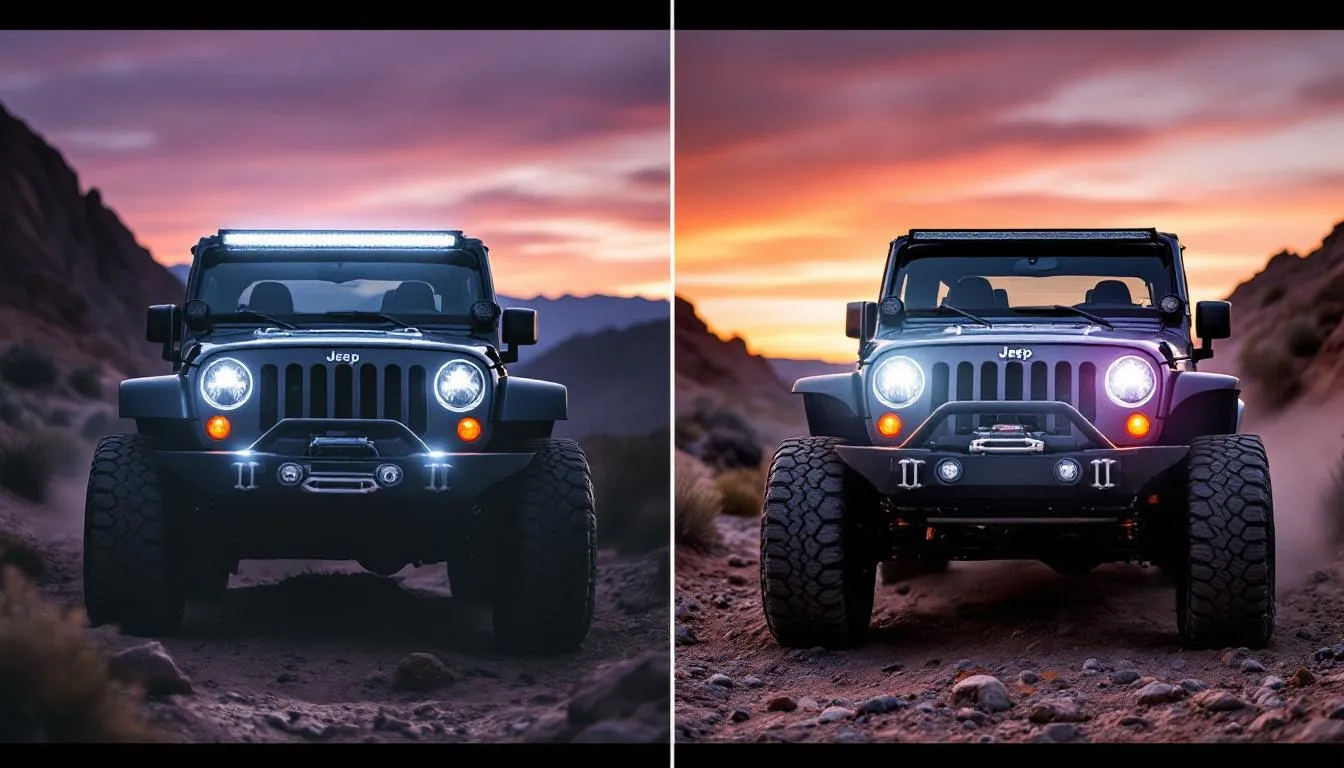
Which Light Bar Is Right for Your JK?
Choosing between Rigid Industries vs KC HiLiTES JK light bars comes down to specific performance needs and budget priorities. Both manufacturers deliver reliable off-road lighting, but they approach the problem differently — Rigid emphasizes precision-engineered beam patterns and premium construction, while KC HiLiTES focuses on proven durability at accessible price points.
Your decision should center on how you actually use your JK. Night trail running, desert pre-running, and weekend camping trips all demand different lighting characteristics. Understanding these differences before spending $400-800 helps you avoid buyer’s remorse and ensures your lighting upgrade matches your real-world needs.
This comparison examines JK-specific considerations including electrical system limitations, hood flex characteristics unique to the platform, and mounting challenges that don’t affect other vehicles. For broader modification planning context, our comprehensive JK modification planning guide shows how lighting fits into a complete build strategy.
Build Quality & Construction: Materials That Matter Off-Road
Rigid Industries constructs their light bars from extruded aluminum housings with integrated cooling fins machined directly into the body (source: warn.com). The polycarbonate lenses feature hard coating that resists scratching from branch strikes and airborne debris. Internal circuit boards use conformal coating protecting against moisture intrusion — critical during water crossings or steam exposure after driving through puddles on hot components.
KC HiLiTES builds their housings from die-cast aluminum with impact-resistant polycarbonate lenses. Their mounting brackets use thicker gauge steel than many competitors, which matters when dealing with hood flex common on JKs running 35-inch or larger tires. The bracket construction difference becomes apparent after several thousand miles of washboard roads — thinner designs crack at stress points, particularly where they bolt to the hood.
Both manufacturers use automotive-grade wiring and weatherproof connectors. Rigid’s Deutsch-style connectors offer tool-free disconnection that simplifies maintenance. KC uses sealed bullet connectors requiring cutting for servicing, though they cost less to replace if damaged.
Construction quality directly impacts how these lights handle JK-specific challenges. Hood flutter at highway speeds creates constant vibration that loosens cheaper light bar mounts. Both Rigid and KC address this, but Rigid’s integrated mounting system distributes stress more evenly across the hood. If you’re experiencing electrical issues alongside lighting concerns, our common JK electrical issues guide helps diagnose whether problems stem from the light bar installation or existing wiring faults.
The IP68 and IP69K ratings both manufacturers claim mean dust-tight protection and resistance against high-pressure water jets. In practice, both brands survive pressure washing and deep water crossings without issue. They differ in long-term seal integrity after rock strikes create small impacts around the lens housing.
Brightness Comparison: Lumens, Lux, and Real-World Visibility
A 30-inch Rigid E-Series produces approximately 16,248 raw lumens with a combination spot/flood beam pattern, measuring around 103,000 lux at 10 meters in the center hot spot. A comparable KC HiLiTES C-Series 30-inch bar generates roughly 13,800 lumens with 89,000 lux at the same distance. That difference translates to seeing trail obstacles about 40-50 feet sooner when traveling at typical trail speeds of 15-25 mph.
But raw numbers don’t tell the complete story. Lux measures intensity at a specific point, while lumens measure total light output. You can have high lumens with poor beam pattern that scatters light uselessly into the sky, or lower lumens with tight beam control that puts light exactly where you need it. This is where Rigid’s engineering focus shows — their beam patterns minimize wasted spill while maintaining usable peripheral lighting.
KC HiLiTES takes a different approach with wider flood patterns that sacrifice some distance for broader coverage. On technical rock crawling trails where you need to see obstacles to both sides, that wider pattern helps you spot line options. On high-speed desert running, Rigid’s focused beam reaches farther down the trail.
The practical difference at typical JK trail speeds: Rigid gives you more reaction time for obstacles directly ahead, while KC provides better situational awareness of your full trail width. Neither choice is wrong — it depends on your typical terrain. Tight Eastern woodland trails favor KC’s width. Open Western desert trails favor Rigid’s distance.
Color temperature also affects perceived brightness. Both manufacturers offer 5000-6000K options that produce a white light closer to daylight than the yellowish tint of halogen. Your eyes resolve detail better in this color range, which matters more than raw lumen output when you’re trying to distinguish rocks from shadows.
One critical note: more lumens always sounds better on paper, but your JK’s electrical system has real limits. A 200-watt light bar on a stock JK alternator already pushes boundaries, especially if you’re running a winch, stereo, and other accessories. Chasing maximum brightness can create voltage drop issues that affect your entire electrical system.
Warranty Coverage & Customer Support: What Happens When Things Go Wrong
Rigid Industries offers a limited lifetime warranty covering manufacturing defects but explicitly excluding impact damage from rocks, debris, or crashes. In practice, their customer service has a reputation for being responsive when you have a legitimate claim, with typical turnaround times of two to three weeks for warranty replacements. You’ll need your purchase receipt and photos documenting the issue.
KC HiLiTES provides a three-year warranty that similarly excludes physical damage. Their support response times run slightly longer — three to four weeks in my experience — but they’re generally straightforward about honoring legitimate claims. The shorter warranty period reflects their lower price point rather than inferior quality.
What neither warranty covers: the most common light bar failure mode on JKs. Rock strikes that crack lenses or damage housings aren’t covered by either manufacturer. If you’re running serious trails, budget for eventual replacement regardless of which brand you choose. A $600 Rigid light bar is just as vulnerable to a baseball-sized rock at 30 mph as a $400 KC bar.
Where warranties do matter: electrical component failures, LED failures (rare but it happens), and housing seal failures that let moisture in. Rigid’s lifetime coverage provides longer peace of mind for these issues, but remember that a hassle-free three-year warranty beats a difficult lifetime warranty. Based on community reports, both manufacturers handle these types of claims reasonably well.
The real test of warranty quality isn’t the terms — it’s how the company responds when you contact them. Rigid’s support team tends to ask detailed questions about installation and usage before approving claims. KC’s process is slightly more streamlined but still requires documentation. Neither company will simply send you a new light bar without verification that the failure falls under warranty coverage.
JK-Specific Mounting & Installation Considerations
The JK’s hood flex characteristics create unique challenges for light bar mounting that don’t exist on vehicles with stiffer hood construction. When running 35-inch tires or larger, additional weight and altered suspension geometry increase hood flutter at highway speeds. This constant vibration works mounting hardware loose over time without proper installation.
Both Rigid and KC offer JK-specific mounting brackets with different engineering approaches. Rigid’s mounts distribute load across more hood mounting points, reducing stress concentration at any single location. KC’s brackets use fewer mounting points but heavier gauge steel at each connection. Neither approach is inherently better — they’re different solutions to the same problem.
For 2011 and newer JKs with auxiliary switch integration, you have factory wiring designed to handle accessory loads without splicing into existing circuits (source: extremeterrain.com). Using the aux switches means your light bar is protected by appropriately sized fuses and relays from the factory, reducing electrical fire risk from improper wiring. Pre-2011 JKs require adding relays and proper circuit protection manually.
Trim level differences affect installation approach. Rubicons with factory differential lockers and sway bar disconnects already push the alternator harder than Sport or Sahara models. Adding high-draw lighting to a Rubicon means you’re closer to the alternator’s maximum output capacity. Check our JK trim level comparison to understand your starting electrical capacity before adding major accessories.
Hood clearance varies slightly between JK years, particularly after the 2012 facelift. Most light bars mount low enough that hood clearance isn’t an issue, but if you’re considering a curved light bar or want to stack multiple lights, measure twice before ordering. The 2007-2011 JKs have slightly different hood geometries than 2012-2018 models — minor differences that don’t affect most installations but can matter for specific mounting configurations.
Our guide to JK year-to-year electrical differences covers specific alternator output and battery capacity changes affecting how many accessories your electrical system can support without upgrades.
Wire routing matters more than most expect. Running wires along factory harness paths and using proper grommets through the firewall prevents chafing that can short your light bar directly to the chassis. Multiple JKs have experienced electrical fires traced to improperly routed accessory wiring that rubbed through on sharp edges between the battery and light bar.
Price Point & Value Analysis: What You Get for Your Money
A 30-inch Rigid E-Series typically costs $650-750 depending on beam pattern and current sales. The comparable KC HiLiTES C-Series 30-inch runs $400-500 for similar configurations. That $200-300 difference represents a meaningful chunk of your modification budget — enough to add recovery boards, upgrade to synthetic winch line, or put toward better tires.
The value equation isn’t as simple as dividing lumens by dollars. Rigid’s higher price buys more precise beam patterns, potentially better long-term durability, and a lifetime warranty. KC’s lower price gets proven performance adequate for most JK owners, a shorter but sufficient warranty, and leaves budget for other modifications.
Here’s how to frame the decision: if you frequently run night trails and lighting performance directly impacts your safety and enjoyment, Rigid’s premium engineering probably justifies the cost. If you occasionally use your light bar for night drives to trailheads and evening trail runs, KC’s performance-to-price ratio makes more sense.
The common rationalization goes “I’ll buy the best once and be done.” Reality check: many JK owners upgrade multiple times as needs change and technology emerges. That $650 Rigid bar represents locked capital unavailable when you want to upgrade to a full bumper-mounted solution two years later. The $400 KC bar leaves you $250 toward that future upgrade.
Consider the opportunity cost. That $250-300 price difference could instead buy Metalcloak overland fenders that protect your investment better than slightly brighter lighting. Or it funds a professional front-end alignment after lifting your JK, improving both on-road and off-road performance more than incremental lighting improvements.
Both manufacturers occasionally run sales that shift the value equation. A Rigid bar at $550 on sale closes the gap significantly. A KC bar at $350 opens it wider. Watching prices for a few months can save enough to justify either choice based purely on features rather than budget constraints.
Product Comparison: 30-Inch Light Bars
| Feature | Rigid E-Series | KC HiLiTES C-Series |
|---|---|---|
| Price Range | $650-750 | $400-500 |
| Raw Lumens | 16,248 | 13,800 |
| Center Lux (10m) | 103,000 | 89,000 |
| Beam Pattern | Focused spot/flood | Wide flood emphasis |
| Warranty | Limited lifetime | 3 years |
| Connector Type | Deutsch (tool-free) | Sealed bullet |
| Best For | High-speed desert, maximum distance | Technical trails, wider coverage |
| Current Draw | ~15 amps | ~14 amps |
Real-World Performance: Trail Reports from JK Owners
On tight woodland trails with overhead canopy blocking ambient light, both light bars transform nighttime navigation from sketchy to manageable. The practical difference comes down to beam pattern preference — KC’s wider flood helps you identify tree lines and trail edges, while Rigid’s tighter pattern reaches deeper down the trail. When you’re moving slowly over technical obstacles, that width difference matters more than the brightness difference.
Desert runners report different experiences. At 30-40 mph across open terrain, Rigid’s longer throw lets you see upcoming terrain changes sooner, giving you more time to choose your line through washes and around larger rocks. KC’s shorter reach means you’re often adjusting your speed downward to maintain adequate reaction time.
Dust performance separates average light bars from good ones, and both Rigid and KC handle dusty conditions better than cheaper alternatives. The key factor isn’t brightness but beam pattern design that minimizes backscatter. Both manufacturers understand this — their combination spot/flood patterns keep the brightest light focused ahead where it penetrates dust rather than scattering it into your field of view.
Snow wheeling presents similar challenges to dust, and again both brands perform well. The 5000-6000K color temperature both manufacturers use cuts through blowing snow better than the cooler blue-white light some LED bars produce. When you’re navigating snow-covered trails, being able to distinguish the trail surface from snow accumulation becomes critical.
Rock crawling at night rarely requires the full output either light bar provides. Most technical crawling happens at walking pace where even moderate lighting suffices. The real value in premium lighting shows up during the drive to and from the trail, or on fire roads between crawling sections where you’re covering ground more quickly.
Platform differences between the JK and newer JL affect how lighting upgrades perform, primarily due to different hood geometries and electrical systems. Our JK vs JL platform differences guide covers these distinctions if you’re considering both platforms.
One consistent community observation: most JK owners who spring for premium lighting report using it less than they expected when they bought it. Night wheeling isn’t as common as daytime trail running for most people. That usage pattern favors the value proposition of KC over Rigid’s premium pricing, unless you’re specifically building for night use.
Which Light Bar Should You Choose for Your JK?
Choose Rigid Industries vs KC HiLiTES JK lighting based on your specific use case and budget priorities. Select Rigid Industries if you frequently run trails at night, want maximum visibility distance, and value precision-engineered beam patterns. The premium price makes sense when lighting performance directly impacts your primary use case. Budget $700-800 including quality mounting hardware and proper wiring components.
Select KC HiLiTES if you want proven lighting performance at accessible price points, run mixed terrain where width matters more than maximum distance, or want to allocate more modification budget toward other upgrades. Budget $450-550 for complete installation with quality accessories.
Neither choice is wrong. Both manufacturers produce reliable products that will serve your JK well. The decision comes down to your specific use case, budget priorities, and whether you value absolute performance or practical value more highly.
Before purchasing either option, verify your JK’s electrical system can handle the additional load without voltage drop issues affecting other systems. Install proper relays, appropriately sized wiring, and adequate fuses regardless of which brand you choose. Poor installation undermines even the best lighting equipment.
Consider starting with a single moderate-output light bar to validate that you’ll actually use auxiliary lighting enough to justify the expense. Many JK owners discover they use their light bars less frequently than anticipated, making the premium-budget question less important than initially assumed.
Once you’ve upgraded your lighting, explore our guide on top choices for your JK to continue improving your build. If you’re planning warm-weather modifications, check out summer sun protection options that complement your lighting upgrades.
Frequently Asked Questions
Can I run a 30-inch light bar on a stock JK alternator without issues?
Yes, but monitor your voltage carefully, especially when running other accessories simultaneously. A 30-inch light bar typically draws 15-20 amps, which most stock JK alternators can handle. However, adding a winch, stereo upgrades, and other accessories pushes you toward alternator limits. Consider upgrading to a higher-output alternator if building a heavily accessorized JK.
Do I need to upgrade my wiring harness for aftermarket light bars?
Both Rigid and KC include wiring harnesses with their light bars, but quality varies. For installations over 20 feet or high-amperage bars, upgrading to heavier gauge wire reduces voltage drop and heat buildup. Always use properly rated relays and fuses regardless of which included harness you receive.
Will a light bar cause issues with my JK’s computer system?
Not if installed correctly with proper relays and circuit protection. The potential issue is voltage fluctuation when switching high-draw accessories on and off. Using relays triggered by aux switches or upfitter circuits prevents this problem by isolating the light bar circuit from sensitive computer systems.
How do I prevent my light bar from vibrating loose on rough trails?
Use thread locker on all mounting hardware, check bolt tension every few trail days, and consider adding vibration-dampening washers between the mount and hood. The JK’s hood flex means you’ll need to re-torque mounting bolts periodically — normal maintenance, not a sign of poor installation.
Can I mount a light bar on my JK’s bumper instead of the hood?
Absolutely, and bumper mounting often works better for heavy light bars that would create excessive hood stress. Bumper-mounted bars require longer wiring runs but eliminate hood flex concerns entirely. Consider this approach if running 40-inch or larger bars, or if you’ve experienced hood-mounted accessories working loose.
Which beam pattern works best for mixed terrain — spot, flood, or combo?
Combination spot/flood patterns offer the most versatility for mixed terrain driving. Pure spot beams excel at high-speed desert running but provide inadequate peripheral lighting for technical trails. Pure flood beams illuminate wide areas but lack distance. The combo pattern balances both needs, making it the most practical choice for JK owners who encounter varied terrain.
How much does professional installation typically cost for a light bar?
Professional installation typically runs $150-300 depending on complexity and local labor rates. This includes proper relay installation, wiring routing, switch mounting, and testing. While DIY installation saves money, professional work ensures proper circuit protection and weatherproof connections that prevent future electrical issues.
Get the Free JK Build Planner
Complete PDF with mod checklists, gear ratios, tire sizing charts, and budget worksheets. Everything you need to plan your JK build.
No spam. Unsubscribe anytime. By subscribing, you agree to our Privacy Policy.
Jeep JK Guide
We're JK owners who've been building, breaking, and fixing Wranglers for years. Everything here is tested on our own rigs - no sponsored fluff, just honest recommendations.
Learn more about us →Get the JK Build Planner
Free PDF with complete build checklists, gear ratios, and tire fitment guides.
By subscribing, you agree to our Privacy Policy.
Related Articles
Bartact vs Rugged Ridge Seat Covers for Jeep JK: Complete Comparison
Real-world comparison of Bartact tactical vs Rugged Ridge neoprene seat covers for Jeep Wrangler JK. Durability testing, installation times, MOLLE functionality, and pricing analysis.
Best Oil For Jeep JK Oil Change
Best Rock Sliders for Jeep JK: Top 7 Trail-Tested Options
Protect your JK's rockers with expert-tested rock slider rankings. Frame-mounted vs pinch seam systems compared for 2-door and 4-door models.