Best Hi-Lift Jack Mount for Jeep JK: Hood, Bumper & Tailgate Mounting Options
This article contains affiliate links. We may earn a commission at no extra cost to you.
Finding the Right Hi-Lift Jack Mount: A Bainskloof Pass Lesson
I learned the hard way that having a hi-lift jack buried under camping gear is almost as useless as not having one at all. On South Africa’s Bainskloof Pass, I watched a stranded driver struggle for twenty minutes to dig out recovery equipment while his Defender settled deeper into soft sand. When I helped him that day, I made a decision: my hi-lift would be mounted permanently and accessible within seconds.
The best hi-lift jack mount for your Jeep JK depends on three factors: security, accessibility, and weight distribution. Hood hinge mounts offer the fastest access and lowest cost but may stress hinges on 2007-2011 models with weaker hinge designs. Bumper-integrated mounts provide maximum security for serious off-roaders but require aftermarket steel bumpers. Tailgate and spare tire carrier mounts keep weight off the front end—a significant benefit for 2-door JKs prone to nose-heavy handling.
Your mounting choice should align with how you actually use your Jeep. Weekend trail riders who rarely face serious recovery situations can get by with a hood hinge mount. Rock crawlers tackling challenging terrain need bumper-mounted security. And overlanders carrying heavy roof loads should consider rear mounting to balance weight distribution, especially on 2-door JK models.
This guide compares all three mounting styles with model-year compatibility notes, installation requirements, and real-world access scenarios. For Rubicon models with factory rock rails, you already have some recovery capability—but a properly mounted hi-lift dramatically expands your options when trails get technical.
Hood Hinge Mounts: Best for Quick Access and Budget Builds
Hood hinge mounts bolt directly to your JK’s factory hood hinges, positioning the hi-lift jack vertically along the driver’s side hood. They’re the most affordable option at $40-80 and require no cutting or welding. Installation takes thirty minutes with basic hand tools.
Pros:
- Fastest access during trail emergencies—unbolt and deploy in seconds
- Works with stock bumpers and armor configurations
- No permanent modifications to body or frame
- Accessible with doors removed during summer wheeling
- Doesn’t interfere with rear cargo space or departure angles
- Compatible with both 2-door and 4-door JKU models
Cons:
- Hood hinge stress increases on rough trails—2007-2011 hinges are weaker than 2012-2018 reinforced versions
- Jack rattling can loosen mounting bolts over time
- Limited security—exposed position makes theft easier
- Adds 30+ pounds to the hood, affecting hood lift effort
- May interfere with aftermarket hood latches or vents
- Water intrusion risk if mount hardware penetrates hood area
My research philosophy centers on real-world community knowledge, not manufacturer spec sheets. I cross-referenced hundreds of JK forum posts about hinge stress and found that 2012-2018 models handle hood-mounted weight significantly better than earlier years. If you’re running a 2007-2011 JK, inspect your hood hinges for stress cracks every 5,000 miles when running a hood mount.
Installation requires careful bolt torque specs—over-tightening can crack the hinge mount points, while under-tightening allows the jack to shift and rattle. Use blue Loctite on all mounting hardware and check torque every few months. The constant vibration from off-road driving will test your installation.
Hood hinge mounts work best for Jeeps that see mixed use—daily driving with occasional trail runs. They excel when you need the hi-lift accessible but don’t want to invest in aftermarket bumpers. Consider your JK model year-specific hinge variations before choosing this option, especially if you’re running heavy armor or a steel bumper up front.
Weight distribution matters more than most people realize. A hood-mounted hi-lift on a 2-door JK already running a winch and steel bumper pushes the front suspension toward its limits. If you’re running a soft top or hardtop configuration, the lighter soft top setup tolerates front-mounted weight better than heavy hardtops.
Bumper-Integrated Mounts: Most Secure for Serious Off-Roading
Bumper-integrated mounts weld or bolt directly to aftermarket steel bumpers, creating the most secure hi-lift mounting option available for JK Wranglers. The jack becomes part of your armor system rather than an add-on accessory. This mounting style virtually eliminates theft risk and handles the most aggressive off-road abuse without loosening or shifting.
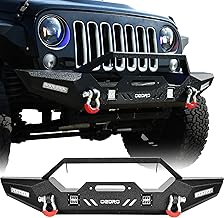
OEDRO Front Bumper, Compatible for 2007-2018 Jeep Wrangler JK & Unlimited, Rock Crawler Bumper with Winch Plate Mounting & 4 x LED Lights & 2 x D-Rings Off Road
$229.35
Check Price on AmazonYou must have an aftermarket steel bumper to use this mount type. Stock plastic JK bumpers lack the structural integrity to support hi-lift jack mounting loads during recovery operations. Most quality steel bumpers include integrated jack mounts or accept bolt-on mount accessories designed specifically for that bumper model.
Front bumper mounting positions the hi-lift for immediate winching support and front-end recovery scenarios. The jack sits low enough that it doesn’t interfere with hood operation but high enough to avoid trail obstacle damage. Accessibility is slightly slower than hood mounts—you’ll kneel to unbolt the jack—but security and durability far exceed other mounting options.
Rear bumper mounting works exceptionally well for overlanders and expedition builds. The weight sits behind the rear axle, counterbalancing heavy roof racks and rooftop tents. Rear-mounted jacks also provide better access for rear recovery points and pulling stuck vehicles from behind. Many JK owners running both front and rear aftermarket bumpers choose rear mounting to keep the front bumper area clear for winch operation.
The OEDRO bumper shown above represents mid-tier quality at a budget-friendly price point. It includes D-ring mounts, LED light provisions, and winch plate integration. The textured powder coat holds up better than many competitors in the same price range. At 78 pounds, it’s manageable for two-person installation without heavy equipment.
Front vs Rear Bumper Mount Comparison:
| Feature | Hood Hinge | Front Bumper | Rear Bumper |
|---|---|---|---|
| Security | Low | Very High | Very High |
| Access Speed | Fastest | Moderate | Moderate |
| Installation Cost | $50-100 | $300-1200 | $300-1200 |
| Theft Risk | High | Very Low | Very Low |
| Weight Distribution | Front-heavy | Front-heavy | Rear-balanced |
Professional rock crawlers almost universally choose bumper mounting. The jack stays secured during extreme articulation and side-angle obstacles that would stress hood hinge mounts. Rubicon’s factory steel bumpers on 2007-2011 models theoretically support mounting, but most serious wheelers replace them with aftermarket options offering better approach angles and integrated recovery points.
Bumper mounting requires commitment. You’re investing in the mount hardware plus the bumper itself. But if you’re already planning armor upgrades for serious trail use, integrating the hi-lift mount into that system makes perfect sense. The added front or rear weight becomes part of your overall suspension planning rather than an afterthought.
Tailgate and Spare Tire Mounts: Best for Rear Approach Angles
Tailgate-mounted hi-lift jacks bolt to the JK’s tailgate hinges or spare tire carrier, keeping recovery equipment accessible from the rear while maintaining clean body lines. These mounts work particularly well for 2-door JKs that benefit from moving weight rearward to balance front-heavy winch and bumper setups.
The primary advantage is weight distribution. A rear-mounted hi-lift counteracts nose-heavy handling on 2-door models, especially when combined with steel bumpers, winches, and heavy-duty front suspension components. You’ll notice improved steering response and reduced front suspension sag during highway driving.
Spare tire carrier integration offers the most refined rear mounting approach. Many aftermarket tire carriers—Teraflex, LOD, GenRight—include hi-lift mount provisions built into the carrier arms. The jack mounts horizontally along the carrier, protected from direct trail debris by the spare tire itself. This configuration works beautifully for 35” and 37” tire setups where the oversized spare provides natural protection.
Advantages of rear mounting:
- Improves front-to-rear weight balance on 2-door JKs
- Protects the jack from front-end trail damage
- Keeps hood operation unrestricted
- Accessible from the rear during stuck situations
- Doesn’t interfere with winch cable spooling
- Compatible with tailgate tables and cargo accessories
Disadvantages to consider:
- Slower access compared to hood mounts—requires walking around the vehicle
- Tailgate stress increases, especially on older JK hinges
- May limit rear cargo door swing in tight trail situations
- Can interfere with bike racks and cargo carriers
- Requires stronger tailgate hinges on 2007-2013 models
- Less convenient for side-pull recovery scenarios
Later JK years received tailgate hinge reinforcements that handle aftermarket tire carriers and mounted equipment better than early production runs. If you’re running a 2007-2010 JK with a heavy spare tire setup, inspect your tailgate hinges regularly for stress cracks. Adding a hi-lift mount on top of a 35” tire and heavy carrier pushes these hinges to their structural limits.
Ideal use cases include overland builds prioritizing storage and expedition equipment. When your roof rack carries sleeping quarters and your rear cargo area is packed with recovery gear, mounting the hi-lift outside keeps interior space free while maintaining accessibility. Rear mounting also works well for Jeeps that frequently travel with bikes, kayaks, or other rear-mounted sports equipment where front hood mounting would waste prime real estate.
The trade-off is convenience during front recovery situations. If you’re winching from the front and need the hi-lift for support or as a deadman anchor, walking to the rear adds precious seconds during time-sensitive recovery operations. Choose rear mounting when your typical off-road scenarios involve rear extractions or when weight distribution benefits outweigh access speed concerns.
Installation Tips and Compatibility Factors
Before bolting any hi-lift mount to your JK, address existing mechanical issues first. I learned this lesson after replacing a radiator, AC compressor, and cracked cylinder head on my own Jeep—repairs that should have happened before I started adding accessories. Don’t add mount weight if your JK has suspension or steering issues that need fixing first.
Pre-installation compatibility checklist:
- Verify your model year’s hinge or bumper specifications
- Check for existing stress cracks in mounting areas
- Measure clearance with doors fully opened
- Test hood operation with simulated weight load
- Confirm compatibility with hardtop, soft top, or bikini top configuration
- Check interference with aftermarket hood latches
- Verify clearance with half doors, tube doors, or factory doors
Hood hinge mount installation (numbered steps):
- Remove hood prop rod and disconnect washer fluid line if mounting on driver side
- Position mount bracket on hinge with protective rubber padding between metal surfaces
- Thread bolts finger-tight, then torque to manufacturer specifications (typically 15-20 ft-lbs)
- Apply blue Loctite to all mounting hardware before final tightening
- Install hi-lift jack and verify it doesn’t contact hood when engine compartment warms up
- Test hood operation through full range of motion with jack mounted
- Recheck bolt torque after first 100 miles and every 5,000 miles thereafter
2-door weight warning: A hood-mounted hi-lift on a 2-door JK running a winch, steel bumper, and heavy-duty front suspension already pushes your Jeep toward nose-heavy handling. Add a hardtop and you’re compounding the front weight bias. Consider rear mounting or bumper-integrated options to maintain balanced weight distribution.
Your soft top or hardtop setup affects optimal mounting location more than most owners realize. Soft tops handle front-mounted weight better because they add minimal roof load. Hardtops—especially insulated or premium models—add 120+ pounds to the roof structure, making front weight even more pronounced. Some JK owners switch to a bikini top for summer wheeling specifically to reduce roof weight when running heavy front armor.
Door configuration matters for hood hinge accessibility. Running half doors or tube doors provides easier access to hood-mounted jacks compared to full doors, especially in tight trail situations where you can’t fully open doors. This becomes critical during actual recovery operations when you need the jack deployed quickly.
Ongoing maintenance requirements:
- Inspect mounting hardware every oil change
- Re-torque bolts after rough trail rides
- Clean and lubricate hi-lift moving parts monthly
- Check for stress cracks around hinge or bumper mount points
- Touch up paint chips immediately to prevent rust
- Remove jack for extended highway trips if theft is a concern
Theft prevention varies by mounting style. Hood hinge and tailgate mounts use simple bolt systems that determined thieves can defeat quickly. Add locking bolts or security pins to slow theft attempts. Bumper-integrated mounts offer better security but aren’t theft-proof—use a cable lock through the jack mechanism when parked in questionable areas overnight.
Most installation problems trace back to over-tightening or under-tightening mounting hardware. Over-tightening cracks hinge mount points. Under-tightening allows the jack to rattle loose during trail riding. Follow manufacturer torque specifications exactly and use a proper torque wrench rather than guessing with hand tools.
Frequently Asked Questions About JK Hi-Lift Jack Mounts
Can I mount a hi-lift jack on stock Jeep JK bumpers?
No, stock plastic JK bumpers lack the structural strength to safely support hi-lift jack mounting. You need an aftermarket steel bumper designed with integrated mount points or compatible with bolt-on mount accessories. Sport and Sahara models with plastic bumpers require bumper replacement before bumper-mounting is possible. Even Rubicon steel bumpers work better when replaced with aftermarket options offering dedicated jack mounting provisions.
Do hood hinge mounts damage JK hinges over time?
2007-2011 JK models have weaker hood hinges that may develop stress cracks with prolonged hood-mounted weight. 2012-2018 models feature reinforced hinges that handle the load significantly better. Inspect your hinges every 5,000 miles for hairline cracks around bolt holes if running a hood mount. Proper installation with torque specs and rubber padding reduces stress, but the constant weight and vibration will test hinge integrity on earlier model years.
Which hi-lift jack mount is fastest to access during trail recovery?
Hood hinge mounts provide the fastest access—typically 10-15 seconds to unbolt and deploy. You can reach the mount from either side of the vehicle with doors on or off. Bumper and tailgate mounts require kneeling and take 20-30 seconds to access, but they offer better security for the trade-off in speed. For time-critical front recoveries, hood mounting wins. For balanced weight distribution and security, accept the minor access delay with bumper mounting.
Will a hood-mounted hi-lift work with doors off?
Yes, hood hinge mounts remain fully accessible with factory doors, half doors, or no doors. This is one advantage over rear-mounted options where door configuration affects your walking path to the tailgate. Summer wheeling with a bikini top and doors off makes hood-mounted jacks especially convenient—you have completely unobstructed access to recovery equipment without walking around the vehicle.
Should I remove my hi-lift jack for daily driving?
Remove the jack for extended highway trips or when parking in high-theft areas overnight. Daily driving with a mounted jack is fine if you’ve properly torqued all mounting hardware and checked for loosening regularly. The constant vibration does stress mounting points over time, so inspect bolts and hinges frequently. Many JK owners leave jacks mounted year-round and report no issues, while others prefer removing them between trail trips to reduce theft risk and extend mounting hardware life. Your decision should factor in your area’s theft rate and whether your JK has common JK suspension and steering issues that might worsen with added weight.
Choosing the Right Hi-Lift Jack Mount for Your JK Build
Hood hinge mounts excel for budget builds and mixed-use Jeeps that prioritize quick access over maximum security. They work best on 2012-2018 models with reinforced hinges and light-to-moderate front weight configurations. Bumper-integrated mounts suit serious rock crawlers and expedition builds where security and durability justify the higher cost and aftermarket bumper requirement. Tailgate and spare tire mounts benefit 2-door JKs needing better weight distribution and overland rigs where rear accessibility makes more sense than front mounting.
Match your mounting choice to how you actually use your Jeep, not how you imagine using it. Weekend trail riders rarely need bumper-mounted security. Daily drivers benefit from the simplicity of hood mounts. Serious off-roaders should integrate the hi-lift into their overall armor system from the start.
Evaluate your JK’s current setup before buying any mount. Check your suspension condition, inspect hinge points for existing damage, and consider planned upgrades that might affect mounting location. A hi-lift jack mount seems like a simple bolt-on accessory, but it affects your Jeep’s weight distribution, handling, and long-term structural integrity when done wrong.
For readers still planning their overall JK modifications, start with our complete JK buying and building guide to understand how recovery equipment fits into your broader build strategy. And if you’re comparing older JK Wranglers to newer JL models, our JK vs JL comparison covers the key differences that affect accessory compatibility and mounting options.
This article contains affiliate links. If you purchase through these links, we may earn a small commission at no extra cost to you. This helps support the site and allows us to continue creating content for the Jeep JK community.
Get the Free JK Build Planner
Complete PDF with mod checklists, gear ratios, tire sizing charts, and budget worksheets. Everything you need to plan your JK build.
No spam. Unsubscribe anytime. By subscribing, you agree to our Privacy Policy.
Allan
I'm Allan. I bought a 2014 Jeep Wrangler JKU and I research the hell out of every mod before I touch it. Everything here is tested or deeply researched on my own rig - no sponsored fluff, just honest findings.
Learn more about me →Get the JK Build Planner
Free PDF with complete build checklists, gear ratios, and tire fitment guides.
By subscribing, you agree to our Privacy Policy.
Related Articles
Best Fender Flares for Jeep JK: Flat, Tube & High-Clearance Options Ranked
Affiliate Disclosure: JeepJK Guide earns a commission on qualifying purchases made through links on this page. This does not affect our editorial...
Best Front Bumper for Jeep JK: Complete 2026 Buying Guide
Find the best front bumper for your Jeep JK. Compare stubby vs full-width designs, steel vs aluminum materials, and budget to premium options for rock crawling and overlanding.
Best Gas Tank Skid Plate for Jeep JK: Armor Your Fuel System
Your Jeep JK's fuel tank sits exposed underneath the rear of your Wrangler, defended by nothing more than a thin plastic shield. One poorly placed rock...