Best Rock Crawling Tires for Jeep JK: Extreme Off-Road Rubber
This article contains affiliate links. We may earn a commission at no extra cost to you.
Best Rock Crawling Tires for Jeep JK: Extreme Off-Road Rubber
The best rock crawling tires for Jeep JK combine soft compound rubber (typically 40-55 durometer), aggressive sidewall tread, and reinforced carcass construction to maximize grip on technical terrain. You’ll want sticky compound tires with deep, widely-spaced lugs when conquering boulders and ledges.
Rock crawling demands different rubber than what you’ll find on standard all-terrain or mud terrain tires. The compound chemistry, tread pattern geometry, and sidewall construction all work together to create grip on surfaces where traditional tires simply slide. Your JK’s capability on technical trails depends as much on tire selection as it does on suspension articulation and drivetrain gearing.
Choosing rock crawling tires means understanding the trade-offs. Softer compounds grip better but wear faster on pavement. Taller sidewalls increase puncture risk but improve rock conformity. Directional tread patterns excel in specific situations but compromise in others. These aren’t daily driver tires for most JK owners—they’re specialized tools for extreme terrain.
The 2007-2018 JK Wrangler platform offers excellent fitment flexibility, especially with the longer wheelbase JKU (4-door) models. Stock suspension handles up to 33-inch tires, while a 2.5-3 inch lift opens the door to 35s. Understanding your specific JK configuration matters when selecting rock crawling rubber. For comprehensive fitment fundamentals, check our JK wheel and tire fitment fundamentals guide.
**FTC
Top 7 Rock Crawling Tires for Jeep JK Wrangler
My research philosophy: real-world community knowledge, not spec sheets. I’ve spent hundreds of hours in JK forums, Facebook groups, and trail parking lots talking to owners who actually run these tires on rocks. The tires below represent what’s working in Moab, Johnson Valley, and the Rubicon—not what looks good in marketing materials.
Best Overall: BFGoodrich Krawler T/A KX (35x12.50R17)
The Krawler T/A KX sets the benchmark for rock crawling performance on the JK platform. This competition-proven tire features BFG’s stickiest compound with a 40-45 durometer rating and massive shoulder lugs that extend down the sidewall for maximum rock surface contact.
Key Specifications:
- Compound: Competition-grade sticky (40-45 durometer)
- Load Range: C (6-ply rated)
- Tread Depth: 18/32”
- Weight: 65 lbs per tire
- Available Sizes: 35”, 37”, 39”, 40”
Pros:
- Unmatched grip on slickrock and sandstone
- Aggressive sidewall tread creates additional contact points
- Self-cleaning tread design prevents mud packing
- Proven in Ultra4 and King of the Hammers competition
Cons:
- Rapid tread wear on pavement (5,000-8,000 miles typical)
- Loud road noise above 45 mph
- Premium pricing at $450-500 per tire
Best For: Weekend warriors and competition crawlers who trailer to the trail and want maximum rock performance regardless of street manners.
Best Sticky Compound: Maxxis Creepy Crawler (37x12.50R17)
Whereas the BFG Krawler dominates with aggressive tread, the Creepy Crawler wins with pure compound grip. Maxxis formulated this tire specifically for low-speed rock crawling with a 38-42 durometer compound that conforms to irregular surfaces like modeling clay.
Key Specifications:
- Compound: Ultra-soft sticky (38-42 durometer)
- Load Range: C (6-ply rated)
- Tread Depth: 21/32”
- Weight: 71 lbs per tire
- Available Sizes: 35”, 37”, 39”, 40”, 42”
Pros:
- Softest compound available in a DOT-legal tire
- Deep tread depth provides excellent rock bite
- Wide tread face maximizes contact patch
- Strong bias-ply construction resists sidewall punctures
Cons:
- Extremely poor pavement wear (3,000-5,000 miles)
- Requires constant air pressure monitoring
- Limited to 15 mph maximum speed rating
Best For: Dedicated rock crawling rigs that rarely see pavement and prioritize absolute grip over longevity.
Best Value: Dick Cepek Extreme Country (35x12.50R17)
The Extreme Country delivers 80% of competition tire performance at 50% of the cost. This hybrid design combines sticky sidewall compound with a more durable center tread, making it viable for the JK owner who drives 50 miles to the trailhead.
Key Specifications:
- Compound: Dual-compound (45 durometer sidewalls, 50 durometer center)
- Load Range: E (10-ply rated)
- Tread Depth: 19/32”
- Weight: 68 lbs per tire
- Available Sizes: 33”, 35”, 37”
Pros:
- Balanced performance between rocks and pavement
- 10-ply construction handles heavy JK weight and armor
- More affordable at $320-360 per tire
- Decent 15,000-20,000 mile tread life
Cons:
- Slightly less grip than dedicated sticky tires
- Heavier weight impacts unsprung mass
- Mediocre performance in deep mud
Best For: JK owners who wheel monthly but need a tire that survives highway miles and handles some daily driving duty.
Best for Mixed Terrain: Nitto Trail Grappler M/T (35x12.50R17)
Unlike pure rock crawling tires, the Trail Grappler works across multiple terrain types. The deep siping and varied block sizes provide rock bite while maintaining reasonable mud evacuation and highway manners. This versatility makes it the top choice for JK owners who explore diverse trail systems.
Key Specifications:
- Compound: Medium-soft (48-52 durometer)
- Load Range: E (10-ply rated)
- Tread Depth: 18.5/32”
- Weight: 66 lbs per tire
- Available Sizes: 33”, 35”, 37”, 40”
Pros:
- Excellent balance across rock, mud, sand, and snow
- Deep siping improves wet traction
- Strong sidewall with reinforced coupling joints
- 30,000-40,000 mile tread life with rotation
Cons:
- Not as grippy as dedicated sticky compound tires
- Higher price point for a hybrid design
- Aggressive tread creates moderate road noise
Best For: Adventure-focused JK owners who encounter everything from Moab slickrock to Pacific Northwest mud in a single trip.
If you’re considering more aggressive mud-focused options, explore our guide to dedicated mud terrain tires for comprehensive MT comparisons.
Best Budget: Milestar Patagonia M/T (35x12.50R17)
The Patagonia M/T surprises with legitimate rock performance at budget-tire pricing. While it lacks the ultimate grip of premium sticky compounds, the aggressive tread pattern and reinforced sidewalls deliver capable performance for new rock crawlers building skills.
Key Specifications:
- Compound: Standard rubber (52-55 durometer)
- Load Range: E (10-ply rated)
- Tread Depth: 18.5/32”
- Weight: 64 lbs per tire
- Available Sizes: 33”, 35”, 37”
Pros:
- Aggressive pricing at $220-260 per tire
- Solid sidewall construction resists punctures
- Predictable breakaway characteristics for learning
- 25,000-35,000 mile tread life
Cons:
- Firmer compound reduces ultimate grip
- Less sophisticated tread pattern than premium options
- Limited availability in larger sizes
Best For: New JK owners entering rock crawling who want capable tires without the premium tire investment while developing skills.
Best for Competition: Maxxis Trepador Radial (37x12.50R17LT)
Competition crawlers choose the Trepador for its proven Ultra4 racing pedigree. The unique tread pattern with alternating step-down shoulder blocks creates multiple biting edges while the bias-belted radial construction provides puncture resistance without sacrificing compound flex.
Key Specifications:
- Compound: Competition sticky (42-46 durometer)
- Load Range: M (8-ply rated bias-belted)
- Tread Depth: 21.5/32”
- Weight: 73 lbs per tire
- Available Sizes: 35”, 37”, 39”, 40”, 42”, 43”
Pros:
- Proven in professional rock racing
- Deep tread provides extended rock life
- Bias-belted construction combines flex with strength
- Available in extreme sizes up to 43”
Cons:
- Premium pricing at $480-550 per tire
- Poor highway manners and rapid wear
- Requires aggressive wheel width (12-14”)
Best For: Serious competition crawlers and built JKs with tube fenders, long-arm suspension, and portal axles tackling the hardest rated trails.
Best Street-Legal Sticky: Goodyear Wrangler MT/R with Kevlar (35x12.50R17)
The MT/R with Kevlar bridges the gap between rock crawling performance and reasonable street manners. Goodyear’s sticky sidewall compound with Kevlar reinforcement creates a tire that grips rocks without disintegrating on the 200-mile drive home.
Key Specifications:
- Compound: Dual-compound with sticky sidewalls (46-50 durometer)
- Load Range: C (6-ply rated with Kevlar)
- Tread Depth: 18/32”
- Weight: 62 lbs per tire
- Available Sizes: 33”, 35”, 37”
Pros:
- Kevlar reinforcement prevents sidewall tears
- Reasonable 20,000-25,000 mile tread life
- Quieter than most rock-focused tires
- Durawall technology resists abrasion
Cons:
- Not as grippy as true competition compounds
- Limited size availability above 37”
- More expensive than standard MT/Rs
Best For: JK owners seeking the best balance between weekend rock crawling and daily driver duties without running two sets of tires.
Understanding proper wheel backspacing for your tire size becomes critical when selecting wider rock crawling tires that may require specific offset to prevent rubbing.
Rock Crawling Tire Technology: What Makes Them Grip
Rock crawling tires work fundamentally different than the all-terrain or highway tires that came on your JK from the factory. Understanding the technology helps you make informed choices about which features matter for your specific terrain and driving style.
Compound Chemistry: The Grip Factor
Tire compound is measured using the durometer scale, where lower numbers indicate softer rubber. Standard all-terrain tires measure 60-70 durometer. Competition rock crawling tires drop to 38-45 durometer. This softer compound works like sneaker rubber on gym floors—it deforms around surface irregularities and creates friction through molecular adhesion rather than just mechanical grip.
The trade-off is exponential. A 40-durometer tire might grip twice as well as a 50-durometer tire but wear four times faster. Softer compounds also become temperature-sensitive. Below 40°F, sticky tires harden and lose grip. Above 100°F on pavement, they can actually delaminate from excessive heat buildup.
Most rock crawling tire manufacturers use dual-compound construction. The sidewalls feature softer rubber (40-48 durometer) for maximum rock grip, while the center tread uses moderately harder compound (48-55 durometer) for improved wear and heat resistance. This construction philosophy accepts that you’ll engage rocks with your sidewalls at 5 mph but roll down highways on your center tread.
Tread Pattern Engineering
Rock crawling tread patterns prioritize void ratio—the percentage of empty space between lugs. Competition rock tires run 40-50% void ratio compared to 25-35% for all-terrains. These massive voids serve multiple purposes: they prevent mud packing, create channels for water evacuation, and most importantly, allow individual tread blocks to flex independently and conform to irregular rock surfaces.
Lug geometry matters as much as spacing. Sharp-edged blocks bite into softer rock and sandstone. Stepped shoulder lugs create multiple biting edges as the tire rotates. Siping (those tiny cuts across tread blocks) increases surface area and improves wet rock traction. The most effective rock crawling tires combine all three features in their tread design.
Directional vs. non-directional patterns create different handling characteristics. Directional patterns (V-shaped or arrow patterns) excel in forward momentum situations but sacrifice lateral grip. Non-directional patterns provide more predictable side-hilling and off-camber performance. Most serious rock crawlers prefer non-directional designs for technical terrain.
Sidewall Construction
Sidewalls receive tremendous abuse during rock crawling. You’ll scrape them across sharp edges, compress them between rocks and wheels, and stress them at extreme deflection angles. Rock crawling tires use reinforced sidewall construction with additional rubber thickness and reinforcing belts.
The key measurement is ply rating, but modern tires use equivalent load ranges. A Load Range C tire has 6-ply equivalent strength. Load Range E offers 10-ply equivalent. Heavier isn’t always better for rock crawling—overly stiff sidewalls reduce conformability. Most dedicated rock crawlers choose Load Range C or D for optimal flex with adequate puncture resistance.
Sidewall tread (lugs that extend down from the shoulder) dramatically increases rock grabbing surface area. When aired down to 8-10 PSI, these sidewall lugs contact the ground and provide additional traction. Some competition tires feature sidewall tread that extends 75% down to the bead for maximum grip.
Air Pressure Management: The Secret Weapon
Rock crawling tire performance depends as much on air pressure as compound or tread pattern. Airing down increases the tire’s contact patch, allows the carcass to flex and conform to rock shapes, and improves grip exponentially. Most rock crawlers run 8-12 PSI on technical trails compared to 30-35 PSI on highways.
This dramatic pressure reduction requires confidence in your tire’s bead retention. Running low pressure on narrow wheels risks the tire de-beading. You’ll need proper wheel width—typically 8-9 inches of wheel width for 12.50-inch section width tires. Some rock crawlers invest in beadlock wheels that mechanically clamp the tire bead to prevent separation. For critical rock crawling, beadlocks provide peace of mind and allow even lower pressure (5-8 PSI) when necessary.
Rock Crawling Tire Sizing and Fitment for JK (2007-2018)
Selecting the right tire size for your JK requires understanding your current suspension configuration, trim level differences, and intended use. Fitment isn’t just about what clears the fender wells—it impacts gearing, braking performance, and suspension geometry.
Stock Suspension Maximum Sizes:
- Sport/Sahara 2-door: 33x10.50 with minor trimming
- Sport/Sahara 4-door (JKU): 33x11.50 with minor trimming
- Rubicon (all years): 33x12.50 with minimal to no trimming
- Rubicon 10th Anniversary/Hard Rock: 33x12.50, factory fit for 35s with trimming
The Rubicon trim came with taller factory suspension and flat fender flares that accommodate slightly larger tires. Sport and Sahara models have lower suspension and more aggressive fender curvature that limits tire size. Understanding these differences between JK trim levels helps you set realistic expectations for your specific JK.
2.5-3 Inch Lift Kit Sizes:
- All trims: 35x12.50 with flat fenders or moderate trimming
- Recommended wheel backspacing: 4.5-5 inches for 35s
- Potential trimming needs: Front bumper end caps, pinch seam, rear fender liner
- Gearing impact: 4.56 or 4.88 rear gears recommended for 35s
A quality 2.5-inch lift like the Rough Country kit opens up 35-inch tire fitment while maintaining reasonable on-road handling.
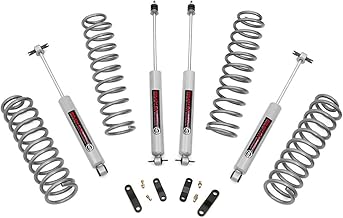
Rough Country 2.5" Lift Kit for 2007-2018 Jeep Wrangler JK Unlimited - 67930
$299.95
Check Price on AmazonFor 35-inch rock crawling tires, you’ll need to address wheel offset carefully. Most 35x12.50 tires require wheels with 4.5-5 inches of backspacing to push the tire outward and prevent rubbing at full steering lock. Some JK owners successfully run 35s on stock wheels with 6.25 inches of backspacing, but this requires aggressive fender trimming and typically limits articulation before contact.
4+ Inch Lift Kit Sizes:
- All trims: 37x12.50 or 37x13.50
- Recommended wheel backspacing: 4-4.5 inches for 37s
- Required modifications: Flat fenders, bumper relocation, possible control arm adjustment
- Gearing impact: 5.13 or 5.38 rear gears required for 37s
Running 37-inch rock crawling tires transforms your JK’s capability but creates significant compromises. The increased rotational mass stresses the Dana 30 front axle, reduces braking effectiveness, and makes the 3.6L V6 engine work hard on hills. Many rock crawlers running 37s upgrade to aftermarket axles with stronger components.
Backspacing and Offset Considerations: Rock crawling tires are typically wider than standard tires. A 35x12.50 tire is 12.5 inches wide, requiring careful wheel selection to avoid rubbing. Too much backspacing pushes the tire inward toward the suspension. Too little pushes it outward but increases steering effort and bearing loads. The sweet spot for most JK rock crawling setups is 4.5-5 inches of backspacing with 35-inch tires.
Model year matters for fitment accuracy. Early JK models (2007-2011) have slightly different suspension geometry than later models (2012-2018), affecting bump stop engagement and articulation limits. Check our year-by-year JK changes guide for specific variations that might impact your tire selection.
Rock Crawling Tire Buying Guide: How to Choose
Selecting rock crawling tires requires balancing performance, budget, and intended use. These specialized tires excel in specific situations but compromise in others. Use this framework to narrow your choices based on your actual wheeling style and JK configuration.
Compound Hardness: Speed vs. Longevity
Your terrain determines ideal compound hardness. Smooth slickrock and polished granite require stickiest compounds (38-45 durometer) for adequate grip. Rough sandstone and volcanic rock provide mechanical grip, allowing harder compounds (48-55 durometer) that last longer. Consider where you actually wheel, not where you wish you wheeled.
Temperature also matters. If you regularly wheel in sub-40°F conditions, sticky compounds become less effective. Choose a moderately soft compound (46-50 durometer) that maintains flexibility in cold weather. Desert wheelers benefit from slightly harder compounds that resist heat buildup during long trail approaches.
The mileage trade-off is real. Ultra-soft competition compounds deliver 3,000-8,000 miles of total life. Hybrid designs with dual-compound construction extend life to 15,000-25,000 miles. Pure highway tires last 50,000+ miles. Calculate your annual trail miles versus street miles honestly. If you wheel six weekends per year but commute daily, you need a more balanced tire than someone who trailers to every trail.
Load Range: Flex vs. Puncture Resistance
Load range determines sidewall stiffness and puncture resistance. Rock crawlers typically choose between Load Range C (6-ply equivalent) and Load Range E (10-ply equivalent). Load Range C tires flex more easily, conform to rocks better, and provide superior grip at low pressures. Load Range E tires resist punctures better and support heavier vehicle weight.
Your decision depends on JK configuration. A lightly built Sport on 33s benefits from Load Range C flexibility. A heavily armored Rubicon with steel bumpers, sliders, and armor plating needs Load Range E support. As a rough guideline, add up your JK’s curb weight plus all modifications. If you’re over 4,500 lbs with gear and passengers, choose Load Range D or E.
Beadlock wheels change this calculation. With mechanical bead retention, you can safely air down Load Range C tires to 5-8 PSI for extreme rock crawling without de-beading risk. Without beadlocks, you’re limited to 10-12 PSI minimum, reducing the flexibility advantage of lighter load ranges.
Tread Depth: Initial Bite vs. Rock Life
Deeper tread provides more initial biting edges and longer service life as tread wears. Competition rock tires offer 20-22/32” of tread depth compared to 16-18/32” for hybrid designs. That extra 4-6/32” translates to 1-2 additional years of rock crawling before the tire loses effectiveness.
However, extremely deep tread creates tread squirm on pavement, reducing high-speed stability and increasing rolling resistance. If your JK sees regular highway use, choose 17-19/32” tread depth as a compromise. Pure rock crawlers who trailer to trails benefit from maximum 21-22/32” depth.
Measure tread depth at purchase and track wear monthly. Most rock crawling tires become less effective below 12/32” remaining depth. The tall lugs that provided rock bite when new become shorter and less aggressive. Replace tires when they reach 10-12/32” for optimal performance, or accept reduced grip as they wear further.
New vs. Used Rock Crawling Tires
Used rock crawling tires represent significant savings—but carry substantial risk. Inspect used tires carefully for sidewall damage, irregular wear, and age-related cracking. Check the DOT date code. Tires older than 6 years degrade regardless of tread depth. The soft compounds in rock crawling tires deteriorate faster than standard tires.
Focus on used tires from trailers or competition rigs. These tires see minimal pavement wear but maintain soft compound characteristics. Avoid used tires worn on daily drivers. The heat cycles from highway use degrade compound chemistry, reducing rock grip even when tread depth appears adequate.
Budget approximately 40-50% of new tire cost for quality used rock crawlers with 50%+ tread remaining and no sidewall damage. At that price point, the savings justify the reduced lifespan. Below 40%, you’re better served buying new tires that will deliver predictable performance over multiple seasons.
If your JK serves dual-purpose duty combining rock crawling with mud, snow, and highway miles, consider our recommendations for all-terrain tires for mixed-use driving as an alternative approach.
Rock Crawling Tire Specifications Compared
| Tire Model | Compound | Load Range | Tread Depth | Weight | Price | Terrain Focus | Tread Life |
|---|---|---|---|---|---|---|---|
| BFG Krawler T/A KX | 40-45 dur | C (6-ply) | 18/32" | 65 lbs | $450-500 | Pure rock | 5-8K mi |
| Maxxis Creepy Crawler | 38-42 dur | C (6-ply) | 21/32" | 71 lbs | $440-490 | Pure rock | 3-5K mi |
| Dick Cepek Extreme Country | 45-50 dur | E (10-ply) | 19/32" | 68 lbs | $320-360 | Rock/mixed | 15-20K mi |
| Nitto Trail Grappler | 48-52 dur | E (10-ply) | 18.5/32" | 66 lbs | $380-420 | All terrain | 30-40K mi |
| Milestar Patagonia | 52-55 dur | E (10-ply) | 18.5/32" | 64 lbs | $220-260 | Budget rock | 25-35K mi |
| Maxxis Trepador | 42-46 dur | M (8-ply BB) | 21.5/32" | 73 lbs | $480-550 | Competition | 5-10K mi |
| Goodyear MT/R Kevlar | 46-50 dur | C (6-ply) | 18/32" | 62 lbs | $360-410 | Street/rock | 20-25K mi |
Rock Crawling Tire FAQ
What tire pressure should I run for rock crawling on my JK?
Start at 10-12 PSI for technical rock crawling on most sticky compound tires. This pressure provides adequate flex for the tire to conform to rocks while maintaining bead retention on standard wheels. With beadlock wheels, you can safely drop to 8 PSI for maximum traction. Monitor tire bulge—if sidewalls bulge excessively or the tire feels mushy during turns, add 1-2 PSI. Always carry a portable air compressor to re-inflate before hitting pavement, where you’ll need 28-32 PSI for safe highway driving.
Do I need beadlock wheels for rock crawling tires?
Beadlocks aren’t required but highly recommended for serious rock crawling. Standard wheels work fine at 10-12 PSI with proper wheel width (8-9 inches for 12.50-inch section width tires). Beadlocks become necessary when you want to run below 8 PSI for extreme traction or when your trails include severe side-hilling that risks de-beading. Budget $200-300 per beadlock wheel versus $100-150 for standard wheels. Many weekend rock crawlers run standard wheels successfully for years without issues.
How long do rock crawling tires last?
Expect 5,000-8,000 miles from sticky competition compounds (38-45 durometer) and 15,000-25,000 miles from hybrid designs (45-52 durometer). Pure street driving accelerates wear dramatically—sticky tires driven daily might last only 3,000 miles. Rock contact causes minimal wear compared to pavement heat and friction. Your longevity depends on street miles versus trail miles ratio. Track tread depth monthly and replace tires when they reach 10-12/32” remaining depth for optimal rock performance.
Can I run rock crawling tires year-round as daily drivers?
Only hybrid compounds (46-52 durometer) work as daily drivers, and even these compromise fuel economy, noise, and wet traction. Pure sticky compounds (38-45 durometer) wear dangerously fast on pavement and provide poor wet braking. If you daily drive your JK, choose a tire like the Dick Cepek Extreme Country or Goodyear MT/R with dual-compound construction. Accept that rock performance won’t match pure competition compounds, but you’ll get reasonable tread life and highway manners.
What’s the difference between rock crawling tires and mud terrain tires?
Rock crawling tires use softer compounds (38-50 durometer) and more open tread patterns than mud terrains (50-60 durometer). Rock tires prioritize grip and sidewall protection over tread life and mud clearing. Mud terrains feature tighter lug spacing and harder compounds for self-cleaning and highway durability. The trade-off: rock tires grip better on technical terrain but wear faster and perform poorly in mud. Most serious wheelers run different tires seasonally or for different trail types. Check our comparison of dedicated mud terrain tires for mud-focused alternatives.
Will 35-inch rock crawling tires fit my stock JK?
No—35-inch tires require minimum 2.5-inch lift and often need trimming or flat fenders. Stock JK Sport and Sahara models max out at 33x11.50 with minor trimming. Stock Rubicons handle 33x12.50 without modifications. For 35-inch rock crawling tires, budget for a quality lift kit, potential gearing change (4.56 or 4.88 ratio), and wheels with 4.5-5 inches of backspacing. Some JK owners force 35s onto stock suspension with extensive trimming, but this creates rubbing at full articulation and steering lock. Check year-specific JK considerations before committing to a tire size, as model year variations affect fitment complexity.
Final Recommendations: Choosing Your JK Rock Crawling Tires
Your ideal rock crawling tire depends on how you actually use your JK. Weekend warriors who trailer to trails and prioritize maximum grip should invest in sticky competition compounds like the BFG Krawler T/A KX or Maxxis Creepy Crawler. Accept the 5,000-8,000 mile lifespan as the cost of superior rock performance.
Mixed-use JK owners who drive to trailheads and combine rock crawling with other wheeling need balanced tires like the Nitto Trail Grappler or Dick Cepek Extreme Country. These hybrid designs sacrifice ultimate grip for reasonable tread life and street manners. You’ll climb 90% of the obstacles while keeping a tire that lasts 15,000-25,000 miles.
Budget-conscious builders developing rock crawling skills benefit from starting with capable but affordable options like the Milestar Patagonia M/T. These tires deliver solid performance while you learn line selection and throttle control. Upgrade to premium sticky compounds once you’re consistently tackling rated trails where tire grip becomes the limiting factor.
How I found and bought my 2014 JKU in Cape Town taught me that the right modifications come from understanding your actual needs, not building someone else’s dream rig. I spent months researching tires before selecting my first set of rock crawlers, talking to local JK owners about what actually worked on our regional trails. That research mindset—learning from people who run the equipment in your conditions—beats any spec sheet comparison.
Size your tires to your suspension and budget. Don’t force 37s onto a stock suspension or overextend on sticky compounds you’ll wear out in one season. Start with properly sized 33s or 35s on adequate lift, develop your skills, then upgrade tires and suspension together as your capability improves. The best rock crawling tire for your JK is the one that matches your current build and wheeling frequency.
Air down appropriately, choose proper lines, and understand that tire technology only matters when you’re pushing limits. Get out and wheel. The trail teaches more than any tire review ever will. For comprehensive JK tire selection covering all categories and uses, review our complete JK wheels and tires guide for the full context.
This article contains affiliate links. If you purchase through these links, we may earn a small commission at no extra cost to you. This helps support the site and allows us to continue creating content for the Jeep JK community.
Get the Free JK Build Planner
Complete PDF with mod checklists, gear ratios, tire sizing charts, and budget worksheets. Everything you need to plan your JK build.
No spam. Unsubscribe anytime. By subscribing, you agree to our Privacy Policy.
Allan
I'm Allan. I bought a 2014 Jeep Wrangler JKU and I research the hell out of every mod before I touch it. Everything here is tested or deeply researched on my own rig - no sponsored fluff, just honest findings.
Learn more about me →Get the JK Build Planner
Free PDF with complete build checklists, gear ratios, and tire fitment guides.
By subscribing, you agree to our Privacy Policy.
Related Articles
Best Wheels for Jeep Wrangler JK: Top 8 Picks for 2026
Find the best wheels for Jeep JK with expert picks for beadlocks, daily drivers, and budget builds. 4.5-inch backspacing, 1,500+ lb load ratings, verified fitment.
Best All-Terrain Tires for Jeep Wrangler JK: 2026 Top Picks
Find the best all-terrain tires for your Jeep Wrangler JK with our expert guide. Real-world testing, honest reviews, and size recommendations for stock to 35-inch builds.
Best 35 Inch Tires for Jeep Wrangler JK: Top 8 Picks for 2026
Discover the best 35 inch tires for Jeep JK with our expert comparison of 8 top options. Complete fitment guide, real-world reviews, and installation requirements.