Best Lift Kits For Jeep JK: Expert Guide to 2.5-Inch & 3-Inch Lifts
This article contains affiliate links. We may earn a commission at no extra cost to you.
Best Lift Kits For Jeep JK: Expert Guide to 2.5-Inch & 3-Inch Lifts
Walk into any Jeep forum or Facebook group, and you’ll see the same question posted daily: “Which lift kit should I buy for my JK?” The sheer number of options is paralyzing. Spring spacers. Complete kits. Budget versus premium. Two-inch versus three-inch. After spending three months researching lift kits for my own 2014 JK Unlimited — reading hundreds of forum threads, watching installation videos, and comparing real-world owner experiences — I finally pulled the trigger on a 2.5-inch lift with adjustable control arms. That decision taught me more about lift kits than any product page ever could.
The best lift kit for most Jeep JK owners is a 2.5-inch complete kit with performance shocks, which provides 33-inch tire clearance without requiring expensive supporting modifications like adjustable control arms or track bar relocation brackets. This sweet spot delivers capability without the cost and complexity of larger lifts.
Understanding the differences between Rubicon vs Sport vs Sahara trim levels matters when selecting a lift kit, since suspension components and spring rates vary between trims. Let’s dive into the specific products that deliver the best performance, value, and compatibility for your JK Wrangler.
Best Overall: Rough Country 2.5” Lift Kit for JK Unlimited
For most JK Unlimited (4-door) owners, the Rough Country 2.5-inch lift kit hits every mark that matters. You get 33-inch tire clearance without trimming fenders, a complete kit that includes everything you need for installation, and a price point under $300 that leaves budget for the larger tires you actually want to run.
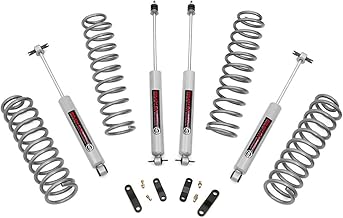
Rough Country 2.5" Lift Kit for 2007-2018 Jeep Wrangler JK Unlimited - 67930
$299.95
Check Price on AmazonThis kit fits 2007-2018 JK Unlimited models and includes front coil springs, rear coil springs, front track bar bracket, sway bar links, and bump stop extensions. The installation is straightforward enough for a weekend DIY project if you have basic tools and a floor jack. Rough Country includes detailed instructions, though watching a YouTube walkthrough beforehand will save you time on confusing steps like the track bar bracket alignment.
The ride quality sits firmly in the “acceptable” category. These aren’t Bilstein or Fox shocks, so you’ll notice more body roll on pavement compared to stock. But off-road, where the suspension actually cycles through its travel, the performance is solid. The springs maintain proper load capacity for daily driving and weekend trail runs without feeling soft or wallowy.
Critical compatibility note: This is the 4-door JK Unlimited version (part number 67930). If you have a 2-door JK, you need part number 651.20 instead. The spring rates are different between wheelbase lengths, and mixing them up will give you incorrect ride height and poor handling.
The kit clears 33-inch tires with factory wheels and standard backspacing. If you’re planning to run 35s, you’ll need to step up to a 3.5-inch lift and budget for additional components like adjustable control arms and extended brake lines.
Premium Pick: TeraFlex 2.5” Lift Kit with Performance Shocks
While the Rough Country kit gets you lifted for under $300, the TeraFlex delivers performance that justifies the premium price — if you’re serious about off-road capability and ride quality. This is the kit for owners who see their JK as a legitimate trail rig, not just a weekend mall crawler with bigger tires.
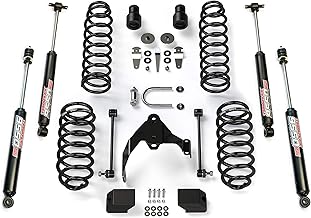
The kit includes all four 2.5-inch performance shocks — two front and two rear — tuned specifically for the increased spring rates and higher center of gravity that comes with a lift. You’re not reusing your worn-out factory shocks or buying cheap replacements separately. The TeraFlex coil springs use a progressive rate design that maintains a comfortable highway ride while providing better articulation on technical terrain.
The hardware quality is immediately noticeable. Thick steel brackets, Grade 8 bolts, and proper polyurethane bushings instead of rubber. This kit will last the life of your Jeep without developing clunks, squeaks, or premature wear. TeraFlex backs it up with a solid warranty and responsive customer support if you run into installation questions.
Installation complexity is similar to the Rough Country kit, but the included instructions are more detailed with better diagrams. Understanding JK model year differences helps here, since 2007-2011 models have slightly different brake line routing than 2012-2018 models — TeraFlex addresses this in their instructions.
The real-world difference comes down to how you use your Jeep. If you’re hitting rough trails monthly and pushing the suspension through its limits, the TeraFlex delivers noticeably better control and less body roll. For occasional dirt road cruising and camping trips, the Rough Country kit performs 90% as well for one-third the price.
Budget Pick: 1” Front Spring Spacer Leveling Kit
Let’s be clear upfront: this is a leveling kit, not a lift kit. At $36, this costs less than a tank of gas — but it also delivers far less capability than a proper 2.5-inch lift. You’re eliminating the factory front-end rake (the nose-down stance that makes stock JKs look ready to dive into a pool), not adding meaningful ground clearance or tire fitment options.
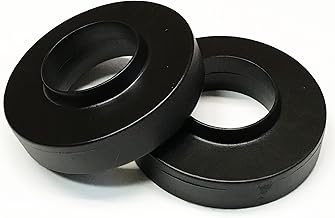
1" Front Spring Spacer Leveling Kit, Compatible with Jeep Wrangler JK 2007-2018, JL 2018-2026, Gladiator JT 2020-2026
$35.99
Check Price on AmazonThe kit works by adding a one-inch polyurethane spacer between the front coil spring and the spring mount. Installation takes about 30 minutes if you’ve done suspension work before — just compress the spring, slide in the spacer, and reassemble. No cutting, welding, or specialized tools required beyond a floor jack and spring compressor.
You’ll gain about one inch of front lift, which levels out the stance and allows you to fit 32-inch tires without rubbing at full steering lock. That’s it. You’re not clearing 33s. You’re not improving approach angle significantly. You’re not changing the suspension geometry enough to need adjustable control arms or other supporting modifications.
This kit makes sense for exactly two scenarios: you bought a budget 2010 JK Sport and want to level the stance while saving money for a proper lift later, or you’re running stock tire size but hate the factory rake and want a quick visual improvement. For everyone else planning to run 33-inch or larger tires, skip this and save your money toward a real 2.5-inch lift kit.
The spacer fits 2007-2018 JK models, plus newer JL Wranglers and Gladiators. Just don’t expect miracles from a $36 modification. You get what you pay for, which in this case is a leveled stance and nothing more.
OEM Option: Genuine Mopar 2” Lift Kit
The Mopar lift kit occupies a strange space in the JK modification world. At $1,595, it costs more than five times the Rough Country kit while delivering similar performance. But there’s one scenario where it makes perfect sense: if your 2016-2018 JK is still under the factory 5-year/60,000-mile powertrain warranty, the Mopar kit won’t void your coverage.
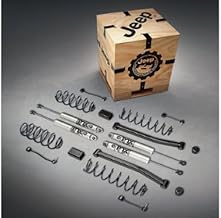
Mopar engineers designed this kit to maintain factory ride quality and handling characteristics. You get two inches of lift, clearance for 32-inch tires (33s with slight trimming), and the peace of mind that your drivetrain warranty remains intact. The kit includes front and rear coil springs, bump stops, and all necessary hardware for installation at a Jeep dealership.
The problem is economics. For the vast majority of JK owners, this kit makes no financial sense. If you bought a used 2012 JK with 80,000 miles, you have no powertrain warranty to protect. Save $1,200 and go with the Rough Country or TeraFlex kit instead. The performance difference is negligible, and you’ll have money left over for the 33-inch tires you actually want.
If you’re concerned about warranty implications and have a newer JK, understand what the Magnuson-Moss Warranty Act actually protects. Dealerships must prove that your aftermarket modification directly caused the failure before denying warranty coverage. A lift kit doesn’t affect your engine or transmission, so those components remain covered even with an aftermarket suspension. Knowing JK common problems by year helps you understand which failures are manufacturer defects versus wear items that wouldn’t be covered anyway.
The Mopar kit exists primarily for dealers to offer as a factory-backed modification option. Unless you’re buying a brand-new JK (which is increasingly rare given production ended in 2018), your money goes further with aftermarket alternatives.
Choosing the Right Lift Height: 2” vs 2.5” vs 3”+ for Your JK
This is where my three months of research paid off. The relationship between lift height, tire size, and required supporting modifications isn’t linear — it’s exponential. Each additional half-inch of lift doesn’t just add clearance; it multiplies the complexity and cost of your build.
Here’s the breakdown that convinced me to go with a 2.5-inch lift:
2-Inch Lift:
- Tire clearance: 32-inch tires comfortably, 33s with minor trimming
- Required modifications: None beyond the lift kit itself
- Cost: $300-$600 for complete kit
- Best for: Stock replacement or mild capability upgrade
2.5-Inch Lift:
- Tire clearance: 33-inch tires with no trimming required
- Required modifications: Adjustable control arms recommended for proper alignment
- Cost: $300-$1,000 for lift, plus $400-$800 for control arms
- Best for: Most weekend wheelers and daily drivers who want 33s
3.5-Inch Lift:
- Tire clearance: 35-inch tires with minimal trimming
- Required modifications: Adjustable control arms (front and rear), track bar, extended brake lines, exhaust spacer, possibly driveshaft spacers
- Cost: $800-$1,500 for lift, plus $1,200-$2,000 for supporting modifications
- Best for: Serious rock crawling and heavy off-road use
- Fuel economy impact: Expect 2-3 MPG loss with 35-inch tires
The 2.5-inch lift with 33-inch tires delivers 90% of the capability you’ll ever use on trails, maintains acceptable highway manners, and doesn’t require you to re-gear your differentials. A 3.5-inch lift on 35-inch tires transforms your JK into a capable rock crawler, but also costs $2,500+ when you account for all the supporting modifications you can’t skip.
The JK buyers guide and JK vs JL comparison resources helped me understand how suspension geometry changes with lift height. The key insight: beyond 2.5 inches, your control arm angles change enough to cause dangerous steering wander and accelerated ball joint wear if you don’t install adjustable arms.
After three months of research, I landed on a 2.5-inch lift with adjustable control arms as the sweet spot. It gave me the 33-inch tire clearance I wanted without requiring a complete suspension overhaul or accepting terrible highway manners.
What’s Included in a Complete Lift Kit (And What You’ll Need to Buy Separately)
This section could have saved me hours of frustration if someone had spelled it out clearly during my research phase. Lift kit product pages love to use terms like “complete kit” while leaving out critical components you’ll discover you need only after the kit arrives.
What’s in the box (typical 2.5-inch lift kit):
- Front coil springs (2)
- Rear coil springs (2)
- Sway bar links (4)
- Track bar bracket
- Bump stop extensions (4)
- Hardware kit (bolts, washers, bushings)
What you need to buy separately:
- Adjustable control arms (front, $400-$800) — Never install a 2.5-inch lift without adjustable control arms. You’ll have dangerous steering wander and accelerated tire wear due to incorrect caster angle
- Extended brake lines (4, $100-$200) — factory brake lines may be stretched at full droop
- Track bar (rear, $150-$300) — recommended for 3+ inch lifts to maintain axle centering
- Exhaust spacer ($30-$50) — prevents exhaust contact with crossmember at higher suspension travel
- Shock extensions or new shocks ($200-$600) — factory shocks may bottom out or become fully extended
The hidden costs add up quickly. That $300 Rough Country kit becomes a $700-$900 project when you factor in the adjustable control arms you absolutely need for safe highway driving. Some “complete” kits from brands like MetalCloak or Rock Krawler include control arms in the box, which explains their higher upfront cost.
I learned about these requirements from real JK owners on forums like JeepForum and Wrangler TJ Forum, not from product pages trying to close a sale. This is why my research philosophy focuses on community knowledge over marketing materials. Owners who’ve already made the mistakes and dealt with the consequences provide more valuable information than spec sheets that technically tell the truth while omitting critical context.
2-Door vs 4-Door JKU Lift Kit Differences You Need to Know
This is one of the most common and expensive mistakes new JK owners make: ordering a 4-door lift kit for a 2-door Wrangler, or vice versa. The kits are not interchangeable, and installing the wrong one creates handling problems that range from annoying to dangerous.
Key Specifications:
| Specification | 2-Door JK | 4-Door JKU |
|---|---|---|
| Wheelbase | 95.4 inches | 116 inches |
| Curb Weight | ~3,760 lbs | ~4,130 lbs |
| Rear Spring Rate | Higher (stiffer) | Lower (softer) |
| Front Spring Rate | Similar | Similar |
The weight difference and wheelbase change require different rear spring rates. A 4-door JKU is heavier and has a longer rear overhang, so it needs softer rear springs to maintain proper ride height and suspension travel. Installing a 4-door lift kit on a 2-door JK will result in too much rear lift and a nose-down stance that looks terrible and handles worse.
Rough Country part number 651.20 is engineered for 2-door JKs, while part 67930 is for 4-door Unlimited models. TeraFlex, Metalcloak, and other manufacturers use similar part number differentiation. Always verify you’re ordering the correct version for your specific wheelbase before clicking “buy.”
The confusion is understandable — both are called “Jeep JK Wrangler,” and many product listings don’t clearly specify 2-door versus 4-door in the title. Look for “JKU” or “Unlimited” in the description to identify 4-door kits, or “JK” and “2-door” for short wheelbase models.
If you need to swap between soft top options for 2-door vs 4-door configurations, you already understand how different these platforms are despite sharing the same JK designation. The suspension differences are just as significant.
Frequently Asked Questions About JK Lift Kits
What size tires can I fit with a 2.5-inch lift?
A 2.5-inch lift clears 33-inch tires with stock wheels and no trimming required. You can run 33x10.50 or 33x12.50 tire widths without rubbing at full steering lock or during suspension compression. If you install aftermarket wheels with less than 4.5 inches of backspacing, you may need minor fender liner trimming to prevent contact on tight turns.
Do I need adjustable control arms with a 2.5-inch lift?
Yes, you should install adjustable front control arms with any 2.5-inch or larger lift. While you can technically drive without them, the incorrect caster angle causes steering wander, reduced stability at highway speeds, and accelerated ball joint wear. The additional $400-$800 investment in quality adjustable arms prevents dangerous handling issues and extends the life of your suspension components. Many experienced JK owners recommend Metalcloak, Currie, or JKS adjustable control arms for reliable geometry correction.
Can I install a lift kit myself or do I need a shop?
A mechanically inclined owner with basic tools can install a 2.5-inch lift kit in a weekend. You’ll need a floor jack, jack stands, spring compressors, basic hand tools (wrenches, sockets, torque wrench), and a safe workspace. The most difficult steps are compressing coil springs and torquing control arm bolts to proper specifications. If you’ve never done suspension work before, budget $400-$800 for professional installation at a 4x4 shop. They’ll also perform a post-installation alignment, which is mandatory after changing suspension geometry.
Will a lift kit void my Jeep warranty?
An aftermarket lift kit does not automatically void your entire vehicle warranty. Under the Magnuson-Moss Warranty Act, the manufacturer must prove your modification directly caused a specific failure before denying coverage. A lift kit doesn’t affect your engine, transmission, or electrical systems, so those components remain covered. However, the dealer can deny warranty claims on suspension components, steering components, and potentially drivetrain parts if they can demonstrate the lift caused the failure. For newer JKs still under factory warranty, consider the Mopar lift kit if warranty protection matters more than cost savings.
What’s the best lift height for 35-inch tires on a JK?
You need a 3.5-inch to 4-inch lift to run 35-inch tires without excessive trimming. This also requires adjustable control arms (front and rear), a new track bar, extended brake lines, and potentially driveshaft modifications. Budget $2,500-$3,500 for the complete installation including all supporting modifications. You’ll also want to re-gear your differentials to 4.88 or 5.13 ratios to maintain acceptable acceleration and fuel economy with the heavier, taller tires. Total cost for a proper 35-inch tire setup approaches $5,000-$7,000 when done correctly.
The JK bikini tops and accessories and half door options you choose may need adjustment after installing a lift kit, since body height and door alignment can shift slightly with larger suspension changes.
Final Recommendation: Which JK Lift Kit Should You Choose?
For most JK owners who want 33-inch tires and improved off-road capability without breaking the bank, the Rough Country 2.5-inch lift kit delivers the best value. Add a set of front adjustable control arms from Metalcloak or JKS, and you have a safe, capable setup for under $1,000 total.
If you’re building a serious trail rig and plan to keep your JK for years, the TeraFlex 2.5-inch kit with performance shocks justifies the higher cost with better ride quality and longer component life. The premium shocks alone are worth $400-$600 if purchased separately.
Skip the budget leveling spacers unless you’re specifically trying to eliminate the factory rake while keeping stock tire size. And unless you have a warranty concern on a 2016-2018 model, save your money and avoid the Mopar kit.
My own modification plan includes the 2.5-inch lift with adjustable arms, followed by front and rear bumpers, 33-inch tires, a Raptor-style bed coating, and eventually a full overland setup with roof rack and recovery gear. The lift is just the foundation — it opens up capability without forcing you down an expensive rabbit hole of regearing and extensive supporting modifications.
Understanding the relationship between hardtop options and soft top vs hard top comparison helps you plan your complete JK build. A lift kit changes your approach angle and departure angle, which affects how you navigate obstacles with different roof configurations and weight distributions.
Choose the lift height that matches your actual use case, not your Instagram aspirations. A properly installed 2.5-inch lift with quality supporting components will serve you better than a half-finished 4-inch lift that handles poorly because you ran out of budget for the control arms and track bar you actually needed.
This article contains affiliate links. If you purchase through these links, we may earn a small commission at no extra cost to you. This helps support the site and allows us to continue creating content for the Jeep JK community.
Get the Free JK Build Planner
Complete PDF with mod checklists, gear ratios, tire sizing charts, and budget worksheets. Everything you need to plan your JK build.
No spam. Unsubscribe anytime. By subscribing, you agree to our Privacy Policy.
Allan
I'm Allan. I bought a 2014 Jeep Wrangler JKU and I research the hell out of every mod before I touch it. Everything here is tested or deeply researched on my own rig - no sponsored fluff, just honest findings.
Learn more about me →Get the JK Build Planner
Free PDF with complete build checklists, gear ratios, and tire fitment guides.
By subscribing, you agree to our Privacy Policy.
Related Articles
Best Sounding Exhaust for Jeep JK: 8 Aggressive Options Ranked
Find the best sounding exhaust for Jeep JK with our ranked guide. Compare 8 aggressive cat-back and axle-back systems for tone, drone, and value.

Best Axle Back Exhaust for Jeep JK: Budget-Friendly Sound Upgrades
Best axle back exhaust for Jeep JK delivers 70-80% of the sound improvement at 30-40% of the cost. Our top picks balance aggressive tone with zero drone and bolt-on installation.
Best Cat Back Exhaust for Jeep JK: Complete System Comparison
Compare the top cat-back exhaust systems for Jeep Wrangler JK. Stainless steel vs aluminized, drone ratings, installation tips, and honest sound reviews for 3.6L and 3.8L engines.